
For Autumn/Winter 2026, the Paris-born, London-based designer turns knitting, crochet and the history of female making into something far more complex than craft — a language of intimacy, resistance and collective strength.

There is something deliberately unsettling about the world Pauline Dujancourt created for Autumn/Winter 2026.
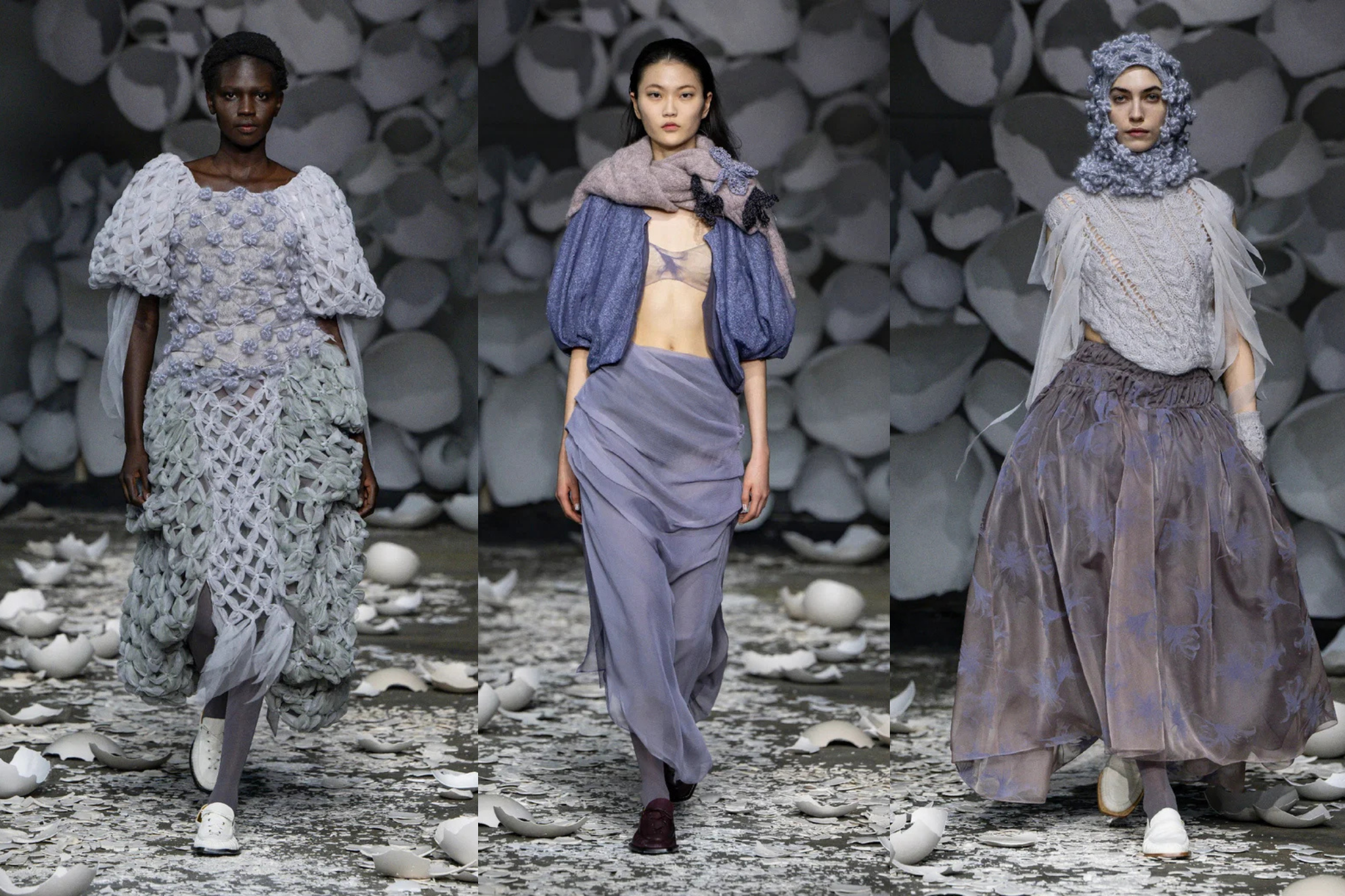
Models walk through the remains of enormous broken white shells. Around them, fragments cover the concrete floor. Behind them, strange organic forms accumulate like eggs, stones, cells or abandoned vessels. Against this landscape, clothes appear simultaneously protective and exposed: dense knits sit beside transparent tulle, delicate crochet becomes architectural, skirts collapse into irregular volumes and familiar domestic techniques are transformed into garments that feel almost ritualistic.
It is beautiful, but beauty alone is not really the point.
At the center of Dujancourt’s work is a larger question: what happens when forms of making historically associated with women, domestic life and private spaces are removed from the margins and treated instead as sources of cultural and creative authority?
For AW26, that question becomes particularly visible.
The collection grew partly from Dujancourt’s reading of Mona Chollet’s In Defense of Witches, a book that examines the historical persecution of women and the enduring cultural suspicion surrounding female independence. What particularly interested the designer was not simply the visual mythology of the witch, but the idea of women living together, exchanging knowledge and maintaining forms of expertise outside established systems of power.
In Dujancourt’s hands, the witch therefore becomes something more interesting than a fashion reference.
She becomes a symbol of community.
The Knowledge Passed Between Women

Long before knitting became a runway language, it belonged largely to homes.
Techniques were learned through observation. Skills passed between mothers, daughters, relatives, neighbors and communities. Making was repetitive, intimate and useful — a form of labor whose cultural importance was rarely proportional to the attention it received.
Dujancourt has built much of her practice around precisely these methods.
Originally from Paris, she studied Fashion and Textile Design at École Duperré before moving to London to complete an MA in Fashion at Central Saint Martins. Her fascination with creating textiles rather than simply designing with existing ones led her to teach herself hand knitting and eventually specialize in knitwear. Before launching her own label in 2022, she worked with designers including Simone Rocha, Rejina Pyo and Alexander Wang.
Those experiences matter, but Dujancourt’s vocabulary has developed into something distinctly her own.
Knitting and crochet are rarely treated as decorative additions. They determine the architecture of the clothes.
Open structures expose the body beneath them. Woven bands form grids around torsos. Loose threads interrupt otherwise controlled surfaces. Textiles gather, twist and collapse into unexpected shapes. Metallic crochet details appear almost like ornaments attached to the body — what the designer describes as “jewellery knits.”
The effect complicates conventional ideas of knitwear.
Softness does not necessarily mean comfort.
Fragility does not necessarily mean weakness.
And something created slowly by hand can still feel radically contemporary.
A Wardrobe Between Protection and Exposure

That tension is particularly strong in the AW26 silhouettes.
One look places a translucent violet blouse beneath a dark floral sleeveless dress, transforming something traditionally romantic into an almost shadowed uniform. Elsewhere, enormous pleated constructions expand outward from the hips, disrupting conventional proportions and making the body appear to inhabit rather than simply wear the garment.
Some pieces reveal much more.
Bodies emerge behind nets of handmade textile. Black transparent skirts expose underwear beneath asymmetrical knitted structures. Crochet stretches across the torso like an improvised armor that protects while simultaneously allowing the body to remain visible.
Other looks move in the opposite direction.
Long knitted coats envelop the figure. Scarves wrap repeatedly around necks and shoulders. Hoods frame faces. Sleeves swell. Fabric accumulates until clothing resembles shelter.
Across the collection, Dujancourt repeatedly moves between those two impulses: concealment and revelation.
It gives the clothes an emotional dimension.
These are garments that sometimes appear to protect the wearer from the world and, moments later, expose her completely to it.
That contradiction is fundamental to Dujancourt’s approach. Her brand describes its language through opposites — sensuality against rawness, delicate techniques against something more disturbing, beauty confronted by imperfection.
On the runway, those ideas become physical.
Nothing feels perfectly resolved.
And that is precisely why it feels alive.
The Politics of the Handmade

Fashion has spent years rediscovering craft.
Crochet, embroidery, hand knitting, weaving and other labor-intensive techniques now circulate through luxury collections with increasing frequency. Yet there is a significant difference between using craft as an aesthetic and allowing craft to define the structure and philosophy of a brand.
For Dujancourt, the handmade is not simply surface treatment.
It is infrastructure.
Her collections draw from ancestral domestic practices while working with female artisans internationally, including knitters in France and Peru. Dujancourt has spoken about these relationships as part of a broader intention to support women’s independence while preserving and developing forms of specialized knowledge.
That position becomes especially relevant in an industry structured around speed.
Hand knitting refuses acceleration.
Every loop contains time.
Every irregularity records human intervention.
The garment cannot be separated completely from the person who made it.
Within Dujancourt’s universe, that intimacy becomes a source of value rather than an obstacle to efficiency.
It also changes the meaning of luxury.
Luxury here is not primarily defined by visual perfection or recognizable status codes. It emerges from labor, knowledge and the impossibility of making every object entirely identical.
What appears delicate may contain hours of human work.
What looks imperfect may actually carry the clearest evidence of a human hand.
From Domesticity to Authority

There is another reason Dujancourt’s work feels particularly relevant now.
For centuries, practices associated with women and domestic life were frequently separated from the categories traditionally used to define serious artistic production. Painting became art. Architecture became culture. Domestic textile making was too often treated as necessity, hobby or anonymous labor.
Contemporary fashion has increasingly challenged those distinctions.
Dujancourt pushes that conversation further by refusing to disguise the origins of her techniques.
Instead, she enlarges them.
A knot becomes a silhouette.
A knitted surface becomes outerwear.
A domestic technique becomes an entire design system.
And the collective knowledge traditionally exchanged between women becomes the conceptual foundation of a contemporary fashion house.
This makes the AW26 reference to witches particularly effective.
Historically, the figure of the witch has often embodied anxiety surrounding women who possess knowledge that exists outside conventional authority. Dujancourt takes that association and turns it toward something constructive: women gathering, teaching, making and preserving skills together.
The collection does not need pointed hats or theatrical occult symbolism to communicate that idea.
Its magic is already present in the process.
Recognition Without Losing Intimacy
The fashion industry is increasingly paying attention.
Dujancourt was one of eight finalists for the 2024 LVMH Prize and is supported through the British Fashion Council’s NEWGEN initiative. She was also part of the first cohort of the Paul Smith Foundation’s Fashion Residency, created to provide emerging designers with studio space, mentoring and business support.
Then, in July 2026, came another significant step: Dujancourt received the ANDAM Special Prize, carrying €100,000 and mentorship from AMI Paris founder Alexandre Mattiussi.
Awards inevitably introduce a new question for independent designers.
How does something built through intimacy survive growth?
Dujancourt’s work depends on techniques that resist industrial logic. Its emotional force comes partly from visible labor, irregularity and the sense that materials have passed through actual hands. Expansion therefore cannot simply mean producing more.
The challenge will be preserving the values that made the work distinctive while building the infrastructure necessary for a global brand.
Yet that tension may also become one of Dujancourt’s greatest strengths.
At a moment when fashion is increasingly shaped by digital imagery, rapid cycles and global visual repetition, her work insists on physicality.
You can see where materials cross.
You can see where threads knot.
You can see where one textile interrupts another.
The construction remains visible.
After the Shell Breaks

The broken forms covering the AW26 runway offer an almost unavoidable metaphor.
A shell is protection.
It is also something that eventually must be broken.
Throughout the collection, Dujancourt seems interested in precisely that moment between containment and emergence.
The clothes occupy a similar space. They shelter bodies and expose them. They preserve old knowledge while refusing nostalgia. They begin with techniques historically associated with quiet domesticity and enlarge them until they occupy the runway.
Perhaps that is what makes Pauline Dujancourt particularly compelling within the new generation of London designers.
She does not need to reject tradition to appear contemporary.
Instead, she asks us to reconsider which traditions we have undervalued.
The hands knitting at home.
The knowledge exchanged between women.
The imperfect objects made slowly for someone else.
In Dujancourt’s world, these are not remnants of an earlier fashion system.
They may be the foundation of another one.
And as the models move through the fragments of shattered shells, wrapped in garments built from knots, loops, ribbons and accumulated hours of human labor, the message becomes unexpectedly clear:
what once belonged to the private sphere can become visible.
What was considered fragile can become structure.
And what was dismissed as women’s work can become power.
Editor’s Note
Pauline Dujancourt’s work reflects one of the most compelling directions in contemporary fashion: the return of the human hand not as nostalgia, but as a form of authorship.
Her practice reminds us that techniques historically associated with domesticity, intimacy and women’s labor can occupy the same cultural space as innovation, experimentation and luxury. In a fashion system often driven by acceleration, Dujancourt proposes another rhythm — one where time, imperfection and craftsmanship become part of the identity of the garment itself.
For QEditorial, this is precisely where fashion becomes most interesting: when clothing moves beyond appearance and begins to reveal how we value labor, memory, community and the people behind what we wear.
— Nicolò Di Stefano
Founder & Editor-in-Chief, QEditorial



Leave a Reply