
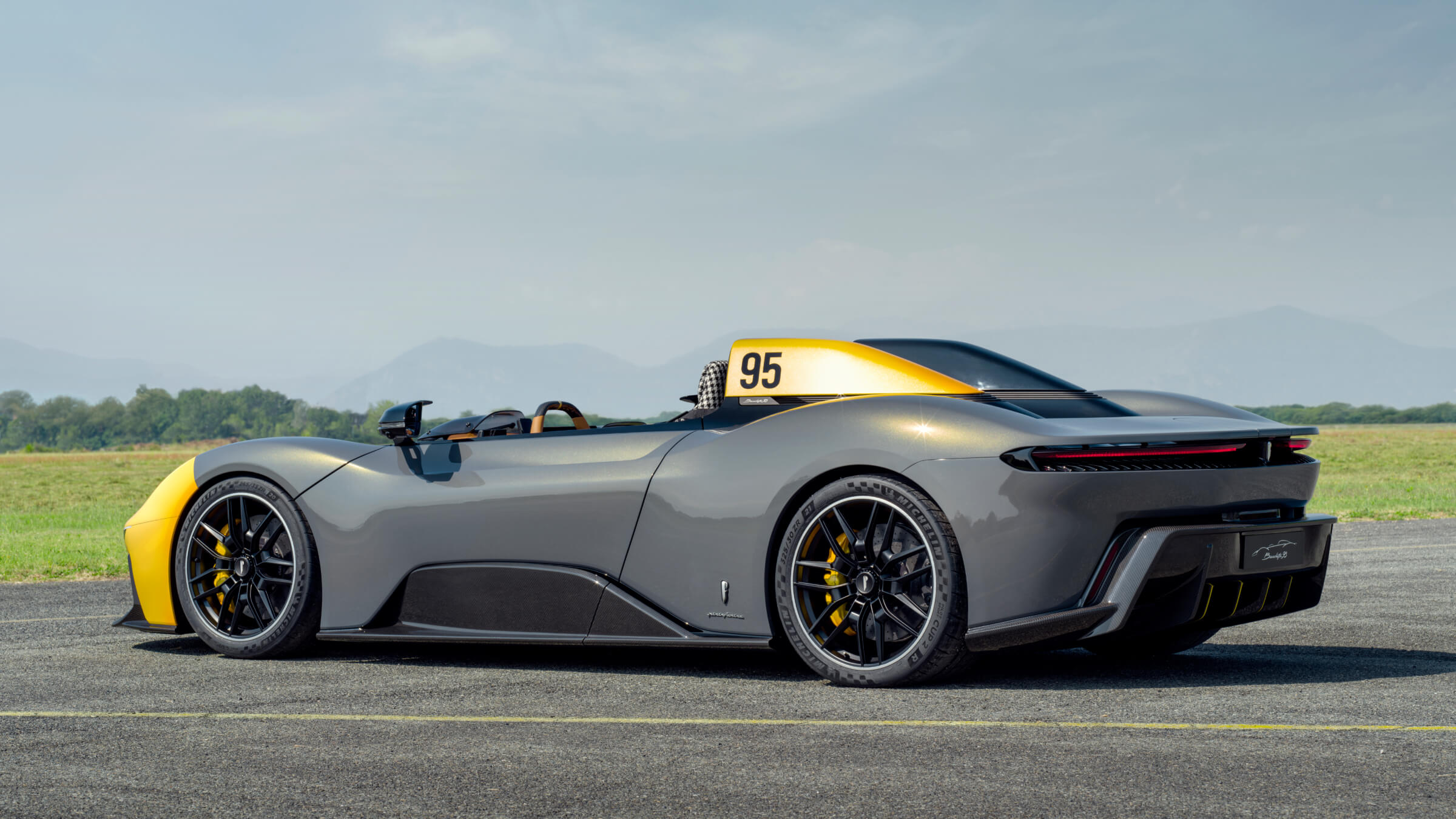
Limited to ten bespoke examples, Automobili Pininfarina’s electric barchetta brings Italian coachbuilding into a new conversation about design, rarity and desire.
By Nicolò Di Stefano
QEditorial Magazine

An extraordinary car should give us a reason to look at it before it gives us a reason to read its specifications.
The Automobili Pininfarina B95 offers that reason through its open cockpit. The eye follows the bodywork around the two seats, across the small aero screens and towards the raised forms behind the occupants. With the conventional roofline removed, the interior becomes part of the exterior composition. Driver and passenger occupy the centre of the image.
It is a revealing choice for an electric hypercar. Here, technology supports a form associated with the exposed, physical experience of driving. The B95 invites a question that horsepower alone cannot answer: what will make the electric cars of this era worth remembering?
A Familiar Shape, Reconsidered

Introduced at Monterey Car Week in 2023, the B95 was announced as a series of just ten individually commissioned cars. Its name combines “B” for Barchetta with a reference to the ninety-fifth anniversary of Pininfarina SpA in 2025.
The manufacturer is Automobili Pininfarina, whose collaboration with the historic design house connects the project to Cambiano’s coachbuilding expertise. That distinction matters: the B95 carries a famous name into a contemporary automotive project with its own engineering and ambitions. www.automobili-pininfarina.com
The barchetta provides a particularly useful starting point. Its open form makes exposure part of the design. It asks the occupants to participate in their surroundings, and gives the designer fewer surfaces behind which to conceal an awkward proportion.
For the B95, that simplicity becomes a discipline. The cabin, body and protective elements must work together as a composition that can be read from above as clearly as from the side. An electric powertrain does not require the car to abandon this older visual language. It gives that language another application.
Designing Around the Air

Two electronically adjustable aero screens take the place of a conventional full-width windscreen. Their transparent polycarbonate surfaces sit on visible aluminium supports and can be raised or lowered to improve occupant comfort. www.automobili-pininfarina.com
The mechanism makes an unusually direct contribution to the car’s appearance. Protection remains visible as a designed object, rather than disappearing into a larger glazed enclosure.
This is where the B95’s appeal becomes more specific. An open car changes the relationship between a person and a journey: the sky enters the frame, the weather becomes relevant, and the cabin ceases to be a completely separate room.
Those qualities give the electric barchetta an editorial interest beyond acceleration. Its emotional proposition can be understood through space, exposure and the position of the body within the machine.
Materials That Carry Memory

The launch car pairs metallic Bronzo Superga bodywork with Giallo Arneis accents. Inside, tan leather and brushed black aluminium meet houndstooth textile on the headrests. These are the presentation car’s choices; individual commissions can take a different direction. www.automobili-pininfarina.com
Houndstooth is a particularly telling detail. Its familiarity brings a textile associated with tailoring into an environment otherwise defined by advanced composites and electric propulsion. It introduces pattern, scale and a reference the eye already understands.
The result suggests a useful connection between automotive design and fashion. In both, a material can carry memory without requiring the entire object to look historical. A recognisable weave, a particular colour or a carefully judged finish can establish continuity while the structure beneath it changes.
Personalisation becomes interesting when those decisions belong to the whole. A successful commission needs a relationship between surfaces, rather than a collection of expensive options.
The Numbers, in Perspective

Automobili Pininfarina specifies peak output of 1,400 kW, approximately 1,900 PS, supplied by four electric motors and a 120 kWh battery. It claims 0–60 mph in under two seconds and a top speed exceeding 300 km/h. www.automobili-pininfarina.com
These figures describe the manufacturer’s stated capabilities. They cannot, by themselves, describe how the car feels to drive.
For an object produced in such small numbers, performance also becomes part of its cultural positioning. It establishes technical ambition, while leaving design to answer the more personal question of why a particular collector would choose this car.
That distinction keeps the B95 interesting. Its electric architecture supplies extraordinary power; its shape gives that power an identity.
What Ten Examples Can Mean

Each B95 is intended to be developed with its owner and the design team. A production limit of ten creates rarity from the outset, but rarity does not settle the question of significance. www.automobili-pininfarina.com
The more demanding measure is whether the finished object offers something coherent: a silhouette worth returning to, materials that reward attention, and an experience that gives its unusual form a purpose.
Viewed this way, the B95 belongs in a conversation about collecting design. It is a commission through which a buyer can express taste, but it also remains a proposition made by its designers about how an automobile should look and be inhabited.
Its most persuasive contribution may be that proposition. Electric desire can be built through an open cockpit, a familiar textile and the careful shaping of air around two people.
The B95 gives the future of the automobile a form we can begin to imagine ourselves inside.
Editor’s Note
This article draws on Automobili Pininfarina’s official B95 presentation materials and model information. Production numbers and performance figures are attributed to the manufacturer. QEditorial Magazine has not conducted a road test; observations on design and collecting are editorial interpretations.



Leave a Reply