
Across AW25 and Birthing Circle AW26, the New York designer transforms reclaimed textiles, historical understructures and the vulnerable body into a language of memory, creation and continuous becoming.

A garment can shelter the body, restrain it or reveal it. In the work of Zoe Gustavia Anna Whalen, it can also carry memory, register physical change and become part of a larger ritual of transformation.
Between her Autumn–Winter 2025 collection, i’minlovewitheverythingandiknownothingatall, and Autumn–Winter 2026’s Birthing Circle, Whalen has not abandoned her intimate visual language. Instead, she has opened it.
The corsetry remains. Antique linens and reclaimed materials continue to carry the visible traces of earlier lives. Seams, bindings and unfinished edges resist the anonymity of industrial perfection. What changes is the relationship between clothing and the body beneath it.
In AW25, the garment often appears to contain the body—to preserve, protect or reconstruct it after an experience. In Birthing Circle, that vessel begins to open. The body becomes more visible, more active and explicitly generative.
This is not simply an evolution from one season to another. It is the expansion of a practice concerned with what the body remembers, what it produces and what it may still become.
A Practice Rather Than a Brand
Whalen describes Zoe Gustavia Anna Whalen clothing as “less of a brand, more of a practice.” Working with deadstock textiles and antique linens, she creates sculptural garments intended for what the designer calls soft, evolving bodies.
Her work is informed by preindustrial silhouettes and historical forms of body modification. Corsets, stomachers, bloomers, bindings and understructures are not treated as nostalgic quotations. They become tools for reconsidering how clothing has shaped, controlled and interpreted the human form.
Born in Boston and now based in New York, Whalen established her independent label in the early 2020s. Her practice is guided by slowness, craft and the idea that well-made garments should exist beyond the accelerated rhythm of seasonal consumption.
This position is reflected in the materials themselves. Deadstock cotton, repurposed leather, vintage lace and fabrics dyed through contact with rust make variation unavoidable. Each object preserves evidence of sourcing, handling and construction rather than presenting itself as a perfectly repeatable product. The limited quantities are not merely a commercial strategy; they are part of the material logic of the work.
Whalen’s clothing therefore begins from an understanding of the body and the textile as unstable forms. Both carry histories. Both change through use.
AW25: Clothing as Emotional Residue

The title of Whalen’s AW25 collection—i’minlovewitheverythingandiknownothingatall—captures its emotional atmosphere before the garments are even considered.
It suggests surrender, confusion and an almost overwhelming openness to experience. The clothes translate that condition through pale fabrics, fragile layers, distorted corsetry and silhouettes that appear simultaneously historical and unfinished.
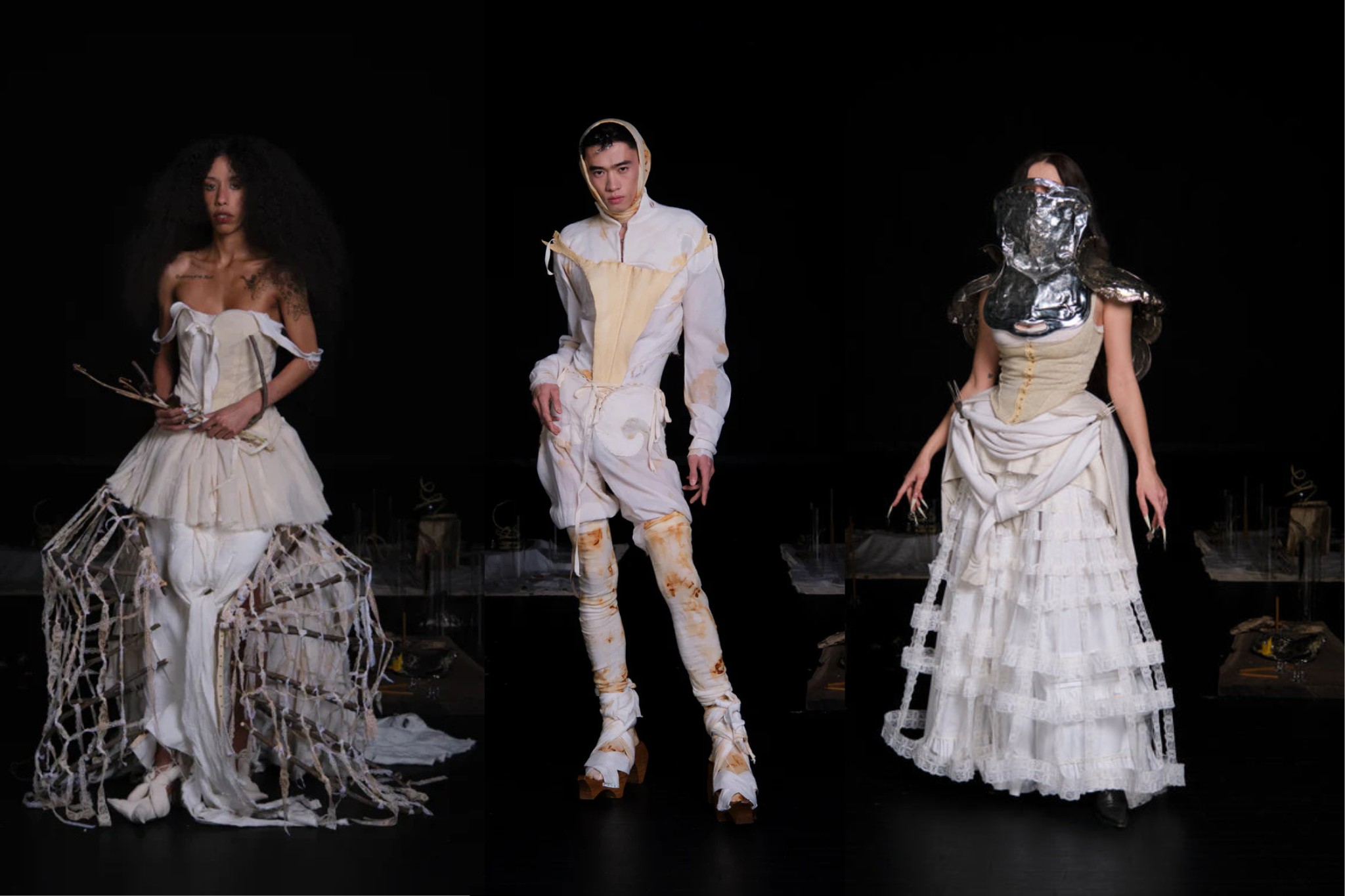
In the AW25 images, the body is frequently surrounded by cream, gray and off-white materials. These muted surfaces resemble antique undergarments, bandages, domestic linens and objects recovered from an uncertain past.
Corsets reshape the torso without always producing a conventional hourglass. Instead, panels project outward, collapse or sit visibly over utilitarian garments. Trousers are tied, stained and wrapped. Skirts are supported by exposed structures resembling broken cages. Metallic elements appear as irregular armor attached to the face, hips and legs.
The collection creates the impression of clothing assembled after an unnamed event.
These are not pristine relics. They appear handled, repaired and psychologically charged.
For the AW25 presentation at Performance Space New York, Whalen placed the collection within a candlelit environment of altars, smoke and burning materials. She described the fashion show as an opportunity to bring people together and make them witness something more emotionally authentic than a conventional commercial presentation.
That setting is essential to understanding the clothes. AW25 was not designed simply to be observed look by look. It functioned as a collective experience in which clothing, atmosphere and audience became inseparable.
The runway approached ceremony without prescribing a specific religion or belief system. Its rituals remained ambiguous, allowing garments to feel like objects of protection, mourning or private devotion.
The Body as a Vessel
Throughout AW25, Whalen repeatedly returns to garments that contain the torso.
Corsets, fitted panels and bound structures suggest the historical regulation of the body, but they also perform a protective function. They hold vulnerable fabric and flesh together.
One pale ensemble places a rigid corset over a hooded, workwear-like foundation. Another look extends metallic forms across the thighs and lower legs, as though the wearer were carrying fragments of improvised armor. A white dress opens into a skeletal structure around the hips, exposing its own construction rather than concealing it beneath fabric.
The result is a tension between enclosure and collapse.
Whalen’s garments rarely propose that clothing can permanently stabilize the body. Instead, structure appears temporary: a method of holding something together while acknowledging that it may continue to shift.
The body in AW25 becomes a vessel for emotional residue. It carries traces of pressure, intimacy, labor and recovery.
This relationship between garment and wearer distinguishes Whalen’s historical references from straightforward revivalism. The past is not reproduced as costume. Its understructures are dismantled and used to speak about contemporary vulnerability.
From Containment to Generation

With Birthing Circle AW26, the language developed in AW25 becomes more anatomical and outward-facing.
The collection retains the designer’s vocabulary of corsetry, antique-looking undergarments, elongated ties, raw construction and soft neutral textiles. Yet these elements now appear to organize themselves around fertility, pregnancy, bodily functions and birth.
Whalen described the collection as a love letter to the body—particularly her own—while reflecting simultaneously on childbirth and the process of growing her independent label.
The title Birthing Circle therefore carries several meanings.
It refers to biological birth, but also to creative labor, community and the difficult process of bringing something new into existence. A collection can be birthed. A business can be birthed. An identity can pass through cycles of pressure, separation and renewal.
The body is no longer only the site where experience has left its mark. It becomes capable of producing the next form.
Opening the Center of the Body
The evolution is immediately visible in the AW26 silhouettes.
A red cropped bodice curves dramatically away from the torso, leaving the abdomen exposed above a low, draped skirt. The construction frames the center of the body rather than disguising it. Long ties descend from the garment, suggesting that it remains adjustable, unfinished or ready to be loosened.
In another look, a voluminous oatmeal coat incorporates curved internal forms at the bust. The coat is imposing, yet its intervention occurs around intimate areas of the body. Protection and exposure are again placed in direct conversation.
A white ensemble opens beneath the chest and across the waist, while long, padded sleeves appear detached from the central structure. Instead of presenting a perfectly unified silhouette, the garment suggests separation: sections of clothing moving away from one another as the body becomes more visible.
These openings do not operate primarily as conventional cutouts. They are spatial devices.
They create room around the abdomen, chest and pelvis—the parts of the body most closely associated with biological transformation, vulnerability and care.
The Historical Body Reconsidered

Whalen’s research for Birthing Circle included preindustrial pregnancy corsets, maternity wear and sanitary garments. These references bring private bodily realities into a fashion system that has often preferred to conceal them.
Historically, undergarments have disciplined the body while also supporting it through physical change. Whalen does not simplify that history into either oppression or liberation. Her garments acknowledge both.
Corsetry can restrict, but it can also hold. A sanitary belt may carry associations of control and embarrassment while representing an intimate form of bodily care. Maternity clothing can conceal pregnancy or accommodate its changing shape.
By revisiting these objects, Whalen asks how garments participate in the interpretation of bodies that are never truly static.
Her work does not treat the body as an ideal form to which clothing must be fitted. Instead, the garment appears responsible for responding to instability.
Fabric folds, stretches, ties and opens. Structure adapts rather than erases.
Beyond a Literal Reading of Motherhood
Although fertility and childbirth are central to Birthing Circle, the collection should not be reduced to a literal study of maternity.
Whalen places corsets, body-modifying panels and historically gendered constructions across different bodies. Menswear silhouettes are shaped through devices traditionally associated with femininity, while feminine looks move between softness, exposure and architectural strength.
In one ensemble, a fitted cream corset is combined with dramatically enlarged shorts. In another, a narrow historical-looking bodice is integrated into a utilitarian, stained garment with a hood and elevated wrapped footwear.
The relationship between garment and gender becomes deliberately unstable.
Whalen is not simply transferring womenswear details onto male models. She is examining the cultural systems through which bodies are classified and shaped.
Birth, in this context, becomes a broader metaphor for transition. It can describe the emergence of a different identity, a creative practice or a new relationship with one’s own physical form.
Every body is capable of becoming something it was not before.
From Reliquary to Living Anatomy

The visual difference between AW25 and AW26 can be understood as a movement from reliquary to anatomy.
AW25 garments often resemble objects carrying evidence of something that has already occurred. Their metallic fragments, distressed surfaces and cage-like constructions transform the wearer into a custodian of memory.
The clothes feel archaeological.
In Birthing Circle, the body is more present beneath the construction. Abdomen, chest, hips and legs become visible through openings and displaced panels. The garments do not merely preserve traces from the past; they respond to an active physical process.
The clothes feel biological.
This does not mean that AW26 abandons history. Rather, historical garments become part of a living system. A corset is no longer only an artifact of bodily regulation. It becomes an adjustable structure surrounding a body that may expand, contract or transform.
The designer’s language grows more precise because the relationship between reference and intention becomes clearer.
The Intimacy of Material
Whalen’s textiles remain essential to this evolution.
The pale palette of AW25 continues through much of Birthing Circle, connecting the collections through linen, cotton, wool, lace and satin-like surfaces. These materials evoke domestic spaces: bedding, undergarments, curtains, table linens and clothing worn close to the skin.
Their familiarity gives the work emotional weight.
Antique and reclaimed textiles already possess a history before they enter Whalen’s studio. They may carry fading, staining, irregularity or evidence of earlier use. Once reshaped into garments, those characteristics become part of a new narrative.
This material continuity prevents Birthing Circle from feeling like a thematic departure. The collection’s ideas of birth and becoming emerge naturally from a practice already centered on transformation.
The textile has lived before. Under Whalen’s hand, it begins again.
A More Legible Creative Language
AW26 also demonstrates a significant development in Whalen’s ability to translate conceptual research into complete silhouettes.
The experimentation remains visible, but the garments are often more immediately readable. Long coats, fluid skirts, cropped knitwear, corseted jackets and layered dresses provide recognizable foundations through which the designer introduces disruption.
A sheer pale top is worn over delicately floral undergarments and paired with a long quilted skirt. A cream jacket opens into a sculptural peplum above layered, knee-length panels. An asymmetric knit exposes part of the torso above a skirt assembled from satin, lace and gathered fabric.
These pieces still belong unmistakably to Whalen’s world, but some can be imagined outside the ritual context of the runway.
This is not necessarily a movement toward conventional commercial fashion. It represents increased confidence.
The designer is learning how to preserve intimacy while allowing individual garments to communicate independently.
Growth does not require her to abandon slowness or imperfection. It requires the structure around those values to become more deliberate.
Fashion as Collective Ritual

The title Birthing Circle also reinforces the communal dimension of Whalen’s presentations.
The collection was shown in a candlelit environment, continuing the reverent and slightly haunting atmosphere associated with her earlier work. The presentation concluded with Whalen entering a bath, turning the designer herself into part of the performance.
The bath can be read through several associations: cleansing, immersion, amniotic fluid, domestic intimacy and rebirth.
Its meaning was later extended through Repose/Reprieve, an installation that transformed the AW26 collection into a dialogue between fashion, sculpture and performance.
The exhibition included suspended garments, a claw-foot tub and a deconstructed mannequin made from fabric remnants. Together, they developed the collection’s themes of life, death, bodily representation and renewal beyond the runway.
This progression demonstrates that Whalen does not consider a collection complete when the final model exits.
The garments can be worn, displayed, suspended, reconstructed or returned to the environment from which their materials originated. Their meaning continues to change according to context.
The Challenge of Growing Slowly
Behind the collection’s study of birth lies another form of creation: the growth of an independent fashion practice.
Whalen’s working methods resist easy expansion. Reclaimed textiles cannot always be sourced in identical quantities. Hand construction limits production speed. Material variation makes absolute standardization impossible.
These qualities give the garments their integrity, but they also create practical challenges for a young label.
Birthing Circle confronts that tension rather than concealing it. The collection is partly about the labor of allowing a creative practice to grow without surrendering the values that made it distinctive.
Whalen’s inclusion among the 2026 CFDA/Vogue Fashion Fund finalists reflects the increasing visibility of her work within American fashion. It also places her practice at a point where artistic intimacy and structural growth must begin to coexist.
The question is no longer whether her world is visually compelling. It is how that world can expand while preserving its relationship to craft, material history and community.
The Unfinished Body
Across AW25 and Birthing Circle, Whalen refuses the idea that the body should appear complete, controlled or permanently defined.
Her garments leave ties hanging. Edges remain exposed. Understructures become outerwear. Openings interrupt expected proportions. Historical references are visibly taken apart and reconstructed.
Nothing is allowed to become entirely fixed.
This incompleteness is not a lack of resolution. It is the central argument of the work.
The body changes through age, intimacy, illness, fertility, memory and personal reinvention. Clothing cannot prevent these transformations, but it can acknowledge them. It can provide temporary structure while leaving space for what may come next.
In AW25, that structure protects a body carrying emotional residue.
In Birthing Circle, it surrounds a body preparing to generate something new.
The evolution between the collections is therefore not a rejection of the past. It is a release of what was already contained within it.
Zoe Gustavia Anna Whalen’s clothing does not present the body as a finished form. It treats it as a living site of memory, construction and continuous becoming.




Leave a Reply