
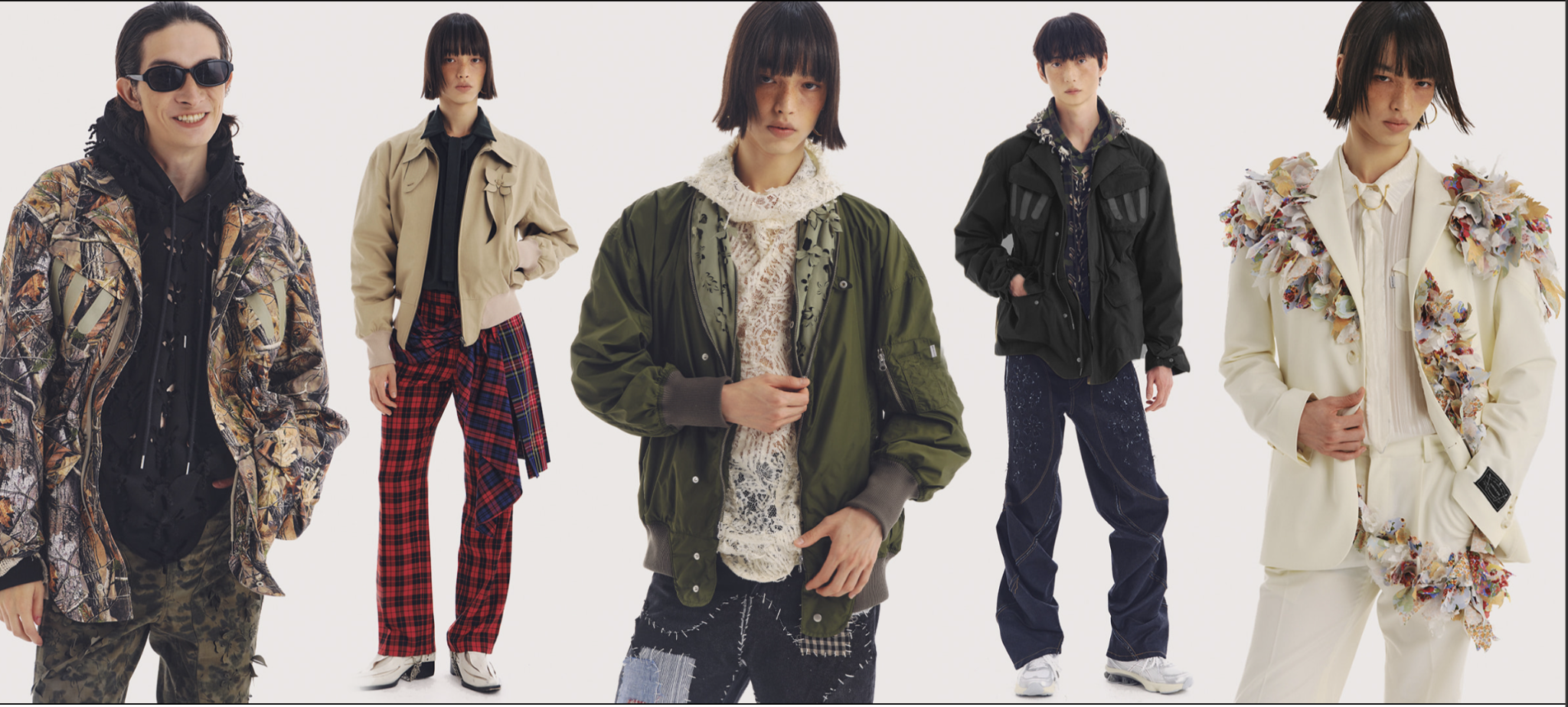
Fashion often speaks about freedom, but very few brands understand that freedom begins with the body.

For JUNTAE KIM, clothing is not simply a surface placed over identity. It is a structure that can either restrict the body or release it. This is where the brand becomes more than fashion. It enters the territory of culture, gender, memory, and historical imagination.
Founded by Korean designer Juntae Kim, the Seoul-based brand has built its language around one precise tension: the encounter between historical women’s garments and contemporary menswear. The brand defines its philosophy through the idea of unravelling binary constructions and loosening the body rather than constraining it, a statement that immediately separates JUNTAE KIM from the many brands that use genderless fashion only as a visual trend.
Here, genderlessness is not a styling decision. It is a research method.
The corset, the historical dress, the tailored jacket, the romantic silhouette, the punk detail — all of these elements are removed from their expected categories and reassembled into a new vocabulary. What once belonged to the architecture of femininity is brought into menswear. What once belonged to menswear is softened, interrupted, opened. The result is not costume, and it is not nostalgia. It is a contemporary conversation about how bodies are allowed to exist.
This is why the brand feels especially relevant now. In a fashion culture where gender-fluidity is often reduced to oversized garments, neutral palettes, or commercial language, JUNTAE KIM moves in a more complex direction. His work asks not only who is allowed to wear what, but why certain garments were assigned to certain bodies in the first place.
That question gives the brand its cultural force.
The designer’s fascination with historical women’s costumes and modern men’s clothing places his work within a wider conversation about fashion history, identity, and the changing construction of the body. But what makes JUNTAE KIM interesting is not visibility alone. It is the way the brand treats fashion history as material rather than museum. A corset is no longer only a symbol of restriction. A tailored jacket is no longer only a symbol of masculine order. In JUNTAE KIM’s world, both can become unstable, sensual, and politically alive.

There is also a distinctly contemporary Korean dimension to this story. South Korea has become one of the most important cultural engines of the present moment, not only through music, cinema, and beauty, but increasingly through fashion. Yet the most compelling Korean designers today are not simply exporting style. They are building new systems of identity. JUNTAE KIM belongs to this generation: designers who understand that fashion can travel globally while still carrying a very specific cultural intelligence.
The brand’s recognition as a 2023 LVMH Prize semi-finalist confirmed that its language had entered the international fashion conversation. But the real strength of JUNTAE KIM is not only institutional recognition. It is the ability to occupy a space between Seoul, London, craft, rebellion, romanticism, and historical study.
That tension gives the clothes their emotional charge.
A silhouette may begin in the memory of a historical garment, but it does not remain trapped there. It is cut, distorted, loosened, and brought into the present. A punk reference may appear, but it does not become costume. A romantic gesture may emerge, but it does not become merely decorative. The clothing exists in between: between masculine and feminine, between past and future, between discipline and softness.
In this sense, JUNTAE KIM is not simply designing genderless menswear. He is questioning the architecture of menswear itself.
Menswear has often been built on control. The controlled shoulder. The controlled waist. The controlled emotion. The controlled performance of masculinity. JUNTAE KIM enters that structure and begins to loosen it. Not by destroying tailoring, but by making tailoring breathe differently. Not by rejecting history, but by allowing history to become fluid.
The result is fashion that feels intellectual without becoming cold. Romantic without becoming passive. Experimental without losing the body.
This is also why the brand’s relationship with romanticism feels so important. JUNTAE KIM has been read through a language of punk, classic tailoring, and historical garments from the 17th and 18th centuries, but the romanticism here is not fragile. It is disruptive. It does not escape the present; it challenges it.
The body, in this world, is no longer asked to obey the garment.
The garment begins to listen.
That is the true elegance of JUNTAE KIM. Not the elegance of perfection, but the elegance of release. Not genderless fashion as a market category, but as a cultural investigation into the codes that shaped the body before the body had the chance to speak for itself.
As conversations around gender-fluid fashion continue to expand, JUNTAE KIM offers something more precise than trend language. The brand’s approach moves beyond the simple blurring of menswear and womenswear, entering instead a more ambiguous and fluid territory where clothing becomes a way to question classification itself through a deeper understanding of genderless design and ambiguity.
And perhaps that is the most powerful part of the brand.
JUNTAE KIM does not ask fashion to erase history. It asks history to loosen its grip.
Editorial Note
With JUNTAE KIM, genderless menswear becomes more than a fashion category. It becomes a cultural reflection on the body, identity, and the historical codes that have shaped how clothing is assigned to gender.
The Seoul-based designer transforms Korean contemporary fashion into a language of freedom, moving between historical women’s garments, corsetry, tailoring, punk references, and romantic silhouettes. What makes JUNTAE KIM especially compelling is not simply the blurring of menswear and womenswear, but the way the brand questions why certain garments were ever restricted to specific bodies in the first place.
In this sense, JUNTAE KIM genderless menswear is not a trend, but a deeper investigation into contemporary identity. The brand belongs to a new generation of Korean designers redefining modern menswear, using fashion not only to dress the body, but to loosen the structures around it.
For QEditorial Magazine, JUNTAE KIM represents one of the most interesting voices in the conversation between fashion, culture, identity, Korean design, and gender-fluid fashion today.
QEditorial Magazine — Fashion · Culture · Identity → qeditorial.com




Leave a Reply