
There are spaces that are not built to impress, but to remember. They do not open themselves to spectacle, nor do they ask to be consumed quickly by the eye. They stand instead as wounds made visible, as landscapes where architecture, art, history, and silence become inseparable.
Alberto Burri’s Grande Cretto di Gibellina is one of these rare spaces.

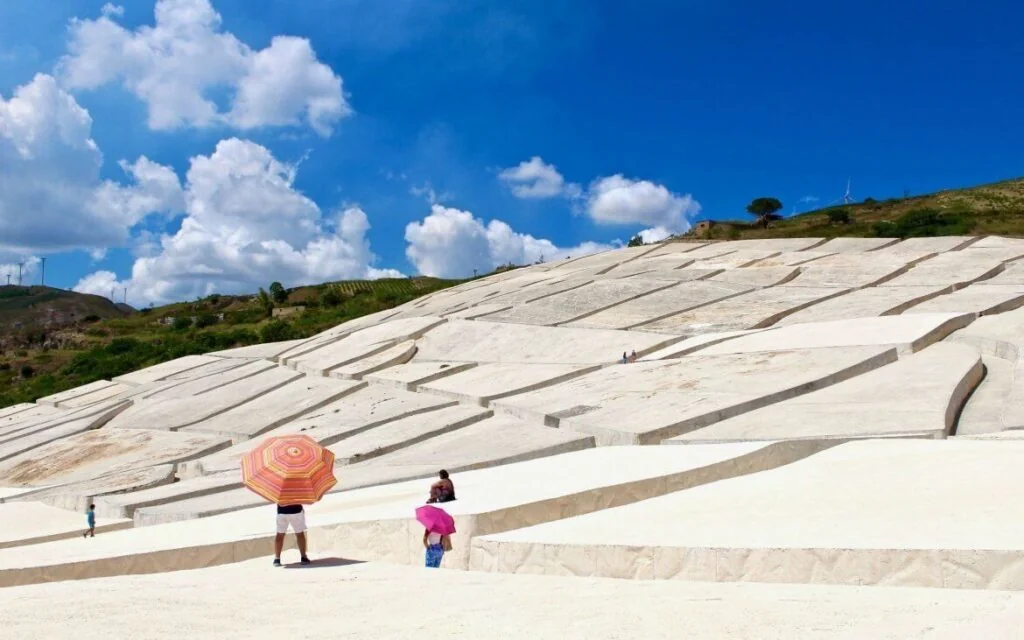
Located in western Sicily, above the ruins of old Gibellina, the work covers the remains of a town destroyed by the catastrophic earthquake that struck the Belìce Valley in January 1968. According to the Fondazione Palazzo Albizzini Collezione Burri, the Grande Cretto extends across approximately 86,000 square metres, making it the largest work ever created by Burri.
What Burri created was neither a monument in the traditional sense nor a simple memorial. It was something more radical. He covered the ruins with white concrete, preserving the outline of the old town beneath a vast cracked surface. The streets remained as fissures. The houses disappeared beneath matter. The city was no longer rebuilt, but sealed.
This is what makes the Grande Cretto extraordinary. It does not erase destruction. It gives destruction a form.

Burri, born in Città di Castello, in Umbria, had spent his life transforming wounded materials into visual language. The Guggenheim Museum notes that he was born in 1915 in the Umbrian town and originally trained as a physician before becoming one of the most important Italian artists of the twentieth century. In his work, burlap, plastic, fire, wood, metal, and cracked surfaces were never simply materials. They were bodies. They carried trauma, resistance, pressure, and memory.
In Gibellina, that language expanded beyond the canvas and entered the landscape.
The Grande Cretto is often described as land art, but the term feels almost too clean. This is not land art as aesthetic gesture. It is land art as burial, as architecture of mourning, as a white shroud placed over a broken town. The Sicilian tourism board describes the work as one of the largest land art pieces in the world and as a monument to the memory of the earthquake that destroyed Gibellina.

To walk through it is to enter a city that no longer exists, yet refuses to disappear. The cracks beneath your feet follow the old urban grid. The paths are not invented. They are inherited. Every turn suggests a former street, every concrete wall a buried domestic life. There is no decoration, no narrative explanation, no sentimental excess. Only whiteness, mass, heat, silence, and distance.
For this reason, the Grande Cretto belongs perfectly within ICON SPACES. It is not simply an artwork placed in a landscape. It is a space that has become an idea. It speaks of how architecture can respond to catastrophe without pretending to heal it completely. It shows how modern form can carry ancient grief.
There is also something deeply Italian in this gesture. Not Italian in the decorative sense, not in the postcard sense, but in the tragic and material sense: the relationship between earth, ruin, memory, and beauty. Italy has always lived with fragments. Temples, churches, abandoned towns, earthquakes, restorations, unfinished futures. Burri understood that some ruins should not be reconstructed into normality. Some ruins must remain visible, but transformed.
The Grande Cretto is therefore not a reconstruction of Gibellina. It is a second life given to its absence.
For a gaze connected to both Umbria and Sicily, the work carries an even more intimate force. Burri’s Umbrian discipline meets a Sicilian wound. One region gives the artist; the other gives the trauma, the land, the silence. Between them, the Grande Cretto becomes more than a masterpiece. It becomes a geography of belonging, where personal identity and collective history seem to touch.
In contemporary culture, many spaces are called iconic because they are photogenic. The Grande Cretto is iconic for the opposite reason. It resists easy beauty. It asks for stillness. It does not seduce the visitor with comfort, luxury, or visual pleasure. It confronts the visitor with permanence.

And yet, there is beauty here. A severe beauty. A beauty made of restraint. The white concrete under the Sicilian sun becomes almost unbearable, as if light itself had become part of the work. The cracks resemble dried earth, old wounds, maps, scars, and sacred geometry. Seen from above, the work appears abstract. Experienced from within, it becomes human.
This tension is what makes Burri’s vision so innovative. He did not create an object to be admired. He created a condition to be entered. The Grande Cretto is painting, sculpture, architecture, urban memory, and cemetery at once. It does not belong fully to any category because its power comes from exceeding them.
In an age obsessed with novelty, the Grande Cretto reminds us that innovation can also be an act of silence. A radical space does not always need technology, movement, or spectacle. Sometimes the most radical gesture is to cover a destroyed town with white matter and allow the cracks to speak.
Burri did not bring Gibellina back.
He made sure it could never be forgotten.
Editor’s Note
The Grande Cretto is one of those rare works where art becomes more than art. For QEditorial Magazine, it represents the deepest meaning of an iconic space: not a place made only to be seen, but a place that holds memory, identity, and silence. Its force is also personal. Burri belongs to Umbria; Gibellina belongs to Sicily. Between these two lands, the work becomes a bridge between origin and wound, between matter and belonging.


Leave a Reply