
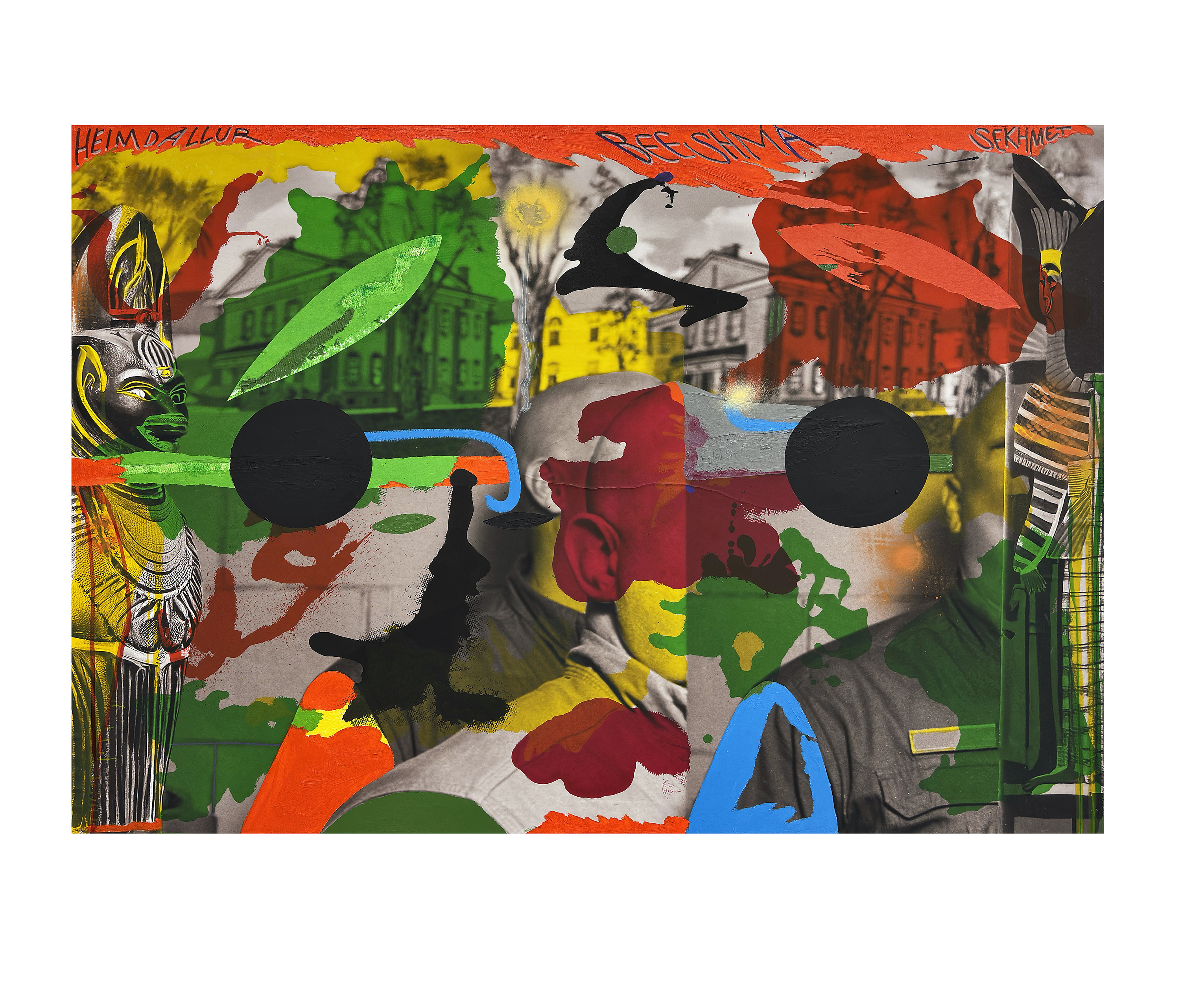
For nearly four decades, the New York artist has moved between photography, painting, fabric, ritual and cultural symbolism in pursuit of something more elusive: a visual language that exists beyond the boundaries we use to define ourselves.

There is a cigarette suspended between two black hands in Cherry Blossom, a 2008 work by James G. Fischetti.
The hands emerge from a construction that is at once pictorial and architectural: bands of yellow, green and red, a field of repeating floral geometry, two severe black curves and flashes of brilliant red. Nothing quite belongs to a single visual system. Painting behaves like collage. Pattern becomes structure. The human body appears only in fragments.
And yet the work holds together.
That tension — between fragmentation and connection — offers a useful way into Fischetti’s practice.
For nearly four decades, the New York artist has moved between photography, painting, fabric, ink and found visual languages, creating works in which distinctions between mediums, cultures and symbolic systems become increasingly unstable.
Fischetti began working primarily with photography around 1985. He soon moved toward painting, looking for ways to bring photography and other materials into the same physical field. Mostly self-taught, he resisted the idea that an artist needed to remain faithful to a particular technique.
The resulting practice is less about mastering individual mediums than allowing them to contaminate one another.
Fabric enters painting.
Photography becomes pigment-like.
Pattern becomes landscape.
Recognizable images dissolve into abstraction, only to surface again elsewhere.
That refusal of fixed categories extends considerably further than material.
At the center of Fischetti’s work is a question about identity itself.
Beyond the Familiar

“My work is influenced by a range of subjects and cultures,” Fischetti explains, pointing particularly to ritual and ceremony, comparative religion and Eastern philosophies.
But the objective is not simply to collect symbols from different traditions.
What interests him is what might exist underneath them.
“I believe that our compulsion to cling to what we know and to the cultural bonds of where our people come from is a limitation,” he says, “because I believe we are much more than that.”
It is an ambitious position for an artist whose paintings visibly contain an extraordinary density of cultural references.
Masks, textiles, photographic fragments, calligraphic forms, religious objects, human bodies, geometric configurations and decorative patterns can occupy the same canvas. Their origins may initially appear important, but Fischetti repeatedly interrupts our ability to organize them into an obvious hierarchy.
The paintings resist becoming inventories.
Instead, images collide until another visual condition begins to emerge.
Fischetti has described humanity as an amalgam of experiences shaped by the interplay between cultures. His paintings operate according to a similar principle. Meaning does not necessarily reside within an isolated object. It is generated through proximity: one image encountering another, one surface interrupting another, one history becoming inseparable from the next.
The subject, ultimately, is not cultural difference.
It is human interconnectedness.
Forty Years Without a Fixed Medium

Fischetti’s relationship with photography is particularly revealing.
Having begun with the medium in the mid-1980s, he spent years working through traditional photographic processes before digital image-making became ubiquitous. In an earlier interview, he recalled decades spent manipulating images in the darkroom and described eventually finding a “middle ground” by collaging photography into paintings.
That history matters when looking at a work such as Hemlock for Cordials, from 2007.
The composition contains recognizable photographic imagery, including a central human figure, but photography has lost its conventional authority. Faces are obscured. Color is imposed rather than observed. Large circles interrupt bodies. African sculptural references occupy the edges. Painted gestures cross photographic space without acknowledging the distinction between them.
The photograph is no longer evidence.
It has become material.
In this sense, Fischetti’s practice developed long before today’s constant circulation and recombination of images became a defining feature of visual culture.
Photography, reproduction, painting and found imagery now coexist effortlessly on screens. Fischetti translates that collision back into physical objects, where differences in surface remain visible.
A photograph possesses one kind of visual memory.
Fabric carries another.
Paint behaves differently again.
Rather than concealing those differences, Fischetti allows them to remain in friction.
Painting as Improvisation

Despite the density of references contained within the work, Fischetti does not describe his process as a predetermined intellectual system.
It is improvisational.
“I orient everything around finding the sense of being that links the energy of the initial marks with the energy of my nervous system,” he says.
It is one of the most revealing statements he makes about his practice.
Because while Fischetti’s work can invite discussions of symbolism, spirituality, anthropology and comparative religion, its construction begins with something considerably more immediate: the physical encounter between artist and surface.
“The space between the painter and the painting becomes the center of all and everything at that moment,” he continues.
It is within that space that intention loosens.
The canvas becomes less a destination than a negotiation.
There is a parallel here with musical improvisation. Fischetti has also worked as a musician and has previously spoken about the relationship between sonic dynamics and the color and texture of painting, describing both forms as ways of working intuitively with energy.
That sensibility remains evident in the paintings.
Forms repeat like rhythms.
Large black passages function almost like pauses.
Sharp changes of color interrupt quieter surfaces.
Images appear, disappear and return transformed.
The compositions rarely lead the eye calmly from one point to another. They accumulate, accelerate and change direction.
The Human Figure, Disassembled

The body appears repeatedly throughout Fischetti’s work, but rarely intact.
Hands float without arms.
Heads are interrupted by color.
Faces disappear beneath painted surfaces.
Figures become silhouettes or diagrams.
In Joy in Spite of it All, completed in 2022, the human form occupies the center of an almost cosmological structure.
A divided figure stretches across a circular field surrounded by geometric forms and explosive black-and-white marks. Fabric, paint and fur participate in the composition. One side of the body carries red; the other moves into white, black and flesh tones. Lines connect several radiant forms across the lower section of the canvas as though mapping an invisible system.
The image seems simultaneously anatomical, ceremonial and celestial.
But its ambiguity is precisely what gives it force.
Fischetti does not provide the viewer with a stable mythology.
Instead, he creates the conditions for one.
The same uncertainty appears in Physical Therapy, from 2026, a remarkably dense composition in which fragments of pattern, animal-like forms, decorative textiles, painted geometries and obscure signs are layered across a dark field.
Here, looking becomes almost archaeological.
The eye uncovers one fragment only to lose it within another.
The painting refuses the speed with which contemporary images are normally consumed. There is too much information to understand immediately.
That excess becomes productive.
The Problem of Symbols
Working across different religious, ceremonial and cultural traditions inevitably raises complicated questions.
What happens when a symbol leaves the culture that produced it?
Can images derived from different histories coexist without collapsing their differences?
And at what point does the desire for universality risk erasing specificity?
Fischetti’s work does not make these questions disappear. In many respects, it depends on them.
His proposition is that cultures have never developed within hermetically sealed boundaries. Human beings migrate, trade, borrow, translate, absorb, reinterpret and transform.
Identity is consequently not static inheritance but an evolving construction.
His paintings make that process visible.
The objective, he explains, is to move “away from customs that separate individuals” and toward what he calls the human element connecting one life to another.
This distinction is important.
Fischetti is not attempting to create another universal symbol system. His paintings are too unruly for that. Instead, he places established systems into contact until their authority begins to shift.
The visual language exists in the collision.
The Intermediaries
Perhaps no title describes this process more precisely than The Intermediaries, a 2026 work combining acrylic, ink and photography.
Across the composition, photographic traces of architecture and human presence sit beneath intensely saturated red, yellow and green. Large areas of black erase information while painted forms simultaneously introduce new possibilities.
At the center is a figure whose identity has been partially consumed by color.
The word REGINA appears near the upper edge.
Figures resembling sculptural or ceremonial forms guard the sides.
Black circles conceal portions of the composition entirely.
The image behaves less like a narrative than a palimpsest: one cultural layer written over another without fully destroying what came before.
The intermediaries of the title could therefore be many things.
Images.
Objects.
Artists.
Cultures.
Memory itself.
Fischetti’s paintings repeatedly inhabit this intermediate territory.
Not photography.
Not entirely painting.
Not abstraction.
Not representation.
Not one culture and not another.
The work lives within the unstable space separating those definitions.
Painting After Certainty

Fischetti has lived and worked in New York for decades, and the city provides a useful context for considering his approach.
New York is itself constructed through cultural simultaneity. Languages, religions, foods, rituals, images and communities coexist not as a seamless utopia but through continual contact, contradiction and transformation.
Fischetti’s paintings possess something of that condition.
They are crowded without becoming documentary.
They contain history without behaving historically.
They borrow the visual intensity of urban life while repeatedly turning inward toward questions of consciousness.
His previous exhibition presentation at La Maison Lune similarly described his practice as one of intuitive improvisation, locating the work within an abstract-surrealist territory that attempts to move across cultural boundaries and toward the subconscious.
But his recent paintings suggest something beyond transcendence.
They suggest permeability.
The boundary between one thing and another remains visible, yet it no longer appears absolute.
This may explain why Fischetti’s refusal to establish a fixed visual identity feels particularly relevant now.
Contemporary culture increasingly asks individuals to define themselves precisely: aesthetically, culturally, politically, professionally and algorithmically. Digital platforms classify preference with extraordinary efficiency. Personal identity becomes a collection of increasingly specific categories.
Fischetti’s paintings move in the opposite direction.
They complicate classification.
They propose identity as accumulation rather than purity.
What Remains When Categories Disappear?

There is another reason the trajectory of Fischetti’s practice is interesting.
It has been a few years since he last exhibited his work publicly.
Yet the studio continued.
The paintings he has shared with QEditorial move from Hemlock for Cordials in 2007 and Cherry Blossom in 2008 to Joy in Spite of it All in 2022 and the newly completed Physical Therapy and The Intermediaries in 2026.
Seen together, they reveal neither a clean stylistic progression nor an artist abandoning one period for another.
Instead there is expansion.
Certain concerns persist while their visual manifestations mutate.
Photography becomes less dominant.
Fabric becomes increasingly structural.
Abstraction becomes more aggressive.
Symbols appear and disappear.
The vocabulary changes while the question underneath it remains remarkably consistent.
What connects human beings once the categories separating them begin to fall away?
Fischetti does not answer that question.
That may be why the paintings continue to work.
“I trust in that energy to guide me to something outside of myself,” he says of the moments spent working in the studio.
Perhaps that is the most useful way to understand his practice.
The paintings do not attempt to illustrate a philosophy already resolved.
They are places in which the philosophy is tested.
Photography meets fabric. History meets intuition. Ritual encounters abstraction. Cultural memory collides with an individual nervous system.
And somewhere inside that collision, another language begins to appear.
Not quite belonging to any single tradition.
Not completely detached from those that preceded it.
Existing instead in what Fischetti himself identifies as the essential territory of painting:
the space between.
Editor’s Note
James G. Fischetti is a largely self-taught multidisciplinary artist who began working with photography around 1985 before expanding his practice into painting and mixed media. Living and working in New York, his work explores the intersection of cultural memory, ritual, spirituality, photography, abstraction and improvisation.
The works reproduced in this feature were provided directly by the artist and are published with his permission for editorial use.
QEditorial Magazine — Art · Culture · Identity
 Image Credits: All artworks and photographs featured in this article are © James G. Fischetti and are reproduced courtesy of the artist with his permission for editorial publication by QEditorial Magazine.


Leave a Reply