
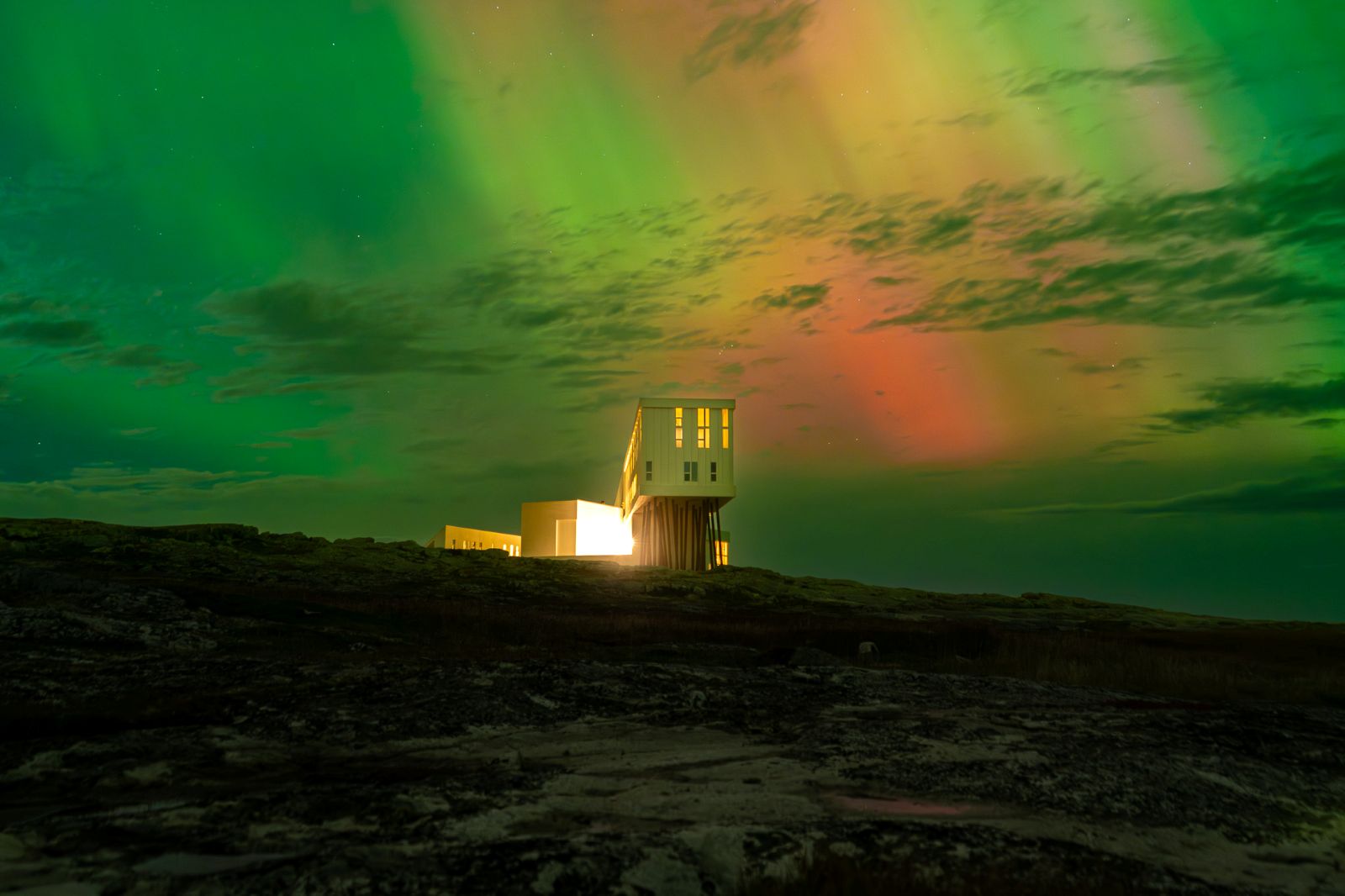
On an island off Newfoundland’s coast, a remarkable hotel asks what hospitality can give back to the place that makes it possible.
By QEditorial | Hospitality · Design · Culture

At the edge of the North Atlantic, a white building rises above dark rock on a series of slender supports. Its windows face the water; its shape belongs as much to contemporary architecture as to the fishing structures that have long stood along this coast. From a distance, Fogo Island Inn could be mistaken for an audacious object placed in the landscape. Up close, it becomes clear that the landscape, and the people who live within it, are the point.
Reaching Fogo Island requires intention. Travellers arriving through Gander continue towards the ferry at Farewell, cross the water, and then make their way across the island. A charter aircraft offers another route. Either way, arrival has a sequence, a sense of leaving familiar rhythms behind. The journey helps explain the Inn’s particular appeal: it invites guests to pay attention to where they have come, rather than simply celebrate where they are staying. Getting to Fogo Island
There are only 29 rooms and suites, all facing the Atlantic. That small number contributes to the feeling of privacy, but scarcity alone would be a thin story. The more compelling question is how a hotel of this ambition came to stand on a remote island, and who benefits from its presence.
A building made with an island

Fogo Island Inn was designed by Newfoundland-born architect Todd Saunders. Its angular, pale exterior makes a striking silhouette against the coastline. Yet the supports beneath it echo the shores used to brace traditional buildings along Newfoundland’s rocky outports. Inside, furnishings and textiles draw on the skills of Fogo Island makers; the Inn says nearly all its furniture was created on the island.
That distinction matters. Local craft here is neither a decorative afterthought nor a collection of souvenirs arranged for guests. It shapes the rooms themselves. The building creates a conversation between an international design language and knowledge handed down through a community accustomed to making what it needs. Its visual drama draws the eye; the work behind it gives the architecture its depth.
The story behind the stay

The Inn is an initiative of Shorefast, a Canadian charity working on the island’s economic and cultural resilience. Shorefast co-founder Zita Cobb grew up on Fogo Island, left after the decline of the inshore cod fishery, built a career in technology and later returned. With her siblings Alan and Anthony Cobb, she established Shorefast in 2004. The Inn opened in 2013 as one expression of a larger effort to create lasting opportunities connected to the island’s own resources and abilities.
According to Shorefast, all of the Inn’s operating surpluses are reinvested in its community initiatives. This is a precise claim: it refers to surpluses from the business, rather than every dollar a guest spends. Shorefast also uses an Economic Nutrition label to show where money flows through its social businesses. For a visitor, the idea poses a useful question: what would change if the value of a luxury stay were measured partly by what remains in the place after the guest leaves? Shorefast’s approach
There is room for scrutiny within that question. A beautiful building and an ambitious business model do not, by themselves, settle every tension between high-end tourism and everyday island life. They do make Fogo Island Inn a more interesting subject than the familiar story of escape. The hotel presents hospitality as an ongoing relationship with a community, one that deserves to be understood through the people who sustain it.
Seven seasons, one table

On Fogo Island, the calendar is described through seven seasons: Winter, Pack Ice, Spring, Trap Berth, Summer, Berry and Late Fall. These names follow changes in the sea, weather, fishing and harvests. A visit in Berry season belongs to a different landscape from one in Pack Ice. Nature sets the terms, rather than serving as a permanent backdrop for a photograph.
The table follows that logic. The Inn’s kitchen works with fishers and growers and builds its menus around ingredients sourced as close to home as possible. North Atlantic cod, local seafood, root vegetables, herbs and wild berries are part of a culinary vocabulary grounded in Newfoundland. Guests can also dine at a participating restaurant elsewhere on the island through a programme in which the Inn covers the meal. It is a small but telling invitation to leave the hotel and encounter the wider place.

There are comforts here, certainly: ocean-facing rooms, thoughtful interiors, meals made with care, and space to withdraw from a crowded world. But the strongest impression Fogo Island Inn offers is an idea of luxury that asks something of its guest. It asks for time, curiosity and a willingness to see an island as a living community rather than a secluded setting.
At the edge of the Atlantic, exclusivity acquires a different meaning. The journey and the limited number of rooms make this a rare stay. Its deeper distinction lies in the attempt to let the place retain something of the value created by being seen.
There are places we visit to leave the world behind. And there are places that ask us to notice the world more closely. Fogo Island belongs to the second kind.
Here, the horizon is vast, but the most meaningful view may be nearer: the hands that made a chair, the knowledge held in a meal, the life of a community beyond the hotel’s windows. We are drawn to Fogo Island Inn because its beauty opens onto a larger question. If travel changes us, what can it leave behind for the people who call a place home?
Perhaps the rarest luxury is to arrive with curiosity, and to depart having truly paid attention.
— Nicolò Di Stefano
Founder & Editor-in-Chief, QEditorial
QEditorial — Fashion · Culture · Identity

Image credits: All photographs accompanying this article are from the official Fogo Island Inn press kit and appear courtesy of Fogo Island Inn. Individual photographer credits are listed where provided.


Leave a Reply