
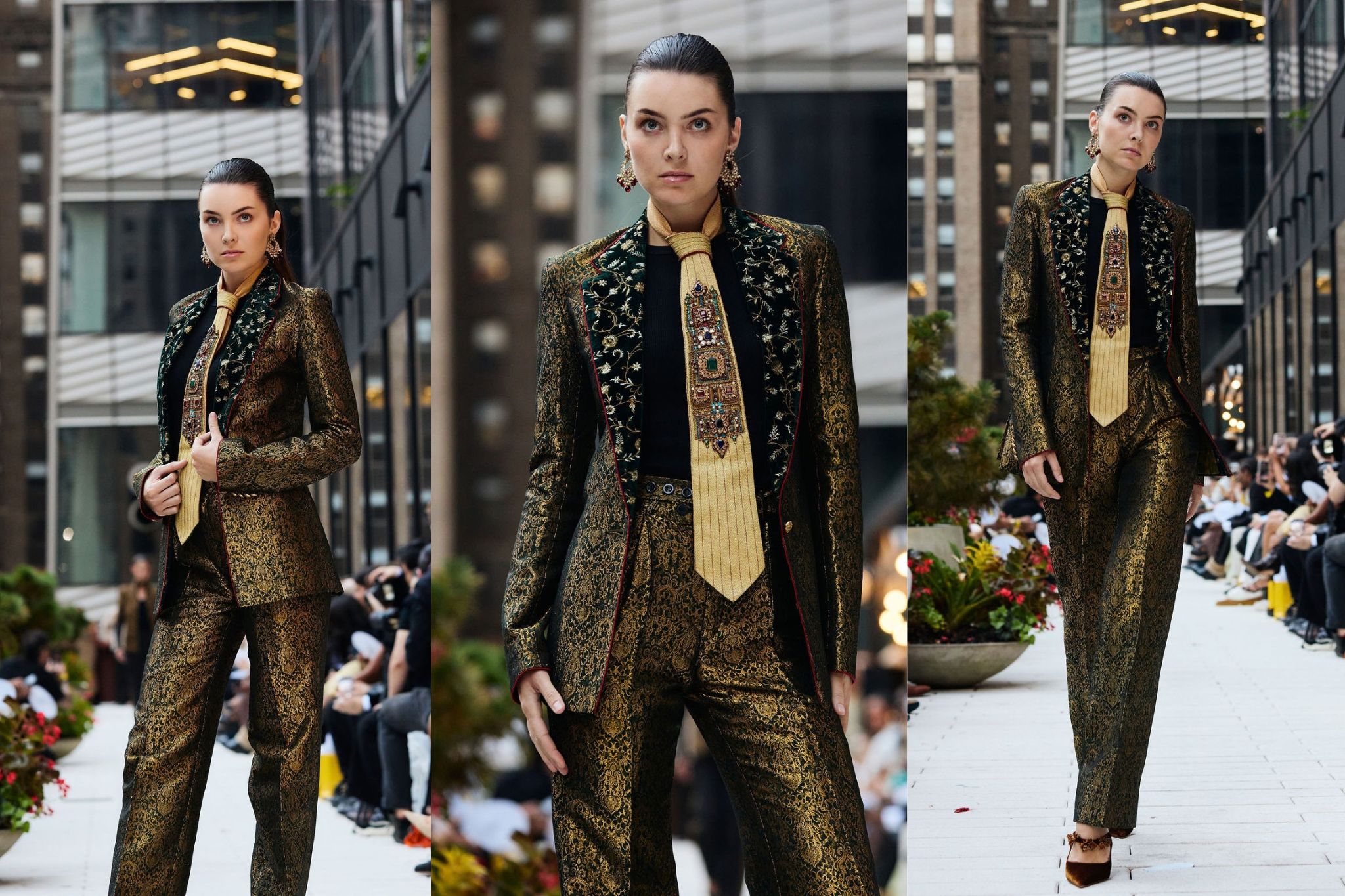
A father’s embroidered tie. The hands of artisans she has known since childhood. A collection that takes inherited clothes apart to ask what deserves to survive. In an exclusive conversation with QEditorial, the Pakistani couturier makes the case for a new life in couture.
By Nicolò Di Stefano | QEditorial Magazine

The tie had a past before Parishae Adnan touched it. Hand-embroidered for a 2001 collection by her father, Amir Adnan, it belonged to another designer’s work, another moment, another silhouette. In Second Skin, Parishae brought it onto a New York runway and placed it at the center of a woman’s look. She called the piece “My Father’s Tie.”
It would have been easy to make the gesture into a story of succession: a daughter takes an object from her father’s archive and claims it for herself. Parishae tells us something subtler. “It felt less like taking something from my father’s authorship and more like continuing a conversation with it.”
That sentence opens the collection. The tie has been given a future her father could not have designed for it in 2001. Across eight looks, Second Skin does something similar with menswear, bridal and ceremonial garments, hand embroidery and the rigid architecture of the corset. Its most compelling question is also Parishae’s own: how do you make room for yourself inside a history you love?
Having met Parishae in person, I wanted our conversation to move past the runway image. I wanted to know who taught her to see the value in a piece of cloth, what it cost her to find a voice beside two established designers, and why she believes taking a garment apart can be a way of caring for it.
Before the language, the fabric
QEDITORIAL: You grew up inside your family’s fashion workshops. What is the earliest memory from those spaces that still influences the way you understand clothing today?
PARISHAE ADNAN: “One of the most vivid is of the fabric storeroom. It was filled with rolls and rolls of different textiles, and as a child I would climb over them, make up stories around them and disappear all the way to the back where no one could see me. When I got tired, I would literally fall asleep on top of piles of fabric.”
The image stays with you: a child making a private world among rolls of cloth, then sleeping on them. Parishae remembers learning weight, tensile strength, drape and touch long before she possessed the technical language to describe them. But when she continues, she shifts our attention away from the fabric and toward the people.

The craftsmen, embroiderers and masters who worked with her parents taught her, joked with her, told her stories and looked after her. She describes the workshop as an extended family. Some of those same people remain with the house today. This is why her language of memory never feels like an abstract theme supplied for a collection statement. She knows some of the hands that made the earlier garments. She has known them since she was a child.
Later in our conversation, I return to the extraordinary labor behind Second Skin. The collection’s press materials state that each look required upwards of 2,500 hours. Parishae refuses to let that number stand alone as a measure of exclusivity. It represents people, expertise and generations of knowledge. “Couture is never the work of one person,” she says. “I may design the garment, but its existence depends on the hands, expertise and time of an entire atelier.”
The people in the storeroom have followed her onto the runway. Once you understand that, every cut she makes into an inherited garment feels more consequential.
Growing beyond the shadow

QEDITORIAL: Both of your parents have established identities within Pakistani fashion. When did you realize that you needed to create a language that was unmistakably your own?
PARISHAE ADNAN: “I think in order to find a voice that was purely my own, I first had to battle my ego out of it.”
It is a striking place for a young designer to begin. Parishae could have offered a familiar story of breaking free. Instead, she admits that for a long time she treated her parents’ achievements as a shadow to fight. “Eventually, I realized that you don’t escape a shadow by fighting it,” she tells QEditorial. “You have to find the light that comes from within you and keep working on it until it becomes strong enough to stand on its own.”
She had to unlearn the urge to prove she was different and the need to draw a hard border between what was hers and what belonged to them. Her family legacy gave her access, education and an uncommon foundation in craft. It also meant her work would be measured against her parents’ work from the start. Parishae does not pretend one side cancels the other.
From her father she recognizes meticulousness, the pursuit of perfection and a critical eye she sometimes turns on herself. From her mother, designer Huma Adnan, she learned craft and sustainability, along with stubbornness and the courage to speak plainly. She cannot neatly list what she chose not to inherit. Inheritance, she says, becomes part of you before you know it is there.
Her mother’s influence deserves more than a passing mention. When I ask what Huma taught her about being a woman building an independent place in fashion, Parishae points to conviction: the willingness to stand by an idea even when it is neither easy nor obvious. Her father’s tie can be photographed. That lesson from her mother is harder to see, but it may be just as present in Second Skin.
QEDITORIAL: Why was Second Skin the necessary collection for you to create at this particular moment?
PARISHAE ADNAN: “Second Skin came at a moment when I was finally ready to stop separating where I came from from where I wanted to go.”
She took garments, techniques, memories and codes she had grown up around and asked what they might become in her own language. The collection gave the materials another life and, she says, gave her permission to begin one of her own. It is an unusually personal account of a design decision. The collection’s title suggests clothing as protection and expression, an armour between the inner self and the world. When asked who its central woman is, Parishae answers: someone she knows, someone she has been and someone she is still becoming.
A Pakistani couturier, on her own terms

QEDITORIAL: You identify yourself specifically as a Pakistani couturier. What do you wish the international fashion industry understood more clearly about contemporary Pakistani design?
PARISHAE ADNAN: “Pakistani design does not have to look traditionally Pakistani in order to be Pakistani.”
This is one of the most direct answers in our exchange. Parishae speaks of Pakistan’s vocabulary of hand embroidery, textile development and craftsmanship as the foundation of her work. She wants those skills to take part in a broader conversation around couture, including through sharp tailoring, contemporary silhouettes and corsetry. Their origin does not disappear when their form changes.
Several pieces in Second Skin began as a lehenga, a sherwani or a pishwas. Parishae dismantles their familiar silhouettes while retaining what she considers vital in the textile, the handwork, the technique and the garment’s history. She does not ask a New York audience to identify each reference before it can appreciate the clothes. She wanted the collection to be encountered first as couture, through its construction and skill.
To explain, she offers an analogy we did not expect. Parishae has spent years strength training. At a gym in New York, strangers could recognize the discipline in her physique without knowing her background. Craft, she suggests, can be recognized the same way. A viewer may first see the precision of an embroidered surface or the control of a tailored line. Learning where that expertise comes from then adds a deeper understanding.
Her answer challenges a persistent demand placed on designers working across cultures: that identity should arrive as an instantly readable sign. For Parishae, Pakistani identity is already inside the construction. She has no need to simplify it to make it visible.
The woman inside the structure

QEDITORIAL: The collection begins with menswear and military codes before moving toward corsetry, exposed structures and volume. What journey through female power were you constructing across the eight looks?
PARISHAE ADNAN: “Power here isn’t necessarily loud or expansive; sometimes it is found in control, precision and restraint.”
The opening looks draw on strong shoulders, ties and rigid tailoring. As the collection develops, those structures meet corsetry and changing volumes. Parishae describes an interplay of restraint and flow rather than a simple passage from confinement to freedom. She wants to see how a woman can inhabit her power without having to perform it for anyone watching.
The corset becomes especially revealing. Parishae finds it sensual, yet she is equally drawn to its long history of reinterpretation. Her version remains close to Victorian construction, with intense boning, panelling and internal structure. She places an old form inside a collection devoted to change. Its seams and supports become part of the story rather than hidden engineering.
There is no single heroine at the end of this progression. When Parishae says the woman of Second Skin is also someone she has been and someone she has yet to become, she leaves the question open. A person can be composed, protected, uncertain and changing at once. The clothes make space for all of those states.
The cut that keeps something alive

QEDITORIAL: How do you determine which parts of an archival garment must be protected and which parts may be dismantled? At what point does destruction become an act of preservation?
PARISHAE ADNAN: “It begins with identifying what gives the original garment its value, whether that is a piece of handwork, a particular textile, an embroidery technique or even the memory embedded within it.”
Those parts become, in her word, almost untouchable. The rest can be reconsidered. Her approach is more exacting than the easy romance of transformation suggests. First she has to decide what the garment holds; only then can she decide where to cut. A beautifully worked piece kept in storage may remain intact while the knowledge in it goes unseen. In a new silhouette, its craftsmanship can move again.
I think here of the tie. Parishae compares the continuing cultural force of an object with provenance to the way an iconic dress can carry meaning decades after it was first worn. Her father’s embroidered tie had a history before she touched it. She wanted that history to survive inside a form unmistakably her own. The look becomes a conversation between two authors, held in a single garment.
QEDITORIAL: Are you attempting to make couture more sustainable, or to redefine what luxury itself should mean?
PARISHAE ADNAN: “I think the question almost assumes that something preexisting cannot already be luxury, and of course it can.”
She stops our question in its tracks. Jewels, art and other treasured objects are passed between generations; age and provenance can deepen their value. Why should clothing be treated as though its greatest claim to luxury were its newness?
“We are temporary, but the things we create can exist far beyond us, so perhaps we are less their owners than their custodians,” she says. This is the philosophical center of Second Skin. Transformation adds to an object’s history rather than wiping it clean. Sustainability follows from that understanding, but Parishae does not offer it as a convenient label for the collection. She asks for a more demanding kind of attention: to the maker, to the material, to the earlier life and to the person who may carry it next.
What remains

The final look is called “Reincarnation.” Its original silhouette has vanished, while its embroidered material remains. It is the boldest test of Parishae’s idea. How much can be changed before a garment loses its identity? Her answer lies in what she chose to carry forward.
QEDITORIAL: As you look beyond this first New York presentation, what part of Parishae’s identity must remain unchanged—and what are you now ready to reinvent?
PARISHAE ADNAN: “I never want Parishae to become so recognizable that it becomes predictable. The identity can remain, but the form should always be allowed to change.”
What she wants to keep is the instinct to question, challenge and push the work further. It is a fitting answer from someone whose first education in fashion came through both touch and trust: a child asleep on cloth, surrounded by artisans who knew her name. Years later, she can cut into an inherited garment because she knows what must survive the cut.
I went into this conversation wanting to understand the person beyond the eight runway looks. I came away thinking about the tie, certainly, but also about the people in the atelier and the courage required to make a new form from something you have been taught to cherish. Parishae Adnan’s second skin is not a finished identity. It is the freedom to keep making one.
This feature is based on an exclusive written interview with Parishae Adnan. Selected questions have been shortened for presentation; quotations retain the designer’s wording.

Editor’s Note
I had the pleasure of meeting Parishae Adnan before this conversation. Her work drew me in, but I wanted to understand the person behind Second Skin: the child who grew up among fabrics and artisans, and the designer now finding her own voice within that history.
What stayed with me in her answers was the care with which she speaks about the people and garments that came before her. She sees an inherited piece as something she can question and reshape while preserving what gives it meaning. In the tie from her father’s collection, the craftsmanship of her atelier and the conviction she learned from her mother, Parishae finds the material for a story that is entirely her own.
— Nicolò Di Stefano
Founder & Editor-in-Chief, QEditorial Magazine
QEditorial — Fashion · Culture · Identity

Photography: Hannah Rozelle (@hannahrozelle_). All photographs are credited to the photographer and used for QEditorial’s editorial coverage of Second Skin.
Runway Note: Parishae Adnan’s Second Skin was presented as part of Flying Solo’s runway show during New York Fashion Week on September 13, 2026.

Leave a Reply