
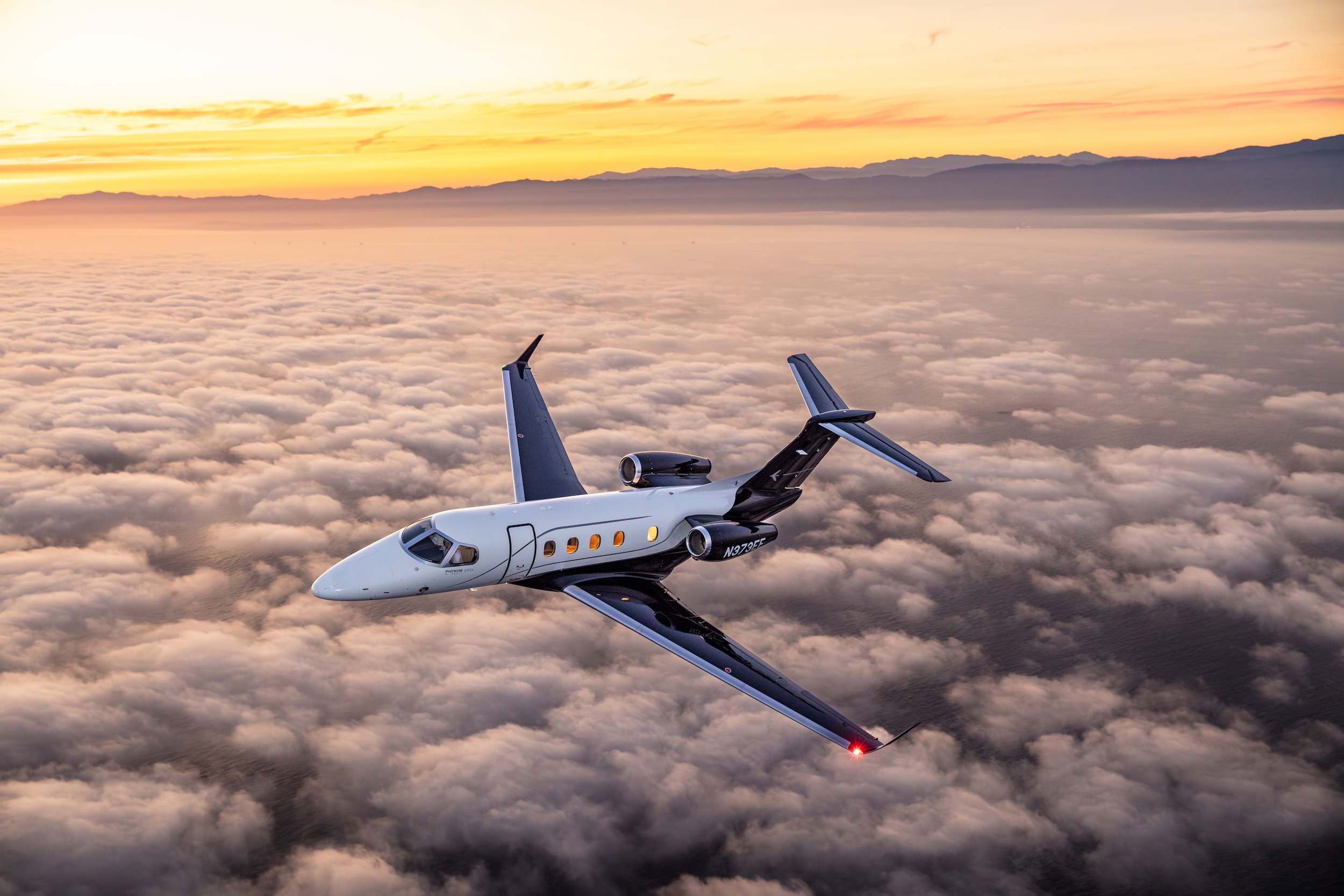
For almost twenty-five years, Cessna’s business jet expressed a precise idea of private travel: crossing continents at Mach 0.935 and measuring distance through time saved.

In July 2014, a Cessna Citation X+ departed Wichita, reached Seattle, crossed the United States to Miami and completed the itinerary in reverse the following day. The four legs became four certified speed records. The 2,375-nautical-mile flight from Seattle to Miami took four hours and 52 minutes. The journey concentrated the aircraft’s identity into two days: sustained speed, transcontinental range and a cabin designed to turn flight time into usable time.
The Citation X+ reached Mach 0.935, equivalent to approximately 617 miles per hour under the conditions published by its manufacturer. It remained a benchmark in its category for years and represented the most radical expression of the Citation family. Its long fuselage, tail-mounted engines, high vertical stabiliser and sharply swept wings communicated its purpose before the interior came into view. Every component appeared to point in the same direction.
An Aircraft Designed Around Speed
When the original Citation X entered service in 1996, Concorde still shaped the public image of supersonic travel. Cessna was working at a different scale, serving small passenger groups and itineraries organised around individual requirements. The aircraft brought near-airliner speed to business aviation, along with access to executive airports and direct connections unavailable through scheduled routes.
Much of that performance came from the wing. During development, NASA Langley collaborated with Cessna through aerodynamic research, transonic wind-tunnel testing and structural analysis. The second-generation supercritical profile managed the shock waves that form over a wing as local airflow approaches the speed of sound. Lower drag allowed the aircraft to sustain high speed with greater aerodynamic efficiency.
The partnership produced one of the most recognisable wings in business aviation. Passengers never saw the research behind it, although it defined their experience: rapid climbs, a maximum altitude of 51,000 feet and long cruise segments above much of the commercial traffic and adverse weather. The Citation X programme received the Robert J. Collier Trophy for its 1996 aeronautical achievements, securing its place in the history of American engineering.
From Citation X to Citation X+

The X+ version, certified by the Federal Aviation Administration in June 2014, updated the aircraft while preserving its fundamental character. Cessna lengthened the fuselage by 15 inches, creating additional space in the forward club section. Winglets improved high-altitude efficiency and take-off and landing performance, while two digitally controlled Rolls-Royce AE3007C2 engines supplied the thrust required to reach Mach 0.935.
Published maximum range increased to 3,408 nautical miles, and the cabin could accommodate up to twelve passengers. Cessna identified direct journeys including New York to Los Angeles, New York to Paris, Dubai to Singapore and Panama City to São Paulo. These routes clarified the aircraft’s role: a compact transcontinental machine created for demanding international schedules and direct access to financial centres, leisure destinations and secondary airports.
Only weeks after certification, the Citation X+ completed its first transatlantic journey under a standard business-flight profile. The flight from Presque Isle, Maine, to Paris–Le Bourget took five hours and 33 minutes at an average ground speed of 502 knots. The aircraft climbed directly to 45,000 feet and cruised near Mach 0.88 for much of the Atlantic crossing. Speed became tangible: North America and Paris could fit within the rhythm of a working day.
The Cabin as Private Space

The interior reflected the language of business travel during the 2000s and 2010s: leather club seating, polished or satin-finished wood veneers, compact surfaces and a customisable palette. Luxury came through separation from the terminal, privacy and continuity between the flight and the passenger’s schedule. The cabin could function as a meeting room, lounge or space for rest, within proportions more intimate than those of today’s ultra-long-range aircraft.
Cessna’s Clairity cabin system gave each passenger individual control over lighting, temperature, window shades and entertainment. Satellite connectivity appeared among the available options. In the cockpit, the Garmin G5000 suite combined three large displays, four touchscreen controllers and integrated autothrottles. Cabin technology and avionics followed the same design logic: reduce interruption and give crew and passengers precise control over their environment.
Owners could define the seating plan, materials and colour scheme. This freedom introduced personal character into an aircraft governed by performance. Its cabin retained the compact discipline of a transcontinental business jet. The resulting elegance came from the coherence of scale, function and speed.
The Value of Time

Private aviation turned time into a category of luxury, and the Citation X+ made that relationship unusually visible. Owners gained direct airport access, control over departure schedules and a cruise speed that reduced journey duration further. The aircraft’s taut profile translated that promise into physical form, with little visual excess.
Speed carries an energy cost, and contemporary coverage must acknowledge it. A 2024 study published in Communications Earth & Environment calculated that direct CO₂ emissions from private aviation rose by 46 per cent between 2019 and 2023. The finding concerns the sector as a whole and does not assess the Citation X+ specifically. It nevertheless establishes the context in which range, flight frequency and responsible aircraft use are now evaluated.
Production Ends, the Legacy Continues

Textron Aviation ended Citation X+ production in 2018, concluding a manufacturing run of more than twenty-one years across the X and X+ programmes. The decision closed a line that had begun in the mid-1990s, when a business jet capable of exceeding Mach 0.9 represented both a technical threshold and a cultural symbol. The end of production did not remove the aircraft from active fleets, charter operations or the pre-owned market.
The Citation X+ retains a distinct position because its identity remains immediately legible. Later generations introduced taller cabins, longer range, lower cabin altitudes and more advanced digital systems. The Cessna continues to stand apart through the clarity of its central idea: the entire journey was engineered around speed.
Its legacy can be traced through current programmes approaching Mach 1 and presenting saved time as a defining part of the experience. The Citation X+ articulated that promise decades earlier, using an aerodynamically advanced wing, two Rolls-Royce engines and a private cabin that allowed life on the ground to continue while the aircraft crossed the distance between cities.
Editorial Note
This article examines the Cessna Citation X+ through the history of business aviation, aeronautical design, speed records, luxury private travel and the development of transcontinental jets. Operational figures may vary according to aircraft configuration, payload, weather, routing and reserve requirements.
Thank you for reading. Join Q Letter to stay connected with QEditorial’s latest stories and become part of a growing community supporting independent fashion and cultural journalism.
QEditorial Magazine — Fashion · Culture · Identity
QEditorial.com




Leave a Reply