
Across fields of water, ice, color and shadow, the Berlin-based artist places fragile presences inside worlds that refuse to explain themselves.

There is a moment in the paintings of Lukas Leibe when matter becomes a world.
At first, the surface appears almost self-contained: layers of blue and white fracture like ice; darker pigments gather into the depth of an ocean; turquoise spreads across the canvas without offering a stable horizon. Elsewhere, red accumulates into a dense, restless field. The material does not immediately describe a place. It remains paint—scratched, washed, covered and rebuilt.
Then a figure appears.
A human body, a group moving through water, an animal crossing an uncertain terrain, a boat suspended inside an expanse of blue. These presences are small enough to be missed at first glance. Once discovered, however, they reorganize everything around them. Texture becomes geography. Color becomes atmosphere. An abstract surface begins to hold distance, danger, memory and possibility.
This transformation sits at the center of Leibe’s visual language. His paintings do not begin with a complete scene waiting to be rendered. They emerge through accumulation and revision. Acrylic paint, translucent pigments and textured materials are applied, disturbed, removed and covered again. Some decisions are controlled; others are left to coincidence. Only later do precisely rendered figures or animals enter the surface.
The resulting image exists between abstraction and narrative, but belongs fully to neither. Leibe gives the viewer enough information to sense that something has happened—or is about to happen—without revealing what that event might be.
When Texture Becomes Territory

Leibe’s surfaces are not backgrounds in the conventional sense. They are active environments.
Their cracks, ridges and abrasions suggest landscapes shaped over time, yet they rarely settle into a single physical reality. A pale surface may resemble ice, cloud, water or weathered stone. A dark blue field can become an ocean, a night sky or an interior state. The ambiguity is essential: the painting becomes recognizable only after the figure enters it, and even then its location remains unstable.
This instability gives the work its emotional charge. The viewer does not simply observe someone occupying a landscape. Instead, the figure appears to be negotiating a world whose rules remain unknown.
Across Fearless, Follow, Frozen Soul, Lifted, Paradise, Sons of the Sea, The Dancer and Bloom, Leibe repeatedly returns to the relationship between a vulnerable presence and an overwhelming field. The works vary in scale, color and temperature, but they share a fundamental question: how much space does a living being need in order to be seen?
The answer is not necessarily physical. Leibe often gives most of the canvas to emptiness—or to what initially appears to be emptiness. His figures occupy only a fraction of the image, yet they carry its emotional weight. Their smallness demands attention rather than diminishing it.
Scale, in these paintings, becomes psychological.
The Distance Between Solitude and Belonging

Leibe’s figures are frequently alone, but solitude in his work is not presented as a single condition.
At times it feels exposed: a presence surrounded by an environment too vast to control. Elsewhere, it suggests concentration, freedom or an encounter with something larger than the self. Even when several figures share the same space, distance remains. They move together without surrendering their individuality.
This tension is particularly visible in the recurring imagery of water and ice. These elements can hold, separate, conceal or threaten. They can become routes of passage as easily as boundaries. The figures within them may be following, searching, escaping or returning, but Leibe does not resolve the direction of their movement.
Who is leading, and who has decided to follow? Is the journey chosen or necessary? Does the distant boat represent arrival, departure or the possibility of rescue? The paintings contain these questions without illustrating their answers.
The titles deepen the uncertainty. Words such as Fearless, Lifted, Paradise and Bloom appear affirmative, yet the images resist uncomplicated optimism. Courage may exist alongside danger. Elevation may also involve surrender. Paradise can contain isolation. Blooming can be an emergence, but it can also require the rupture of an earlier form.
Rather than explaining the image, the title creates friction with it. It offers one possible emotional direction while leaving the viewer to determine whether the painting confirms or unsettles that direction.
The Body Inside the Field

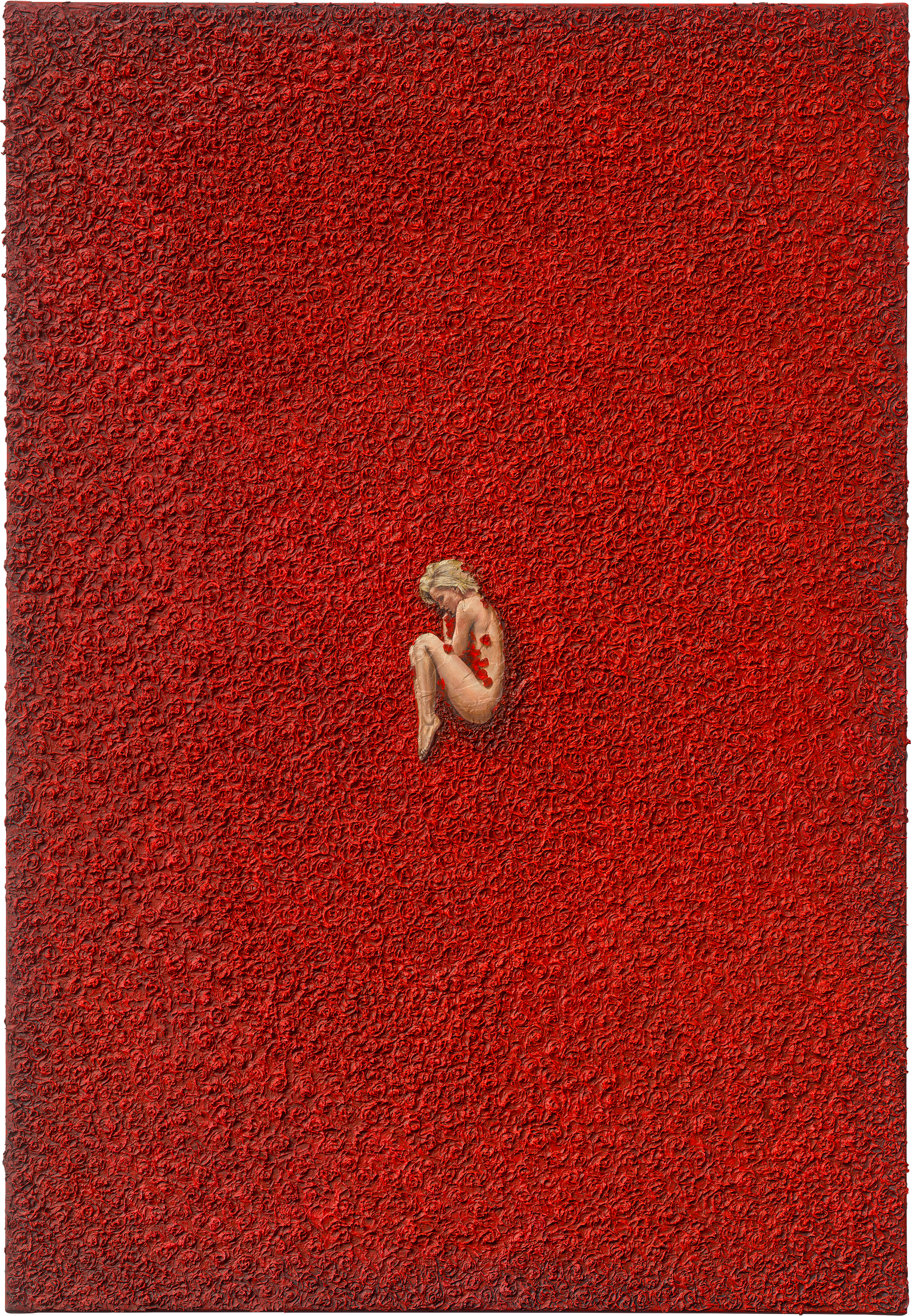
Among the cool aquatic and glacial tones that dominate much of this body of work, Bloom arrives as a rupture.
Its red field is dense and almost bodily. Within it, a curled human figure appears suspended rather than securely placed. The image may evoke protection, exposure, birth, injury or transformation, but none of these interpretations fully contains it. The surrounding material could be read as flowers, tissue, earth or something without a physical equivalent.
What matters is not the identification of the environment but the relationship between body and surface. The figure does not stand in front of the abstraction. It appears embedded within it.
That same relationship runs through the other works. Human beings and animals do not seem to have been placed upon finished backgrounds. They feel discovered inside the material—as though Leibe has allowed the surface to develop until it reveals what kind of presence it can hold.
This raises one of the most compelling questions surrounding his process: does the environment call the figure into existence, or does an imagined figure determine what the surface must eventually become?
Leibe has described his interest in the moment when paint stops behaving like paint and begins to feel like “a tiny world frozen in time.” That shift is central to his practice. Yet the world he creates is never entirely frozen. Footprints suggest previous movement. Water appears disturbed. Shadows stretch beyond the bodies that produce them. Figures look as though they have been caught between one state and another.
The stillness contains evidence of motion.
Animals Without Allegory

Animals recur throughout these paintings, but they should not be reduced too quickly to symbols.
A whale, shark, bird or polar bear inevitably carries cultural associations, yet Leibe’s compositions do not provide a fixed allegorical system. The animals are not decorative additions, nor are they merely substitutes for human characters. They possess their own scale, direction and vulnerability within the painted environment.
Their presence also shifts the viewer away from an exclusively human understanding of solitude. What does isolation mean for an animal? What does courage look like outside human language? When an animal appears to guide, confront or carry a human presence, are we witnessing companionship, imagination or a reversal of power?
Leibe leaves these relationships unresolved. The lack of explanation allows the images to remain emotionally accessible without becoming literal. We recognize the possibility of care, fear, trust and separation, but we cannot assign a definitive story to what we see.
This resistance to closure is one of the work’s strengths. The paintings invite projection while never becoming blank screens for it. Their material specificity—the cracks, shadows, currents and accumulated pigments—keeps pulling the viewer back toward the physical object.
Emotion is present, but it has been built through matter.
Between Control and Coincidence

Leibe’s method depends upon a productive contradiction. The surfaces develop through experimentation, revision and partially unpredictable material processes, while the figures are rendered with concentration and precision.
One language allows the accidental. The other introduces intention.
The two do not always meet comfortably. That discomfort creates tension. A carefully painted figure may appear threatened by the abstraction around it, while an otherwise chaotic field can suddenly seem protective once it contains a living presence. Neither side fully controls the other.
Leibe’s background as an actor offers a secondary way of understanding this tension, although the paintings should not be treated simply as an extension of performance. Acting also involves movement between preparation and instinct, structure and emotional uncertainty. On canvas, however, the voice, script and duration of performance disappear. What remains is a silent presence whose circumstances cannot be confirmed.
The paintings therefore ask the viewer to perform the final act of interpretation.
Yet Leibe does not surrender authorship entirely. His decisions—especially his control of scale—direct how we approach each image. We look first at the environment, then search for life within it. Discovery becomes part of the experience of viewing.
The Story Before It Is Told

Since beginning to share his paintings publicly in 2023, Leibe has developed a recognizable language built from material density, restrained narration and the tension between intimacy and immensity.
What remains unknown is equally important.
Are these figures invented, remembered or drawn from private experiences? Why do water, ice and suspension return so insistently? Do the titles come before the images or after them? Is the recurring distance between figures an expression of solitude, protection or the impossibility of fully reaching another being? And when hope appears in these paintings, is it located in survival, movement or simply in the decision to remain visible?
These are not weaknesses in the work’s narrative. They are the spaces that keep it alive.
Leibe does not offer complete stories. He creates the instant in which a story becomes possible: a surface acquires depth, a figure enters it, and the viewer begins to wonder what existed before this moment—and what might happen after it.
The paintings stop there.
The questions continue.
Editor’s Note
Lukas Leibe’s paintings do not ask to be explained too quickly. They invite us to remain inside the uncertainty—to consider why these figures appear so small, what they are moving toward, and whether the spaces surrounding them represent solitude, protection or possibility. QEditorial has chosen to leave these questions open. They will form the beginning of a future conversation with the artist, in which we hope to explore the experiences, decisions and private meanings behind these suspended worlds.
— Nicolò Di Stefano, Founder & Editor-in-Chief, QEditorial


Leave a Reply