
With his Autumn/Winter 2026 collection, the Hong Kong designer transforms digital exposure, body horror and sustainable materials into a radical study of vulnerability—revealing how fashion is learning to see differently.

Fashion once worked hard to conceal the mechanisms holding an image together. Seams disappeared. Structure remained beneath the surface. Beauty was expected to arrive resolved, polished and seemingly untouched by effort.
ANGUS TSUI begins somewhere else: with a body that can no longer pretend to be intact.
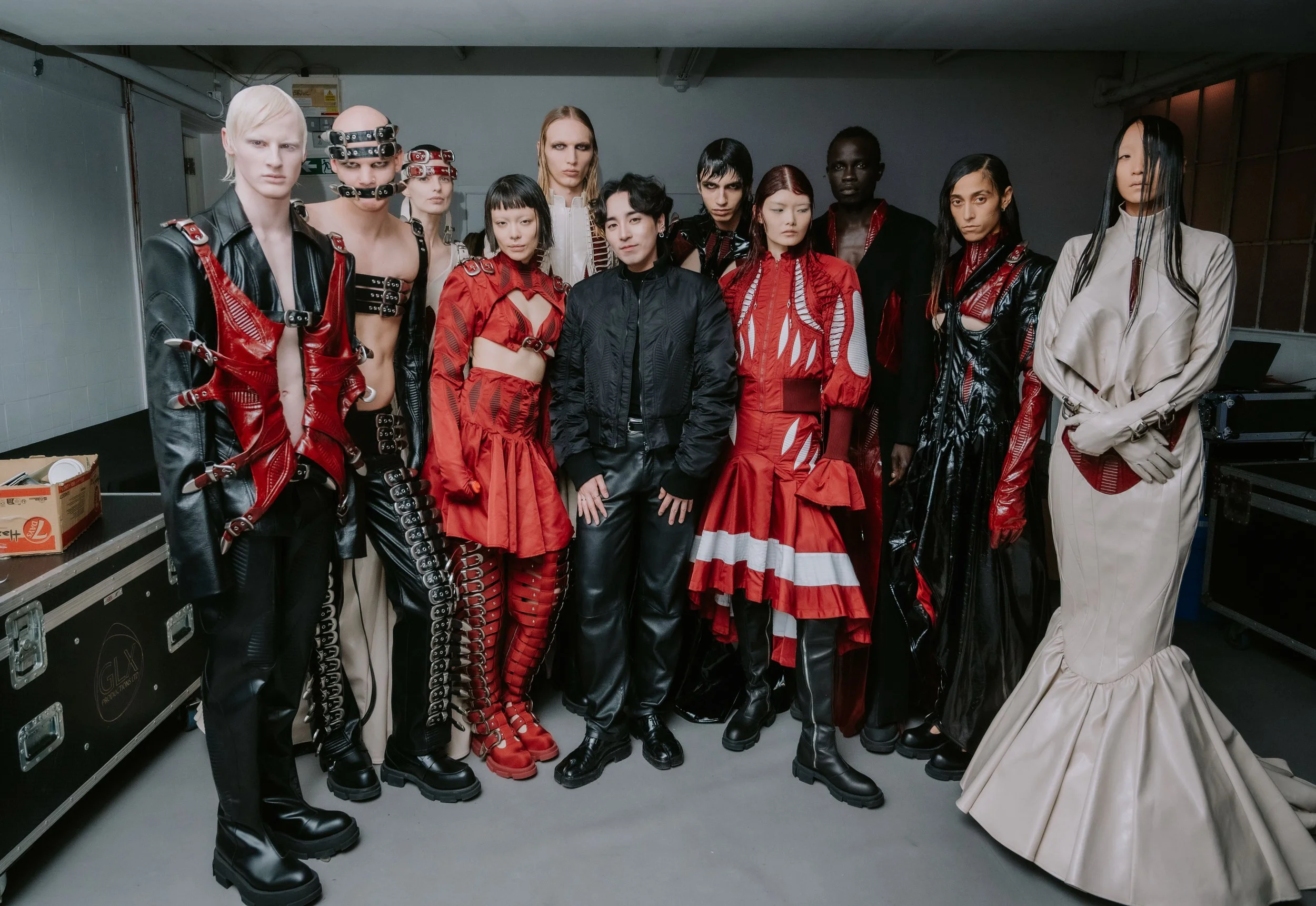
In 404: Safety Not Found, the Hong Kong designer’s Autumn/Winter 2026 collection, flesh appears split, stretched and restrained. Glossy surfaces resemble exposed muscle. Belts encircle torsos, limbs and faces. Garments open like wounds, while sculptural constructions seem to protect the body and imprison it at the same time.
This is not provocation added simply for effect. It is the visual architecture of a collection concerned with what happens when the systems designed to protect us stop working.
A “404” error traditionally signals that a requested digital page cannot be located. Tsui redirects that familiar message toward something more human: safety itself cannot be found. Privacy, certainty and emotional distance have become increasingly difficult to maintain in a world where identities are continuously displayed, recorded, compared and consumed.
According to the official collection statement, 404: Safety Not Found explores humanity’s fundamental fears in the digital age, translating the designer’s conflicted feelings about exposure, restraint and freedom into a visual language concerned with vulnerability and the search for an authentic self.
The collection does not imagine technology as a distant science-fiction threat. It examines the vulnerability already produced by living inside it.
A Brand Built Beyond the Familiar

Founded in Hong Kong in 2014, ANGUS TSUI has spent more than a decade developing a language positioned between sustainable design, speculative fiction and anatomical construction.
This is no longer a newly emerging label. It is an established independent fashion project entering a more visible international phase.
The brand has presented collections during the fashion weeks of London, Shanghai and Hong Kong. Its designs have also been exhibited in the Museo Salvatore Ferragamo’s Sustainable Thinking exhibition in Florence and the Vancouver Art Gallery’s Fashion Fictions. It has been named among the JOOR × Not Just A Label 100 Project’s global designers and has received multiple DFA Design for Asia Awards. These milestones are documented by the Hong Kong Design Centre and the brand’s official biography.
Tsui’s commitment to responsible fashion began before the creation of his label. He received the EcoChic People’s Award for Hong Kong in 2012 and subsequently won further distinctions from the Redress Design Award. Since 2021, he has returned to the competition as an international judge. His background and awards are recorded in his official Redress Design Award profile.
The designer also established ANCares, an educational initiative connecting sustainability with workshops, exhibitions and community projects. Through this work, Tsui has collaborated with companies including Swire Properties, Cathay Pacific, Shangri-La Hotels, American Eagle and DHL to develop upcycled products and collections.
The DHL collaboration, launched in early 2025, transformed retired company uniforms into a series of bags and accessories. These projects demonstrate that environmental responsibility is not a seasonal story attached to the brand. It has been part of its structure since its foundation.
Yet sustainability alone does not explain ANGUS TSUI.
The label’s strength comes from its refusal to make responsible design visually predictable. Its universe is futuristic, theatrical and occasionally disturbing. Exoskeletons, biomechanical forms, elaborate panel construction and references to science fiction have remained part of its evolving identity.
Instead of presenting sustainability only through neutral colors, natural textures and reassuring minimalism, Tsui places it inside a far more confrontational visual world.
That tension reaches a new intensity in 404: Safety Not Found.
When Clothing Begins to Resemble Flesh

Presented through Fashion Hong Kong on the official schedule of London Fashion Week, AW26 marked the beginning of the brand’s second decade. It also represented a turn inward.
Earlier ANGUS TSUI collections frequently looked toward imagined organisms, alien environments and post-human futures. 404: Safety Not Found brings those ideas closer to the skin. The future is no longer somewhere outside the body; it has entered the nervous system.
The collection moves through black, anatomical red and flesh-like tones. Vegan leather is cut, sculpted and layered to suggest wounded tissue. Red surfaces emerge beneath darker constructions as if the garment has been opened to reveal what should have remained hidden. Industrial belts operate as closures, harnesses and instruments of restraint.
In one of the collection’s most striking looks, the body is wrapped inside a straitjacket-inspired construction while the chest, shoulders and back appear exposed. A system of leather and metal surrounds the head, restricting sight and movement. The silhouette is controlled, but the body appears to fight against that control.
Elsewhere, glossy black forms cling to the torso like external anatomy. Extended shoulders and segmented panels suggest armor, yet their organic curves prevent them from feeling entirely mechanical. The wearer seems caught between mutation and self-protection.
This instability is central to Tsui’s work. His clothes do not establish a simple division between human and machine, safety and danger, beauty and discomfort. Each form appears to contain both conditions.
The runway presentation reinforced this sense of confinement. Shadows resembling office blinds crossed the background, while reduced lighting and an unsettling soundtrack placed the models inside an environment that felt controlled, observed and psychologically compressed. The staging and its relationship to the collection were documented in Tatler Asia’s conversation with the designer.
AW26 also marked Tsui’s first experience designing footwear. The thigh-high “Mary Jaaaaane” boots, constructed with seventeen stacked belt clasps, extend the language of restriction down to the ground. They are theatrical, fetishistic and physically commanding, turning the act of walking into part of the collection’s narrative.
Movement becomes a negotiation: the body advances, but never without resistance.
Horror as a Contemporary Fashion Language

The influence of Clive Barker’s Hellraiser is unmistakable. So are echoes of H.R. Giger’s biomechanical worlds, where flesh, machinery, eroticism and fear become almost impossible to separate.
In his discussion of the collection, Tsui also identifies the wounded sculptures of Belgian artist Berlinde De Bruyckere and Giger’s Necronomicon and biomechanical works among his references. These influences are explored directly in the designer’s Tatler Asia interview.
But 404: Safety Not Found is most compelling when these references stop behaving like cinematic or artistic quotations and begin describing contemporary life.
The straps, wounds and exposed surfaces do not belong only to horror. They can also be read as expressions of a generation accustomed to watching catastrophe through a screen before immediately returning to a carefully edited personal feed. Images of war, violence and private suffering circulate beside advertising, entertainment and self-promotion. Trauma is witnessed, absorbed and then displaced by the next image.
Tsui translates this contradiction into clothing. The body becomes the place where the emotional consequences of digital overexposure finally become visible.
This interpretation is supported by the designer’s own explanation of the collection. Tsui has described watching his generation consume trauma digitally and then return to curated online identities. In his account, the body becomes a vessel for second-hand pain, while the collection imagines what happens when the screen disappears and that pain can no longer remain abstract.
The use of vegan leather therefore carries more than a technical function. A material selected to avoid animal harm is manipulated to represent torn human flesh.
The contradiction is intentional.
In the designer’s own discussion of the material, he connects this choice to the disparity between contemporary society’s ethical aspirations and its psychological condition: people may be increasingly conscious of what they consume and the environmental footprint they leave while remaining internally wounded by comparison, isolation and digital overexposure.
The collection consequently poses a difficult question: can we behave gently toward the external world while remaining brutal toward ourselves?
It is an uncomfortable question—and precisely the kind of question fashion is increasingly prepared to confront.
Fashion Is Learning to Look Differently

There was a time when many of the codes present in Tsui’s collection would have been positioned outside conventional fashion: fetish harnesses, horror imagery, simulated wounds, restrictive face coverings and silhouettes intentionally resistant to familiar definitions of attractiveness.
This does not mean earlier generations of designers avoided darkness, bodily distortion or subcultural references. Fashion has repeatedly challenged the boundaries of taste, gender, beauty and physical form.
What has changed is the breadth of the lens through which these expressions can now be understood.
Ideas once dismissed as costume, underground expression or excessive spectacle are increasingly examined as legitimate forms of design research. Fashion is absorbing the languages of gaming, biotechnology, digital identity, artificial intelligence, performance art, horror, fetish culture and speculative design.
The runway is no longer expected to speak exclusively about clothing. It can operate as a place in which political anxiety, technological change, psychological instability and new relationships with the body become visible.
Digital culture has accelerated this transformation. It rewards images capable of producing an immediate reaction, but it has also exposed audiences to visual languages once separated by geography, institutions or subcultures. A runway presented in London can enter conversations in Hong Kong, New York, Seoul or Milan within minutes.
A garment no longer needs to fit neatly inside an established category to become culturally significant.
This expanded visibility has not automatically made fashion more thoughtful. Novelty can still be consumed without context, and provocation can easily become an empty strategy. What matters is whether an unusual image is supported by a coherent idea.
In Tsui’s case, the visual extremity is connected to a vocabulary developed over more than a decade. The biomechanical construction, environmental responsibility and science-fiction references are not temporary accessories. AW26 intensifies an existing language and directs it toward the psychological reality of the present.
The collection therefore feels radical without feeling disconnected from the identity of the house.
Hong Kong in Every Contradiction

Although the collection was presented in London, Hong Kong remains embedded in its tension.
Tsui has described his native city through contradiction: extreme modernity beside tradition, constant movement beside moments of stillness, and freedom existing alongside less visible forms of constraint. In 404: Safety Not Found, he connects this tension to the relationship between exposure and restraint.
The flesh opens, but belts hold the body in place. The surface appears futuristic, while the fear beneath it is ancient. The clothes suggest freedom through transformation but repeatedly return to straps, closures and confinement.
The palette of deep black, pale flesh and intense red also draws from the city’s nocturnal environment—the glow of screens against skin, artificial light and neon appearing through darkness. As Tsui explained to Tatler Asia, Hong Kong is present less as a literal image than as a tension felt throughout the collection.
After Safety, What Remains?

The most interesting fashion does not merely predict what people will wear next. It gives physical form to emotions that society has not yet learned to articulate clearly.
404: Safety Not Found succeeds because its garments are not simply illustrations of technology. They are studies of what technology has already done to the ways people experience visibility, privacy and their own bodies.
The collection arrives at a moment when fashion is reconsidering what deserves to be placed on a runway. Beauty is no longer required to be reassuring. Sustainability does not have to look restrained. Horror can become a way of discussing intimacy. Fetish codes can describe systems of power. A shoe can change the emotional meaning of a walk.
Through this widening field of references, fashion is becoming less interested in providing one definition of elegance and more capable of examining the complicated realities surrounding it.
ANGUS TSUI stands inside that transition with a distinct visual identity and more than a decade of experimentation behind it. The label may remain independent and relatively unfamiliar to much of the American market, but its work should not be mistaken for the tentative arrival of a new designer.
This is a brand entering its second decade prepared to become less comfortable, more exposed and more exacting about the questions it asks.
The system has failed to locate safety.
Angus Tsui responds by showing us the body that remains.

Editor’s Note
Fashion Is No Longer Asking Permission
What is fashion today?
It is no longer only the creation of garments, nor can it be measured exclusively through wearability, beauty or commercial success. Fashion has become a language through which we examine the body, identity and the tensions of the world around us.
The runway can now accommodate what previous generations might have dismissed as too disturbing, too theatrical, too technological or too closely connected to underground culture. Horror, artificial intelligence, gaming, biotechnology, fetish codes and digital anxiety are entering fashion not simply as visual trends, but as instruments through which designers can describe contemporary experience.
This does not mean that every act of provocation possesses meaning. An arresting image can attract attention without contributing anything to the conversation. The distinction lies in intention, coherence and the ability to build a recognizable language over time.
ANGUS TSUI demonstrates that distinction. In 404: Safety Not Found, the exposed body, restrictive belts and wounded surfaces do not exist merely to shock. They give physical form to conditions many people already experience but cannot easily describe: permanent visibility, the loss of privacy, emotional overexposure and the pressure of constructing an identity for continuous public consumption.
Fashion’s evolution also requires us to reconsider what we call beautiful. Beauty today may be fragmented, unsettling or intentionally unresolved. It may emerge from a garment that protects the body or from one that reveals its vulnerability. It may ask us to confront an image rather than desire it.
Perhaps this is what makes the present moment so significant. Fashion is learning to observe through different lenses. It is allowing unfamiliar materials, marginalized aesthetics and previously separated cultural languages to occupy the same space. In doing so, it is expanding not only what can be worn, but what clothing can communicate.
Fashion does not always need to offer an answer. Sometimes its most important function is to recognize a question before the rest of society is prepared to ask it.
404: Safety Not Found asks what remains when protection, privacy and certainty disappear.
The answer may not be comfortable. But fashion, at its most relevant, was never created merely to make us comfortable.
Nicolò Di Stefano
Founder & Editor-in-Chief
Fashion · Culture · Identity


Leave a Reply