
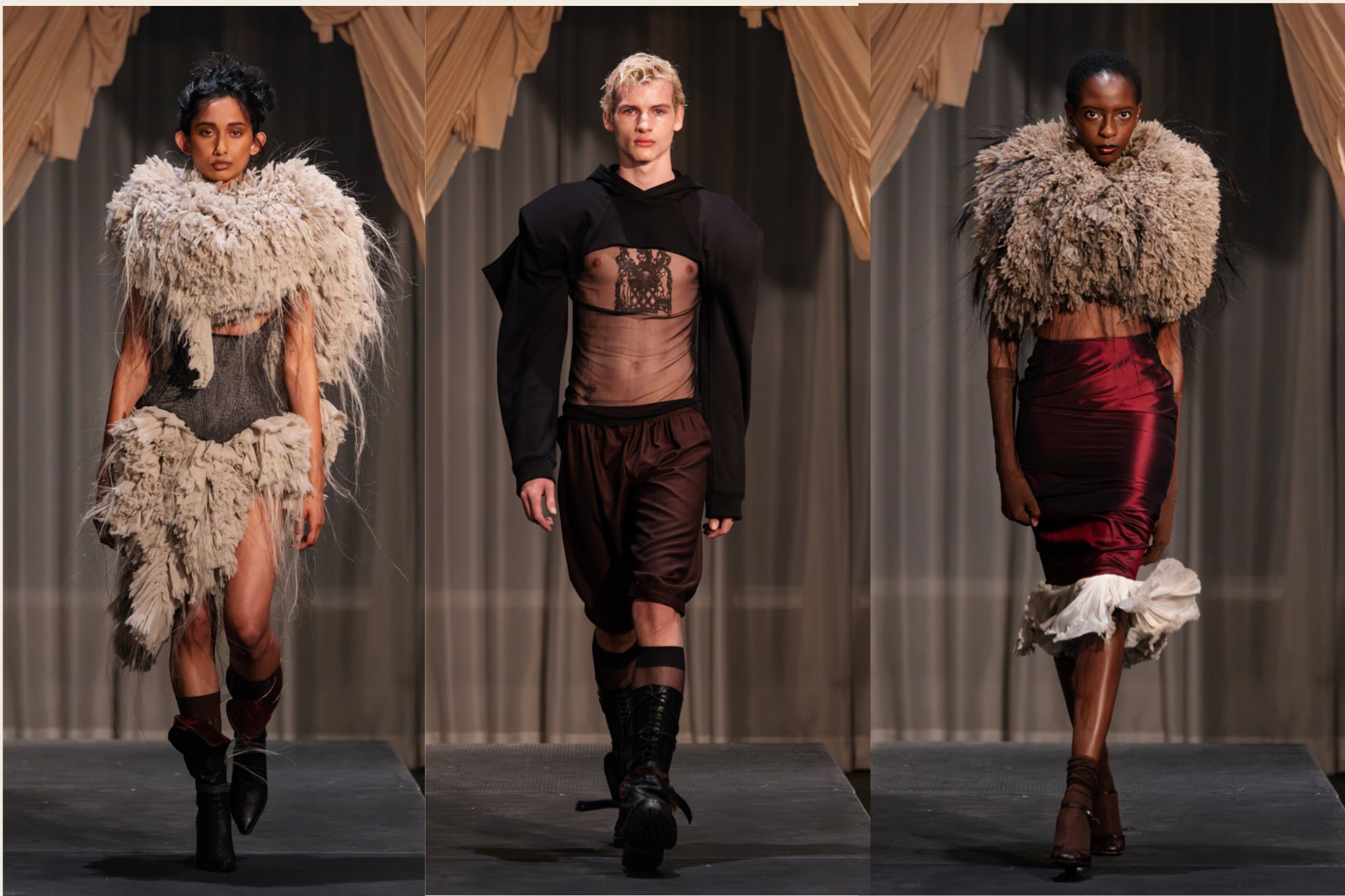
From corsetry and distorted tailoring to the nocturnal characters of his New York runway, Andrew Curwen is building a language around fashion’s capacity to alter the body, create tension and produce an emotional response.

Andrew Curwen belongs to a young generation of New York designers treating clothes as objects of imagination rather than exercises in immediate commercial clarity. Born in Lake Placid, New York, and trained at Parsons, Curwen spent formative years working around several distinct corners of the city’s fashion ecosystem: an internship at Area, time at secondhand institution Beacon’s Closet, three seasons assisting Elena Velez, and later work with Jane Wade. Vogue introduced Curwen to a wider audience in July 2025, following the presentation of his first collection in Bushwick.
Less than a year later, his name appeared on the official New York Fashion Week schedule for Fall/Winter 2026, placing a still-young independent label alongside the established machinery of American fashion.
The speed of that transition is striking. The more interesting story, however, lies in the clothes themselves and in what their growing visibility suggests about the atmosphere surrounding fashion today.
Curwen makes clothing that demands an emotional reaction.
Fashion After Restraint
For much of the past decade, fashion has repeatedly returned to ideas of reduction: discreet branding, disciplined wardrobes, controlled silhouettes and clothes whose cultural value often rests on their apparent ease.
Curwen moves in another direction.
His collections deal in compression and expansion. Waists are tightened; shoulders extend; skirts accumulate volume; fabric trails, tears and moves around the body. Historical techniques appear without becoming costume reproductions. The silhouette is familiar enough to carry associations with Victorian dress, corsetry and couture construction, then altered until those references become unstable.
The result belongs to a broader appetite for fashion capable of producing spectacle again. Curwen’s relevance does not depend on proposing an entirely unprecedented silhouette. It comes from his willingness to treat exaggeration, discomfort, romance and fantasy as legitimate tools for contemporary dress.
That impulse was already clear in his debut.
Your Last Breath Belongs to Me

Curwen presented Your Last Breath Belongs to Me in Bushwick in July 2025. There were eleven looks and relatively little of the infrastructure associated with a conventional industry debut. Vogue described a room populated largely by friends and family, with fellow designers including Jackson Wiederhoeft and Elena Velez among those present.
The intimacy sharpened the effect of the clothes.
Voluminous skirts appeared alongside corsetry, elongated sleeves, sharp tailoring and distressed silk. The body was manipulated through proportion rather than simply dressed. Curwen had already identified corsetry and tailoring as central to his fascination with design, and that combination remains important because both techniques physically change how a person occupies space.
On the designer’s own presentation of the collection, corsetry and tailoring form its structural thread, while historical forms are filtered through fantasy and ideas of self-definition. Individual looks receive character-like names — The Raven, The Rogue, The Hunter, The Nightcrawler, The Harpy, The Courtesan, The Duchess — turning the collection into something closer to a cast than a sequence of products.
This distinction matters.
Curwen is designing characters before he is designing wardrobes.
The clothes ask what happens when dressing becomes a temporary transformation of identity: shoulders change posture, corsets reorganise the torso, a bustle changes the space behind the body. Garments become instruments through which their wearer can appear physically different from the person who entered the room.
Fashion has always understood this ability. Curwen simply makes it impossible to ignore.
The Body as a Site of Transformation
Corsetry currently occupies a particularly visible place in fashion. Its historical associations with control, sexuality and bodily discipline have been repeatedly dismantled and reconstructed by designers from Vivienne Westwood and Jean Paul Gaultier onward. Recent collections have once again placed the corset at the centre of runway imagery, with Harper’s Bazaar noting its use by designers including Dilara Findikoglu, Jackson Wiederhoeft, Zoe Gustavia Anna Whalen and Curwen.
In Curwen’s work, its importance is highly physical.
He told Harper’s Bazaar ahead of his first official NYFW show that putting on either a tailored jacket or a corset can immediately change the way someone sees and carries themselves.
That observation offers a useful way into his work.
Clothes here do not simply communicate identity outwardly. They alter the experience of the person inside them.
A sharply constructed shoulder can change posture. A compressed waist changes proportion. A skirt extending behind the body changes how someone moves through a doorway or approaches another person. Fashion becomes behavioral as much as visual.
The idea gives Curwen’s historical references a contemporary purpose. His fascination with older forms is most convincing when those forms function as tools rather than quotations.
Nocturnal Conditions

The next test came with Nocturnal Conditions, Curwen’s Fall/Winter 2026 collection and his first appearance on the official New York Fashion Week calendar.
The CFDA listed Curwen among the season’s first-time additions, formalising a transition that had taken place remarkably quickly after the Bushwick debut.
The collection pushed his established language further into darkness.
Deep shades approaching black, emphatic shoulders, corsetry and displaced proportions created figures imagined for life after daylight. Curwen described the collection to Harper’s Bazaar through the idea of after-hours subcultures and spoke about his interest in pushing tailoring toward extremes.
Office Magazine’s review of the collection documented wool, silk tulle, taffeta and kid skin across silhouettes in which shoulders sharpen, waists contract and the bustle reappears. The publication connected these transformations to Curwen’s continuing interest in “romantic violence” and nocturnal states of thought.
The darkness works because Curwen does not use it purely as decoration.
Night becomes a condition in which identities shift.
There is the person observed during the day and another person emerging after midnight: in a club, on an empty street, inside a room where social codes have temporarily loosened. Curwen’s exaggerated silhouettes give those alternate selves a physical vocabulary.
This is where Nocturnal Conditions becomes more interesting than a gothic mood board. The collection considers clothing as permission to inhabit another version of the body.
New York and the Desire for Spectacle
Curwen’s arrival also raises a question about New York itself.
The city has an extraordinary fashion history, yet its international identity remains closely connected to sportswear, pragmatism and clothes designed in conversation with everyday urban life. Curwen has openly discussed his desire to challenge that expectation.
Speaking with Harper’s Bazaar before his Fall 2026 show, he argued for greater visibility for young and independent designers on the New York calendar and described a hunger for creative work that can sit outside the city’s commercially oriented reputation.
His appearance was part of a wider group of young designers receiving attention that season. Teen Vogue identified Curwen alongside Meruert Tolegen, Zoe Gustavia Anna Whalen and Advisry’s Keith Herron, presenting them as evidence of renewed creative energy at NYFW.
Curwen brings a particularly theatrical proposition to that conversation.
There are obvious historical ghosts surrounding the work. Alexander McQueen and John Galliano are among the designers he has cited as formative influences, references already documented in Vogue’s account of his debut.
Their relevance should be handled carefully.
A young designer working with corsets, historical silhouettes and theatrical darkness will inevitably encounter comparisons with the designers who transformed those elements into some of late twentieth-century fashion’s defining images. Treating Curwen as a successor to any of them would flatten the more interesting question.
Why does this language feel compelling again?
A Generation Looking Back to Feel Something Again
Young designers encounter the runway archive differently from the generations that experienced those shows firsthand.
McQueen and Galliano’s defining presentations now circulate continuously through digital archives, social media, documentary clips and reference imagery. Fashion students can move between decades in minutes. A show once experienced as an ephemeral event becomes a permanent visual vocabulary.
What survives most strongly from that period is often the emotional memory of fashion: the idea that a collection could disturb, seduce, overwhelm or confuse its audience.
Curwen appears interested in recovering precisely that intensity.
He told Harper’s Bazaar that his inspirations for Nocturnal Conditions included contemporary dance and films capable of creating anticipation, sexual tension and discomfort. His point was revealing: beauty alone was insufficient. He wanted the presentation to generate another sensation.
That desire feels particularly relevant in an image environment where enormous quantities of fashion are consumed instantly.
When every collection can be reduced to a sequence of images seconds after a runway ends, emotional specificity becomes valuable. A garment that is merely attractive competes with thousands of other attractive garments. A silhouette that creates unease, desire or curiosity has a greater chance of remaining in memory.
Curwen seems acutely aware of that distinction.
The Economics of an Impractical Dress

There is another tension inside the project.
Extreme fashion still needs an economic structure.
Independent designers face production costs, minimums, wholesale uncertainty and the pressure to convert attention into revenue. Curwen’s answer, at least at this stage, appears relatively pragmatic despite the theatricality of his work.
After his debut, he told Harper’s Bazaar that custom commissions arrived quickly. He also expressed hesitation about entering wholesale in its current state, acknowledging the difficulty of asking a retailer to take a risk on an unconventional piece.
The comment reveals an important contradiction in emerging fashion.
The images that establish a designer are frequently the garments least suited to conventional retail logic.
A spectacular corset, enormous bustle or exaggerated sleeve can define an entire collection in a photograph. The same piece can become difficult to produce, stock and sell at scale.
For a young designer, solving that equation too quickly can dilute the reason people paid attention in the first place.
Curwen’s work is strongest while that friction remains visible.
Building Before Scaling
When Vogue profiled Curwen after his debut, he spoke about keeping the project relatively small and intentional.
The statement has gained significance as his visibility has increased.
Emerging designers today are frequently expected to behave like established brands almost immediately. A successful show can produce editorial coverage, celebrity requests, social-media attention and international interest before the underlying business has had time to develop.
There is value in resisting that acceleration.
A recognisable fashion language usually develops through repetition, correction and experimentation. Curwen has so far established several clear elements — corsetry, altered tailoring, historical proportions, distressed surfaces, darkness, theatrical character building — while leaving enough instability for those elements to evolve.
That instability may be one of the most compelling things about watching the label now.
The aesthetic is visible. The final shape of the house is still unresolved.
Fashion That Wants to Be Felt
Andrew Curwen is still at the beginning of his career, and two collections are too little material from which to declare a legacy or predict a trajectory.
They are enough to identify an instinct.
Curwen believes in the capacity of clothing to change the body and in the runway’s capacity to produce emotion. He is interested in the moment when beauty becomes slightly uncomfortable, when proportion disturbs familiarity and when a garment makes its wearer occupy more — or differently shaped — space.
That approach places him within a broader reconsideration of what emerging fashion can offer New York.
The strongest young designers do not need to provide an answer to the state of the industry. Their work can reveal what the industry has been missing.
In Curwen’s case, the answer emerging from the darkness is remarkably physical: tension, volume, fantasy, unease, desire.
Fashion capable of being felt before it is fully understood.
Editorial Note
Andrew Curwen’s developing practice offers a useful lens through which to consider the renewed visibility of emotional fashion, contemporary corsetry, theatrical runway design, emerging New York designers and the changing identity of New York Fashion Week. His work belongs to a wider return to silhouette, craft and performance among independent designers seeking room for experimentation within an increasingly compressed fashion economy.
QEditorial Magazine — Fashion · Culture · Identity



Leave a Reply