
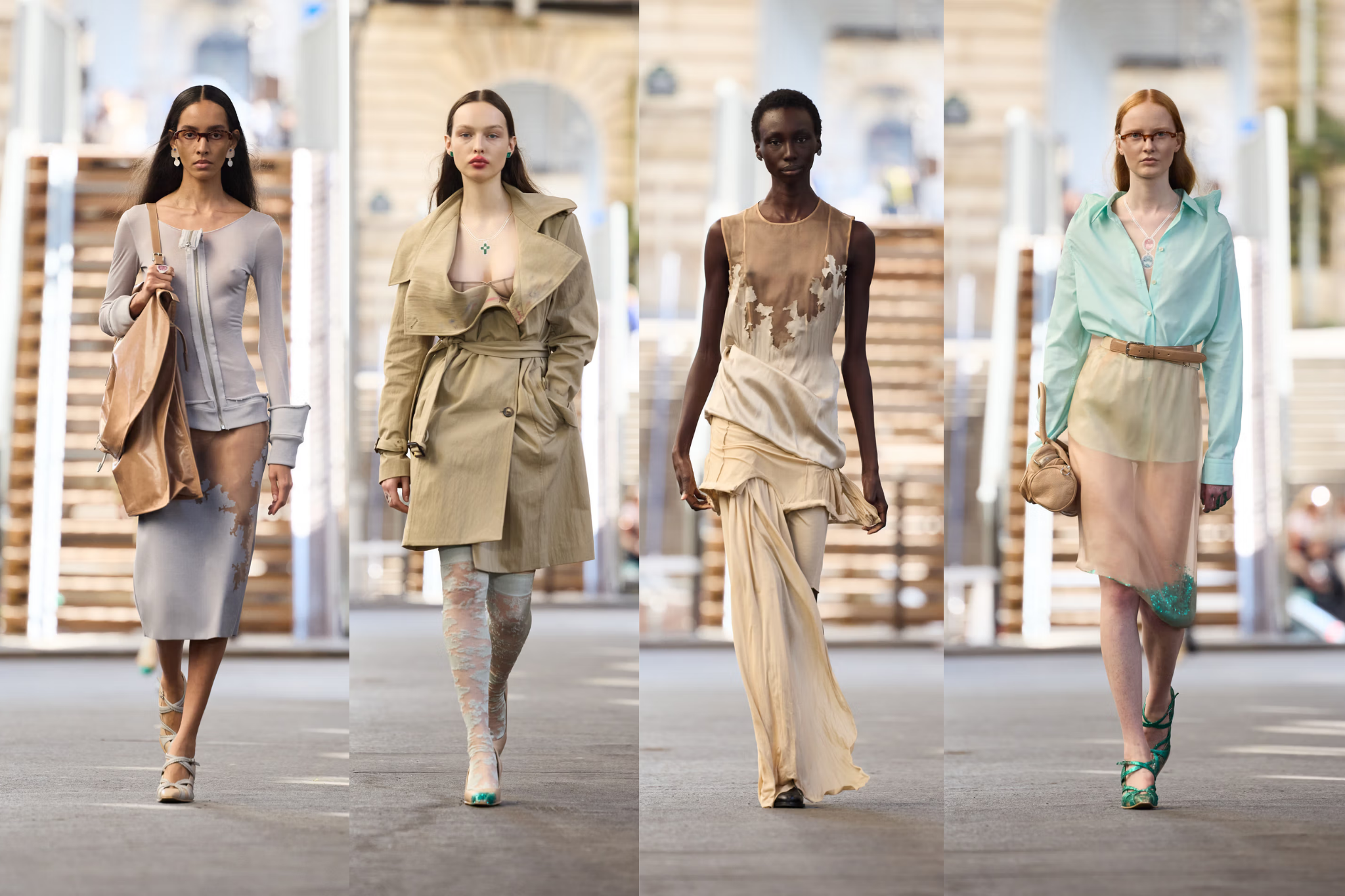

Julie Kegels has built her young label around the shifting identities contained within an everyday wardrobe.
A woman can move from work to intimacy, from public presentation to private disorder, from practicality to desire within a matter of hours. Clothes accompany those transitions and sometimes expose them. For Kegels, this instability has become one of the most productive territories in her work.
The Belgian designer graduated from Antwerp’s Royal Academy of Fine Arts before developing her experience in Paris at Alaïa. She founded her eponymous fashion house in 2024, establishing a womenswear project centred on female archetypes, contrast, elegance and playfulness. The Fédération de la Haute Couture et de la Mode also traces her trajectory from Antwerp to Alaïa and the creation of her own label.
That trajectory has accelerated considerably.
In April 2026, Kegels was announced as one of the nine finalists of the 2026 LVMH Prize for Young Fashion Designers, selected from a semifinal group of 20 designers originally drawn from more than 2,400 applicants. The finalists will present their work to the jury at the Fondation Louis Vuitton in Paris on 4 September 2026.
The nomination places Kegels within an increasingly visible generation of independent European designers, while the clothes themselves reveal a more specific concern: the ways women construct, alter and occasionally lose control of their appearance.
Designing Through Characters

Kegels often begins with women rather than isolated garments.
Her collections have repeatedly drawn from contrasting female identities: the businesswoman, the party girl, the woman performing control and the woman slipping outside it. The official biography of the house describes the rejection of a single female archetype as a recurring principle of the brand.
That approach is also rooted in her years at the Antwerp Academy. Speaking to Vogue, Kegels described the school as a place where she learned to reconstruct her creative identity and developed her interest in contrasts. She later worked with Meryll Rogge before spending a year at Alaïa under Pieter Mulier, experiences that gave her an understanding of the mechanics surrounding the creative process inside a fashion company.
The tension between fragility and control remains visible throughout her work.
Tailored pieces may be interrupted by exposed lingerie. Domestic materials migrate into formal clothing. Familiar silhouettes are altered through proportion, layering or unexpected construction. The clothes often look composed from a distance and more complicated on closer inspection.
This creates a particularly contemporary type of femininity: one in which polish does not imply simplicity.
Quick Change

For Spring/Summer 2026, transformation became the collection itself.
Kegels titled the season Quick Change and presented 32 looks developed with creative consulting by Philemon Hahlweg, styling by Jamie-Maree Shipton, movement direction by Ed Munro and a wider team documented by the house.
The show marked her first runway appearance on the official Paris Fashion Week calendar. The Fédération de la Haute Couture et de la Mode described it at the time as her first official-calendar show.
The concept emerged from the speed at which women move through different situations during a single day.
In an interview with Vogue, Kegels explained that the collection began with three words written in her notes: “change, change and change.” That sense of movement translated into clothes able to shift their own identity. A wedding dress transformed into other silhouettes; layered shirts changed configuration; skirts revealed lingerie underneath.
The show took place beneath a metro bridge in Paris’s 16th arrondissement, an environment that gave the collection an urban directness during a season dominated by major creative-director debuts. Wallpaper* later selected Kegels among its rising fashion names of 2026, focusing particularly on the transformational quality of these garments.
Within the collection, transformation operated as construction rather than decoration.
Pleating changed the behaviour of shirts. Layers accumulated until garments appeared almost collaged together. Domestic references entered the wardrobe, while translucent materials created another form of visual instability.
Wallpaper* subsequently featured Kegels among the standout looks of Spring/Summer 2026, noting her approach to layering garments until they appeared to develop a life of their own.
The underlying subject was the woman wearing them.
Quick Change recognised the physical and psychological adjustments required to move through contemporary life: professional, social, romantic and private identities overlapping without always resolving neatly into one another.
Face Value

For Fall/Winter 2026–27, Kegels moved from transformation toward perception.
Her current collection, Face Value, was developed with Kegels as creative director and head designer, Philemon Hahlweg as design director and Jamie-Maree Shipton on styling. Inge Grognard led make-up, Noemi Orgaer created the scenography and Ed Munro directed movement.
Where Quick Change examined how identity moves, Face Value studies what becomes visible.
The phrase itself describes the act of accepting appearance without investigating what lies beneath it. Kegels uses that idea to examine clothing as a surface through which people are observed, categorised and understood.
Guests arriving at the Paris presentation received a small leather mask attached to an invitation carrying the words Face Value, a detail documented by Numéro.
Masks, shadows and visual distortion continued through the collection.
Kegels has connected this research to the relationship between public and private identity. In her July 2026 interview with Numéro, she explained that the Fall/Winter 2026–27 collection investigates aura, the influence clothing has on how somebody is perceived and the ways garments can reveal or protect identity.
The idea is particularly relevant to a culture in which appearance is increasingly mediated through images.
For Kegels, clothing becomes part of the mechanism through which a person controls what others are permitted to see.
The collection also drew attention from Vogue Runway, which covered the Fall 2026 presentation within the wider Paris season.
The progression from Quick Change to Face Value feels precise.
The first collection asks how many identities can exist within the same woman. The second considers how those identities are interpreted from the outside.
Antwerp, Without Repetition

Kegels inevitably enters a fashion conversation shaped by Antwerp.
The city’s Royal Academy of Fine Arts has produced generations of designers whose work placed research, construction and individual visual language at the centre of fashion education. Yet reducing every Belgian designer to Antwerp’s historical mythology risks obscuring what the current generation is actually doing.
Kegels carries the discipline of that system without reproducing its past aesthetics.
Her references emerge from contemporary female experience, mass imagery, domestic environments, popular culture and clothing itself. Collage, vintage garments and experimentation through draping remain important parts of her design process.
In her recent Numéro interview, she described spending significant periods researching, making collages, draping and cutting vintage clothes before a collection takes final form.
This process gives the work an immediate material quality.
Ideas are developed through garments rather than imposed onto them afterwards.
A Young House Growing Quickly

Kegels’ creative progression has been accompanied by an unusually rapid expansion of the business.
When Vogue profiled her around the Spring/Summer 2026 show, the publication reported that the company was already working with 29 stockists and had recorded 33 per cent growth between seasons, while expanding its presence across international markets. Kegels also spoke about developing direct-to-consumer sales while maintaining careful relationships with wholesale partners. Vogue’s report presented patience as an important element in the company’s approach to growth.
That caution matters.
Independent fashion companies today face a difficult balance between creative visibility and commercial scale. Social media, celebrity dressing and fashion-week exposure can produce recognition long before a company has the infrastructure of a mature house.
Kegels is experiencing that acceleration first-hand.
International performers including Rosalía have already appeared around the brand, and Numéro describes both Rosalía and Dua Lipa among the figures who have worn her designs.
The challenge will be preserving the particularity of her work as distribution and visibility expand.
So far, the collections suggest a designer interested in building continuity through ideas rather than repeating one recognisable product.
Clothes as Character

There is humour throughout Julie Kegels’ fashion, although it rarely becomes spectacle for its own sake.
Her garments can contain tricks, interruptions and visual misdirection. A familiar item acquires an unexpected proportion. Lingerie appears where convention might hide it. Everyday objects and domestic references become components of an elegant wardrobe.
This sensibility gives Kegels an unusual relationship with sophistication.
Her clothes acknowledge that getting dressed is rarely a completely controlled act. A woman can begin a day with one intention and end it inside an entirely different version of herself.
The beauty of the work lies partly in accepting that instability.
The label’s own current collection archive places Face Value at the centre of the house in 2026, following 50/50, A Pool Will Do., Dresscode and Quick Change. Read together, the titles reveal a designer repeatedly returning to roles, appearances, environments and the social codes embedded in clothing.
Her collections rarely offer a definitive woman.
They offer situations in which a woman can become several things at once.
What Comes Next

The next significant date arrives on 4 September 2026, when Kegels joins the other eight finalists at the Fondation Louis Vuitton for the final of the 13th LVMH Prize for Young Fashion Designers. The winner of the main prize will receive €400,000 and a year of tailored mentorship from LVMH teams; the Karl Lagerfeld Prize and Savoir-Faire Prize each carry €200,000 alongside mentorship.
Winning would inevitably accelerate the trajectory.
The more interesting question may concern what Kegels chooses to preserve as the company becomes larger.
In her conversation with Numéro, the designer said she wants to develop the label thoughtfully while remaining connected to craft, curiosity and emotion.
Those priorities are already visible in the clothes.
Across Quick Change and Face Value, Julie Kegels has established a language built around movement, perception, character and the instability of appearances. Her women are polished without being static, sensual without becoming predictable and composed without pretending that control is permanent.
For a house founded only in 2024, that is already a remarkably clear position.
The next stage will reveal how far that vocabulary can travel.
Editorial Note
Julie Kegels is a Belgian fashion designer and founder of the Antwerp-based womenswear label bearing her name. A graduate of the Royal Academy of Fine Arts Antwerp with professional experience at Alaïa, she founded her fashion house in 2024 and has since presented collections including 50/50, A Pool Will Do., Dresscode, Quick Change and Face Value. In 2026 she was selected as one of nine finalists for the LVMH Prize for Young Fashion Designers, placing her among the most closely watched figures of Europe’s emerging fashion generation.
Thank you for reading. Join Q Letter to stay connected with QEditorial’s latest stories and become part of a growing community supporting independent fashion and cultural journalism.
QEditorial Magazine — Fashion · Culture · Identity

Image & Editorial Use Notice
Images accompanying this article are used solely for editorial, cultural, commentary, review, reporting or educational purposes. All rights remain with their respective copyright owners, designers, photographers, agencies and brands. QEditorial Magazine claims no commercial ownership of third-party imagery. Rights holders may contact contact@qeditorial.com regarding corrections, credits or removal requests.



Leave a Reply