
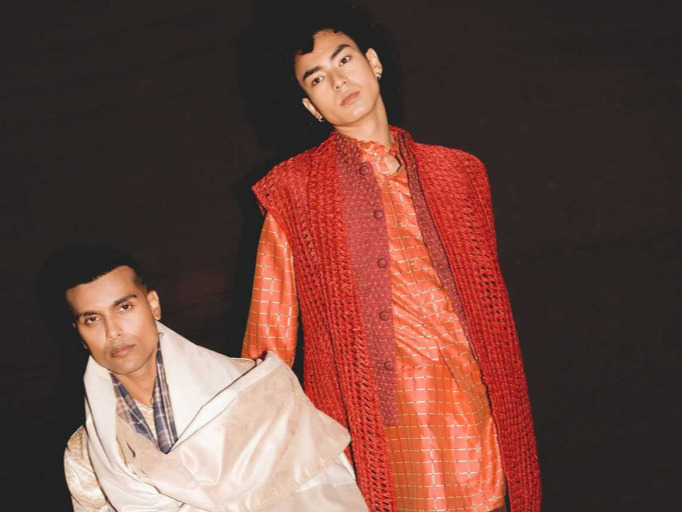
How colonial history, gender and contemporary fashion shaped the everyday wardrobe of Indian men. Written by Aditi Dhapola.

Stand on an urban street in India for a few minutes and the range in women’s clothing becomes difficult to miss. Someone walks past in jeans and a top. A few steps later, someone is in a kurta set or a saree. And then, more often than either, someone in between — a short kurti over jeans, a kurti with a denim skirt, ethnic jewellery worn over a plain top. Western, traditional and hybrid forms exist alongside one another, and sometimes within the wardrobe of the same woman.
The men’s wardrobe, by comparison, is considerably narrower. Depending on age and setting, the everyday rotation tends to be shirts and trousers, T-shirts and jeans, cargos, jackets, sneakers and caps. The variations are there, but most remain within the same broad vocabulary of Western casualwear.
So why has Indian menswear not developed a widely worn contemporary vocabulary for everyday dressing from its own sartorial traditions? Between global Western casualwear and explicitly traditional or occasion-specific clothing, relatively little has become part of the mainstream urban wardrobe.
Indian menswear has its own range of garments — kurtas, bandhgalas, Pathani suits, dhotis and regional forms — along with an enormous range of textiles, embroidery and craft techniques. Yet many of these forms are now associated with weddings, festivals, particular regions, or religious and spiritual settings. A T-shirt and jeans, by contrast, can move between most everyday settings without carrying the same cultural association. Why, then, did these Indian forms become so strongly marked as traditional or occasionwear?
This becomes clearer when you look at contemporary Indian menswear. Kunal Rawal, whose work is centred on menswear, has spent years reworking forms such as the bandhgala and sherwani through changes in proportion, layering, surface and embellishment. The clothes don’t treat Indian menswear as something fixed in the past; they alter its proportions and construction and introduce techniques such as French knots and metallic work into contemporary designs. Yet much of this experimentation remains tied to weddings, festive dressing and other occasions. The designer can push the boundaries of what Indian menswear looks like without necessarily changing what an Indian man wears on an ordinary day.

The same question looks different when you move from designer menswear to streetwear. Urban Monkey, for instance, works largely with the clothes that have become familiar within contemporary streetwear: oversized T-shirts, hoodies, cargos, caps and other pieces shaped by global skate and hip-hop culture. There are Indian references within this space, but they can enter at different points — through graphics, slogans, textiles, embroidery, colour, construction or the silhouette itself. What matters is that these references do not necessarily change the basic category of the garment. The T-shirt remains a T-shirt; the cargo remains a cargo.
What emerges from looking at both parts of contemporary menswear is a difference in where experimentation sits. Indian references and new interpretations of Indian garments are much more established in luxury and occasionwear, while everyday streetwear remains more closely tied to the global casualwear vocabulary of T-shirts, hoodies, jeans, cargos and sneakers. There are exceptions, and the boundaries are changing, but experimentation at the designer level has not yet translated into a widely recognisable everyday vocabulary for Indian men.
Western clothing had already acquired a particular social meaning in India by the time it became ordinary everyday dress. British rule reshaped education, law, bureaucracy and professional life, creating institutions in which Western forms of dress became associated with the educated and professional sphere. This was part of the broader process M. N. Srinivas described as Westernization, which extended far beyond clothing to changes in Indian social life and culture. For Indian men entering offices, courts, universities and other institutions shaped by British rule, Western clothing belonged to the same public world they were entering. Dress became one of the ways in which that new social position could be made visible.
However, the transition was not uniform. Around the independence period, Indian men also combined the two sartorial systems: tailored shirts with dhotis, kurta-pajamas with coats, turbans with Western tailoring. These combinations allowed Indian and European forms to exist within the same outfit, particularly at a time when professional and personal identities were not always expressed through the same clothes. Hybrid dressing was therefore not unfamiliar to Indian menswear. But why did it not become a stronger foundation for everyday urban dressing as Western clothing became increasingly ordinary?

Indian men were not under the same everyday expectation to make their relationship with tradition visible through clothing. A man could be deeply rooted in Indian culture without his daily clothes having to communicate that rootedness. Women’s clothing has historically carried more visible expectations around continuity, respectability and appropriate dress for different settings. You can see a small version of this in government schools, where girls often move from skirts to salwar-kameez or suits after middle school, while boys continue in trousers and shirts. The uniform is only one example, but it reflects a broader difference in what men’s and women’s clothing has been expected to communicate. Men could enter modern public life without their everyday clothes having to carry the same visible negotiation between tradition and modernity.
Over time, Western clothing also lost much of the social meaning it had carried when it was first adopted. A man wearing a T-shirt and jeans today is not necessarily signalling education, professional status or distance from tradition; the clothes have simply become ordinary. They form the unmarked part of the everyday wardrobe, while Indian garments continue to carry more visible associations with tradition, region or occasion. Once that distinction becomes established, there is less cultural pressure for everyday menswear to develop a separate Indian category. Western casualwear is already understood as everyday clothing, while Indian forms continue to arrive with more context attached to them.
The contemporary menswear landscape is not static. Designers and streetwear labels are experimenting with new proportions, hybrid garments, gender-neutral forms, textiles and surface treatments, and some of these ideas are reaching consumers outside the luxury market. The difficulty is their scale of adoption. An experimental garment can exist, find an audience and even become influential without becoming part of the everyday wardrobe of a large number of men. Much of the more distinctly Indian experimentation in menswear still occupies this position: visible within particular brands, communities and occasions, but less visible in the ordinary urban streetwear that forms the centre of men’s daily dressing.
The difference visible on the street is therefore less about the disappearance of Indian menswear than the separation of Indian and everyday menswear. Indian garments continue to carry cultural, regional and ceremonial associations, while the clothes that dominate ordinary urban dressing carry far less cultural information. A man can wear a T-shirt and jeans without making a statement about his relationship to Indian tradition; the same is less true of many garments that are recognisably Indian. That distinction has allowed Western casualwear to become the ordinary language of men’s everyday dress while Indian forms remain more strongly associated with occasions where clothing is expected to express something about culture, identity or belonging.
Indian menswear did not lose its traditional forms. What changed was where those forms belonged within the wardrobe. Western casualwear became the everyday default, while Indian silhouettes remained concentrated in occasion dressing. The challenge for contemporary Indian menswear is to take the experimentation already happening in designer collections and translate it into silhouettes, proportions and garments that can exist comfortably in everyday dress.




Leave a Reply