
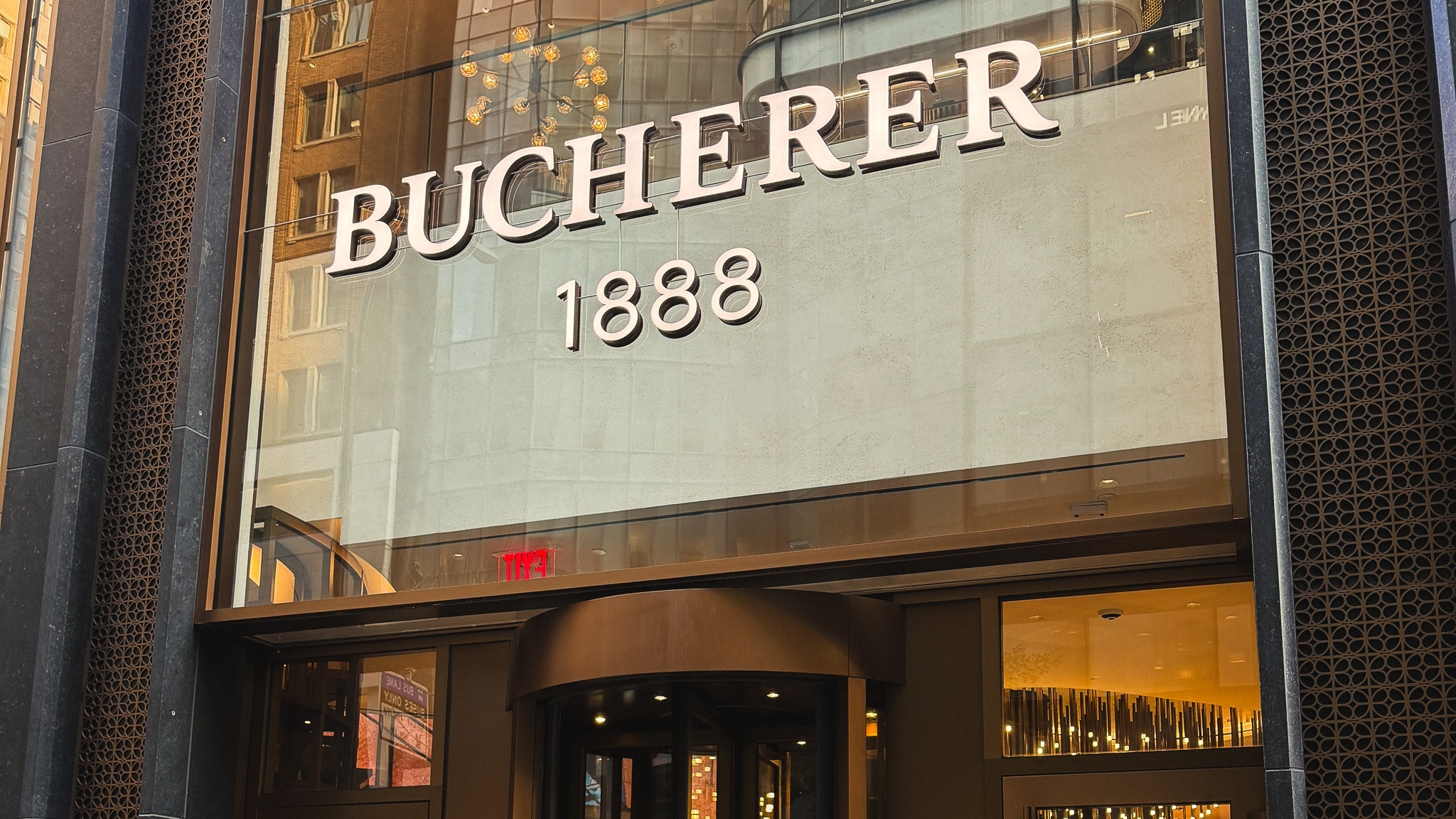

Inside the Manhattan flagship of Bucherer, collectible watches shared their setting with artworks composed from books, magazines, sporting memorabilia and fragments of popular culture. Presented in collaboration with Art Angels, Time Capsules brought together the distinct practices of Paul Rousso and Cedric Sequerra, known as SQRA, through a shared interest in objects, memory and the passage of time.
Jiatai and I attended the event as guests and had the opportunity to meet Sequerra personally. The encounter offered a closer understanding of the artist behind the carefully arranged visual archives: a collector who recognizes how an ordinary object can acquire emotional, historical and cultural meaning through the person who chooses to preserve it.
Art Beyond the Traditional Gallery

Contemporary art is increasingly encountered beyond museums, fairs and conventional galleries. It now appears within hotels, restaurants, fashion boutiques and spaces devoted to luxury, reaching audiences through environments already shaped by architecture, design and material culture.
The expansion of art into these settings changes the context in which a work is experienced. Inside Bucherer TimeMachine, the relationship between contemporary art and fine watchmaking developed through the subjects of time and collecting. A mechanical watch records the progression of seconds through engineering and precision. An artwork can interrupt that progression, holding the viewer’s attention until the external rhythm of the room appears to slow.
The connection becomes especially clear in a space dedicated to exceptional timepieces. Collectors study the movement, provenance, materials and history of a watch, often looking beyond its practical function. The same concentration emerges before an artwork whose details gradually reveal themselves through prolonged observation.
An exhibition such as Time Capsules therefore feels at home within Bucherer. The watches measure time, while the works preserve its cultural and emotional traces.
Cedric Sequerra and the Objects That Remember for Us

The emotional center of the exhibition belonged to Cedric Sequerra, whose photographic works transform private collections into large-scale cultural portraits. Sequerra travels to photograph collections and arranges their contents into compositions he describes as “pop culture time capsules.” Books, vintage toys, music, cinema, fashion and sporting memorabilia become the material through which individual lives and collective histories can be read.
The press kit describes Sequerra as a collector himself, an important detail when considering the intimacy of his images. He approaches each collection with an understanding of the years required to build it: the search for elusive objects, the personal associations attached to them and the desire to preserve what might otherwise disappear into storage. His works allow those private archives to be seen as complete visual narratives.
In Sports Capsule II (Black), books associated with athletes, competition and sporting history are arranged across dark shelves, forming a dense portrait of fandom and achievement. Basketball Capsule I gathers publications connected to basketball culture, while Music Capsule V (White) and Music Capsule VI (Black) construct broad musical landscapes through biographies, album histories and familiar performers.
Golf Capsule narrows the format into a carefully selected account of the sport, while Fashion Capsule III (White) presents books and images connected to designers, models, photographers and fashion history. The press kit’s final page also includes Tennis Dreams, created in 2026, in which the instantly recognizable surface of a tennis ball becomes a graphic object of memory and desire.
Each composition initially appears ordered and controlled. Closer viewing reveals an abundance of individual stories. A recognizable title can recall a specific period, person or place. A book once owned by a collector becomes part of a wider cultural map. The images operate as archives, yet they remain deeply personal.
Meeting Sequerra allowed us to see how naturally his work grows from curiosity and close observation. His interest lies in the objects themselves and in the individuals who assign value to them. The resulting photographs preserve the character of each collection while introducing it to viewers who bring their own memories and references.
The past remains active within these works. It survives through the books we retain, the music we return to and the objects we continue to associate with important stages of our lives.
Paul Rousso and the Physical Life of Printed Matter

Alongside Sequerra’s photographic compositions, Paul Rousso presented a sculptural approach to printed culture. Through digital printing, heat-formed acrylic and detailed fabrication, Rousso enlarges newspapers, magazines, currency and other forms of printed ephemera until they acquire the physical presence of sculpture.
In New York Times Showtime, dated 2025, familiar pages appear folded, curved and suspended in space. Material that would usually be read and discarded is given scale and permanence. The transformation encourages viewers to reconsider the cultural information carried by printed objects and the speed at which such information is consumed and replaced.
Rousso and Sequerra work through different formal languages, yet their practices meet in their attention to familiar material. Rousso alters the scale and physical structure of printed media. Sequerra gathers related objects into complete photographic environments. Both artists give lasting visibility to things that belong to everyday life and are often overlooked because of their familiarity.
Collecting as a Form of Cultural Memory

Collecting connects the exhibition’s artistic and horological worlds. A collection begins with individual choices and gradually becomes a record of attention. Each acquisition marks an interest, a discovery or a personal association. Over time, the objects form a portrait of the collector.
This principle applies to books, sporting memorabilia, artworks and watches. A significant timepiece may be valued for its movement, rarity and craftsmanship, while also carrying the history of an inheritance, an achievement or a particular moment. Its emotional importance develops alongside its material value.
Bucherer’s history in watchmaking and fine jewellery gives the exhibition an especially relevant setting. Founded in Lucerne in 1888, the company has developed an international presence centred on luxury timepieces, jewellery and collecting. Its New York flagship extends this identity through cultural programming that considers what objects can represent beyond ownership.
Within Time Capsules, collecting appears as a way of giving structure to memory. Sequerra’s photographs show how personal archives can become cultural documents. Rousso’s sculptures preserve the appearance of printed media by transforming it into something designed to endure. The watches surrounding the exhibition contribute another language of preservation, one based on mechanical knowledge, craftsmanship and continuity.
Luxury Spaces as Cultural Destinations
The presence of contemporary art within a luxury environment reflects a broader development in how culture is presented. Art no longer depends entirely on the neutral white walls of the gallery. Its meaning can be expanded by spaces with their own histories, materials and communities.
Luxury boutiques are increasingly becoming cultural destinations where exhibitions, books, design and live conversations accompany the objects traditionally displayed there. The strongest examples treat art as a serious part of the environment, giving works enough space and context to maintain their independence.
At Bucherer TimeMachine, the relationship felt especially coherent. Fine watches and contemporary artworks both require time from the viewer. They reward close attention and reveal their construction gradually. Neither experience can be fully understood through a passing glance.
Art also changes the rhythm of the commercial space. It introduces moments of uncertainty, reflection and recognition. A visitor may arrive to discover a watch and encounter an artwork that brings back a book, an album or a cultural reference from another period. That unexpected connection is one of the exhibition’s most effective qualities.
The Moment Time Appears to Stop
The title Time Capsules describes the archival nature of the works, while also capturing the experience of viewing them. Each composition holds together objects from different moments and allows them to exist simultaneously in the present.
A watch continues to move while its owner examines it. An artwork seems to suspend movement by concentrating attention. Inside Bucherer, these two experiences occupied the same room. One made the passage of time visible; the other temporarily made it disappear.
The exhibition showed how contemporary art can develop meaningful relationships with luxury, design and collecting when the setting supports the ideas within the work. It also demonstrated how an encounter outside the conventional gallery can introduce art to a wider public without weakening its cultural significance.
For Jiatai and me, attending Time Capsules and meeting Cedric Sequerra offered a personal view of this evolving landscape. The evening connected artists, collectors and guests through objects that hold stories far beyond their physical dimensions.
Our sincere thanks go to Bucherer for hosting us and for opening its New York flagship to a thoughtful conversation between art, time and collecting; to Cedric Sequerra and Paul Rousso for presenting their work; to Art Angels for its role in bringing the exhibition together; and to KCD, including Kate Jacobsen and Dhalyn Vene Warren, for the invitation, organization and warm welcome. The press kit identifies KCD as the agency representing the event.




Leave a Reply