
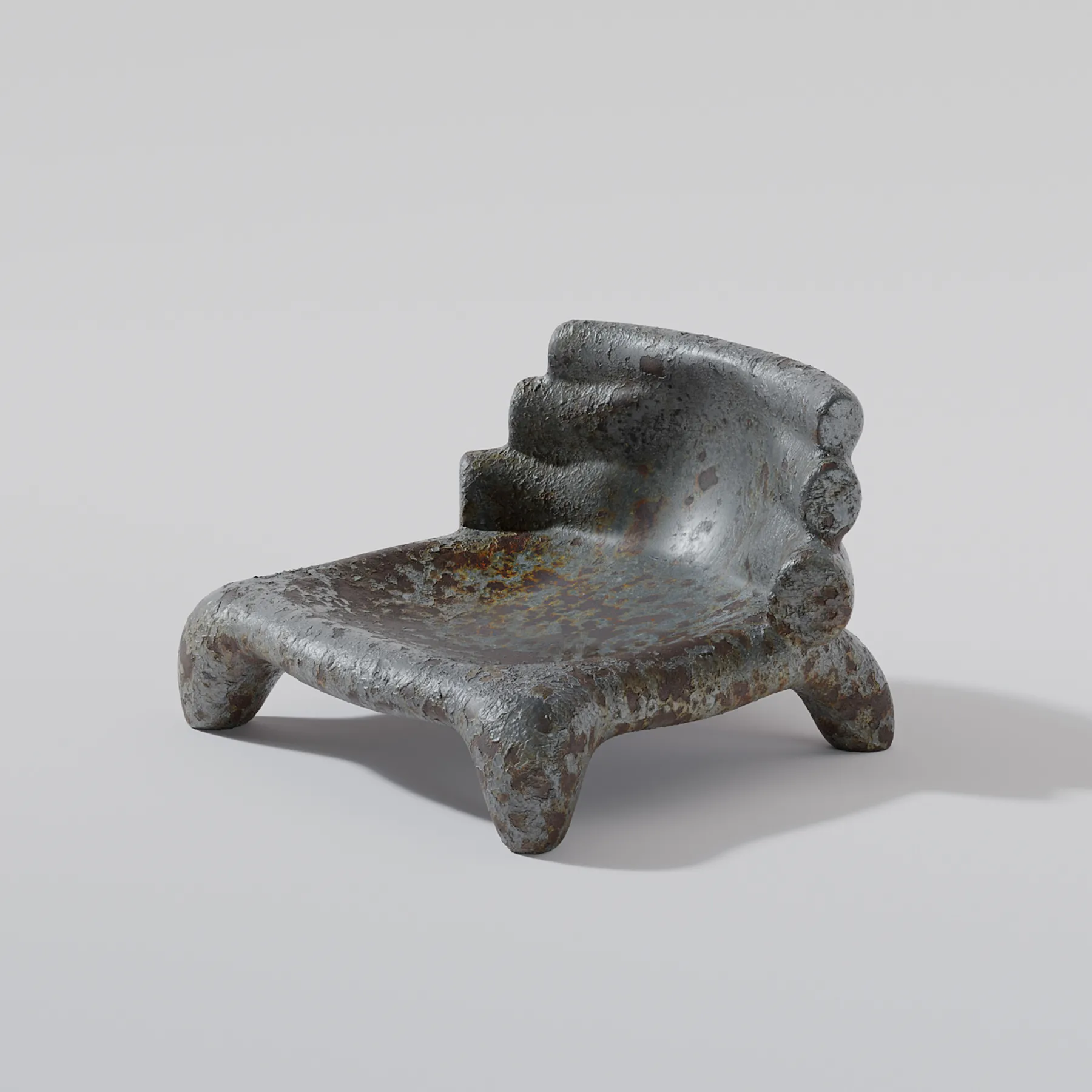
Through monumental ceramic furniture, ancestral forms and handmade imperfections, Ukrainian artist Serhii Makhno imagines a domestic landscape suspended between archaeology and the future.

At first glance, the objects of the ZEMLYA collection do not appear to have been designed. They seem to have been excavated.
Chairs emerge like dark mineral formations. Tables resemble stones shaped by centuries of erosion. Mirrors feel less like decorative surfaces than portals cut into an unknown wall. Even the collection’s more recognizably functional pieces carry the weight and silence of archaeological fragments.
Created by Ukrainian artist, architect and ceramicist Serhii Makhno, ZEMLYA occupies an ambiguous territory between furniture, sculpture and imagined history. Its objects belong to the contemporary interior, yet they appear to remember a world that existed long before it.
This tension gives the collection its central identity: a vision of the future constructed through the material language of the earth.
Furniture That Appears to Have Grown
The Ukrainian word zemlya can be translated as “earth” or “land.” The name is not simply poetic. It describes both the physical material from which the collection is formed and the broader philosophy behind it.
Clay is treated not as a neutral substance waiting to be perfected, but as an active presence. Its irregularities remain visible. Surfaces are rough, marked and often deliberately uneven. Rather than disguising the traces of human hands and kiln firing, the collection makes them part of each object’s identity.
The result is a family of forms that appears to have grown organically rather than emerged from an industrial production line.
The rounded ceramic body of the KOLO armchair, for example, surrounds its upholstered interior like a protective shell. Its circular profile suggests both a primitive enclosure and an object from an imagined future. The PYL chair is similarly difficult to classify: part seat, part creature and part geological formation.
These are usable objects, but their function never completely explains them.
Between Sculpture and Domestic Life

Collectible design often exists in the space between art and utility. ZEMLYA pushes that ambiguity further by creating furniture whose physical presence can dominate the architecture around it.
A conventional chair is expected to adapt to a room. A ZEMLYA chair seems capable of reorganizing the room around itself.
The collection includes ceramic seating, tables, lighting, mirrors, shelving and bathroom elements. Among them, the monumental VALUN table resembles a boulder placed inside a domestic landscape, while the sculptural MUL bench transforms an ordinary furniture typology into something archaic and almost ceremonial.
Even the BIBLIOTEKA shelving system challenges the visual lightness commonly associated with contemporary storage. Its combination of wood and ceramic gives it the mass and authority of a permanent architectural structure.
ZEMLYA does not treat furniture as a collection of objects added after architecture is complete. Instead, it imagines furniture as something formed from the same earth on which architecture stands.
The Meaning of Imperfection

For decades, luxury interiors were frequently associated with precision: flawless surfaces, invisible construction and materials controlled until every irregularity disappeared.
ZEMLYA proposes another definition.
Here, luxury is found in weight, texture, rarity and the evidence of labour. The handmade surface becomes more valuable precisely because it cannot be repeated with complete accuracy. Each variation records the behaviour of clay, fire and the artisan responsible for shaping it.
This approach reflects the wider multidisciplinary practice of MAKHNO Studio, founded in Kyiv in 2003. The studio combines architecture, interior design, ceramic production, functional art and lighting within a single creative environment. Its ceramic workshop is not separate from its architectural work; both are part of the same investigation into material, space and cultural memory.
The importance of craft within ZEMLYA is therefore not decorative. It is structural. The hand of the maker determines the character of the object.
An Archaic Future

The collection is often described through the idea of the “futuro-archaic”: a visual language in which ancient techniques and futuristic imagination are allowed to coexist.
This is perhaps ZEMLYA’s most compelling contradiction.
Its forms recall prehistoric vessels, ritual objects and weathered fragments, yet they also resemble props from an unfamiliar science-fiction world. They seem simultaneously ancient and not yet invented.
The collection does not reconstruct a particular historical period. Instead, it works with the emotional power of archaeology: the fascination produced by an object whose complete meaning cannot immediately be understood.
A ZEMLYA chair may suggest a throne, a shelter, an animal or a fragment of architecture. The interpretation remains deliberately open.
That uncertainty allows the pieces to retain a sense of mystery even when placed inside highly contemporary environments.
From Kyiv to New York

After approximately two years of development, ZEMLYA was presented in New York at Les Ateliers Courbet, the gallery known for representing artists and master craftspeople working across furniture, lighting and decorative arts.
The presentation brought the collection’s heavy ceramic forms into dialogue with the international collectible-design market. Yet the works remained closely connected to Makhno’s Ukrainian background and to a practice shaped by local craft traditions, nature and the cultural meaning of the land.
This connection carries particular resonance. Earth is never merely a raw material. It is also territory, memory, origin and belonging.
In ZEMLYA, those ideas are not illustrated through symbols or literal narratives. They are communicated physically, through the mass of the objects and the material from which they are made.
Objects With Their Own Gravity

The most memorable interiors are not necessarily the most perfectly coordinated. They are often the spaces containing one object powerful enough to change how everything around it is perceived.
ZEMLYA is built around that kind of object.
Its furniture does not disappear politely into a decorative scheme. It establishes its own atmosphere. It asks the viewer to notice weight, shadow, surface and scale. A single chair can make a room feel more ancient, more intimate or more mysterious.
In this sense, the collection offers an alternative to the increasingly rapid circulation of interior trends. These pieces are not designed to represent a season. Their visual language resists easy dating because it moves backward and forward at the same time.
They appear to carry traces of an unknown past while anticipating a future in which the distinction between furniture, sculpture and architecture becomes less important.
ZEMLYA begins with clay, one of humanity’s oldest creative materials, but it does not use tradition as a form of nostalgia. Instead, Serhii Makhno transforms the earth into a speculative language—one capable of imagining what domestic life might look like after perfection, uniformity and mass production have lost their authority.
The collection’s objects may be chairs, tables, mirrors and lamps. But they behave like fragments of another civilization: heavy with memory, marked by fire and waiting to be interpreted.
Editorial Note:
This article explores the ZEMLYA Collection by MAKHNO Studio as a meeting point between collectible design, ceramic craftsmanship, architecture and cultural memory. Through its sculptural forms and materially expressive surfaces, the collection offers a distinctive vision of contemporary interiors—one in which furniture is not simply placed within a space, but becomes part of its emotional and architectural identity.
QEditorial Magazine
Fashion · Culture · Identity





Leave a Reply