
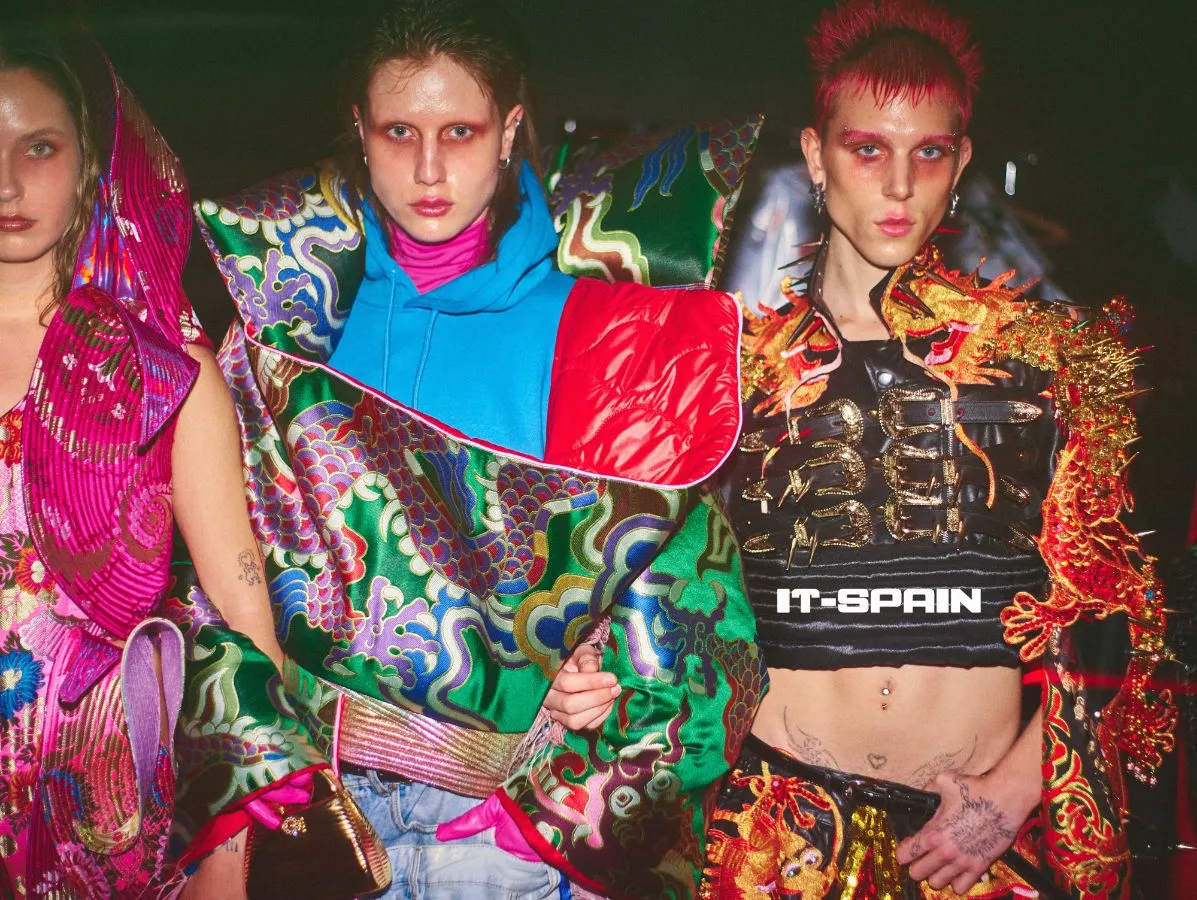
Through sculptural silhouettes, saturated colour and the physical language of performance, José Luis Díaz Megías turns clothing into a space for personal expression.
By Nicolò Di Stefano

A sweep of blue and white feathers rises above the head. Beneath it, a gold-toned dress falls almost uninterrupted to the floor, its surface animated by colourful motifs. The silhouette has the presence of a character arriving onstage: immediately legible from a distance, increasingly intricate as the eye moves closer.
In IT-SPAIN’s El Dorado, scale becomes a way of directing attention. Shoulders expand, collars surround the face, and fabric extends beyond the familiar outline of the body. Each look establishes its own proportions and asks the wearer to inhabit them.
The photographs offer an introduction to a designer whose understanding of clothing began with performance. José Luis Díaz Megías, the creative force behind IT-SPAIN, approaches the dressed body as a source of movement, emotion and visual possibility.
IT-SPAIN, El Dorado. A sweeping feathered headpiece frames a richly patterned dress. Photography: Dominik Valvo.
Learning from the Body

Born in Madrid, Díaz Megías studied image and sound while pursuing training in Spanish dance. Working with dance companies brought him into contact with the construction of stage costumes. Observing tailoring backstage helped him understand how clothing participates in a performance.
In a 2022 interview with Neo2, he described himself as a self-taught designer, developing his methods through repeated experimentation. He also traced IT-SPAIN’s beginnings to his first workshop in Madrid’s Malasaña neighbourhood, approximately twelve years before the interview. His practice developed through making, adapting and finding solutions with his hands.
That background offers a useful way to read El Dorado. A raised collar changes how a head is framed. A broad shoulder gives a standing figure greater authority. An asymmetric volume makes a simple gesture appear more dramatic. In these photographs, clothing helps establish the character before the wearer moves.
IT-SPAIN, El Dorado. Curved pink panels reshape the torso, while contrasting textures extend the silhouette. Photography: Dominik Valvo.
Building a Different Silhouette

One pink ensemble makes that relationship particularly clear. Curving panels surround the chest and hips, opening outward like petals. Their repeated ridges give the surface a sense of rhythm, while shaggy elements at the arms and legs introduce a looser, more irregular texture.
The body remains visible between these constructions. Those openings matter: they allow the eye to understand the distance between the wearer and the garment’s expanded outline.
Elsewhere, a patterned green coat rises around the shoulders and reveals a bright blue hood beneath. Pale, heavily distressed trousers interrupt the density of the upper half. The familiar vocabulary of a coat, hoodie and denim survives, but the proportions change how those pieces relate to one another.
This is where IT-SPAIN’s theatricality becomes interesting. The effect depends on the arrangement of shapes as much as on ornament. A collar, sleeve or hem can become the main event.
IT-SPAIN, El Dorado. An elevated collar and elongated patterned coat meet the familiar forms of a hood and distressed trousers. Photography: Dominik Valvo.
Experience as a Creative Vocabulary

Díaz Megías has described an interest in imagined environments where people from different cultures coexist, alongside a fascination with architecture and clothing research. In an interview published by VOL•UP•2, he also discussed working with unique pieces, artisanal processes and the reuse of vintage garments and earlier designs. These are accounts of his working approach, rather than a comprehensive environmental assessment of the brand.
In El Dorado, dragon imagery, ornate surfaces and enveloping forms appear alongside exposed skin, boots and recognisable everyday garments. Their combination invites a closer reading of how references are transformed through proportion and styling.
Neo2 documented the collection in October 2023 as a presentation of 56 looks at Sala Art in Madrid’s Príncipe Pío. Its coverage described a narrative of discovery and individual freedom, bringing together traditional clothing references from different cultural contexts.
The photographs give that narrative a physical form. A gold-toned, dragon-patterned garment opens into an enormous curved volume beside a bare torso. The contrast between the exposed body and the surrounding fabric makes the construction feel particularly imposing. Its shape occupies the space around the wearer, becoming part of the setting.
IT-SPAIN, El Dorado. Dragon motifs travel across an expansive asymmetric silhouette. Photography: Dominik Valvo.
The Freedom to Be Seen

A different look places a large, vividly coloured face across the torso. Wide eyes, teeth and curling forms turn the front of the garment into an image with its own expression. The wearer’s hands rest against it, creating an exchange between the human figure and the graphic figure.
The effect is playful and slightly confrontational. Clothing often supplies clues about its wearer; here, it introduces another character altogether.
Across the selected images, ornament allows the body to assume different kinds of presence. It can appear ceremonial, protective, exuberant or strange. The wearer becomes a participant in the image, giving scale and attitude to forms that would read differently on a hanger.
IT-SPAIN, El Dorado. An oversized face motif turns the garment’s surface into a character of its own. Photography: Dominik Valvo.
A World Held in Fabric

The most enveloping look brings together patterned panels, quilted surfaces, reflective colour and a broad structure around the neck. Almost the entire body disappears within the garment. The face becomes the point of connection.
Seen alongside the other photographs, it reveals the range of Díaz Megías’s visual language. Some constructions expose the body; others surround it. Some extend vertically, while others spread outward. Their shared quality is an insistence on presence.
IT-SPAIN’s appeal lies in this ability to give personal imagination a tangible shape. The connection to performance remains visible in the way each garment prepares a figure to be looked at.
In El Dorado, a person standing against a plain wall can already suggest a story. The clothing supplies its first scene.
IT-SPAIN, El Dorado. Layered surfaces and an enveloping construction draw attention toward the wearer’s face. Photography: Dominik Valvo.
Discover more at IT-SPAIN’s official website.
QEditorial — Fashion · Culture · Identity

Photography by Dominik Valvo. Images sourced from IT-SPAIN’s official website and included for editorial and informational purposes. All image rights remain with their respective copyright holders.



Leave a Reply