
How a Portuguese fashion project built around the Jeffrey Epstein quarter zip tests the boundary between digital memory, provocation and responsibility
By QEditorial Magazine

A navy quarter zip should be almost anonymous. It belongs to the ordinary vocabulary of menswear: practical, restrained and familiar enough to pass without comment. Yet the internet has a way of removing ordinary objects from their original lives. Once an image is repeated often enough, clothing can become evidence, shorthand or meme. A garment stops being only a garment and begins to carry the person the public remembers wearing it.
einzip was created inside that transformation. Established in Portugal in February 2026 by two brothers who have chosen to remain anonymous, the online project began with the quarter zip associated with Jeffrey Epstein’s public image. It does not conceal that origin. Its name itself encodes it: “ein” combines selected letters from Epstein’s surname, while “zip” refers to the silhouette around which the store was built.
This directness gives einzip its visibility, but it also creates the central problem the brand cannot escape. Epstein was a convicted sex offender, and his name is inseparable from sexual abuse, exploitation and the experiences of victims. In July 2019, federal prosecutors in New York charged him with sex trafficking of minors and conspiracy to commit sex trafficking of minors, alleging the exploitation and abuse of dozens of underage girls. Those federal charges were formally dismissed following his death and were therefore never adjudicated at trial. Any fashion project that deliberately enters this territory assumes an ethical burden greater than the usual language of provocation.
When Recognition Becomes the Product
The founders describe einzip through a sentence that is both concise and revealing:
“We wear the internet’s memory.”
Their proposition is that clothing acquires meaning through circulation. A conventional piece may remain neutral to one viewer while becoming instantly charged for another who recognizes the image behind it. The wearer, the observer and the algorithm all participate in producing meaning. In that sense, einzip is not really selling a new silhouette. It is selling recognition: the brief, uncomfortable interval in which someone sees an otherwise familiar quarter zip and understands the reference.
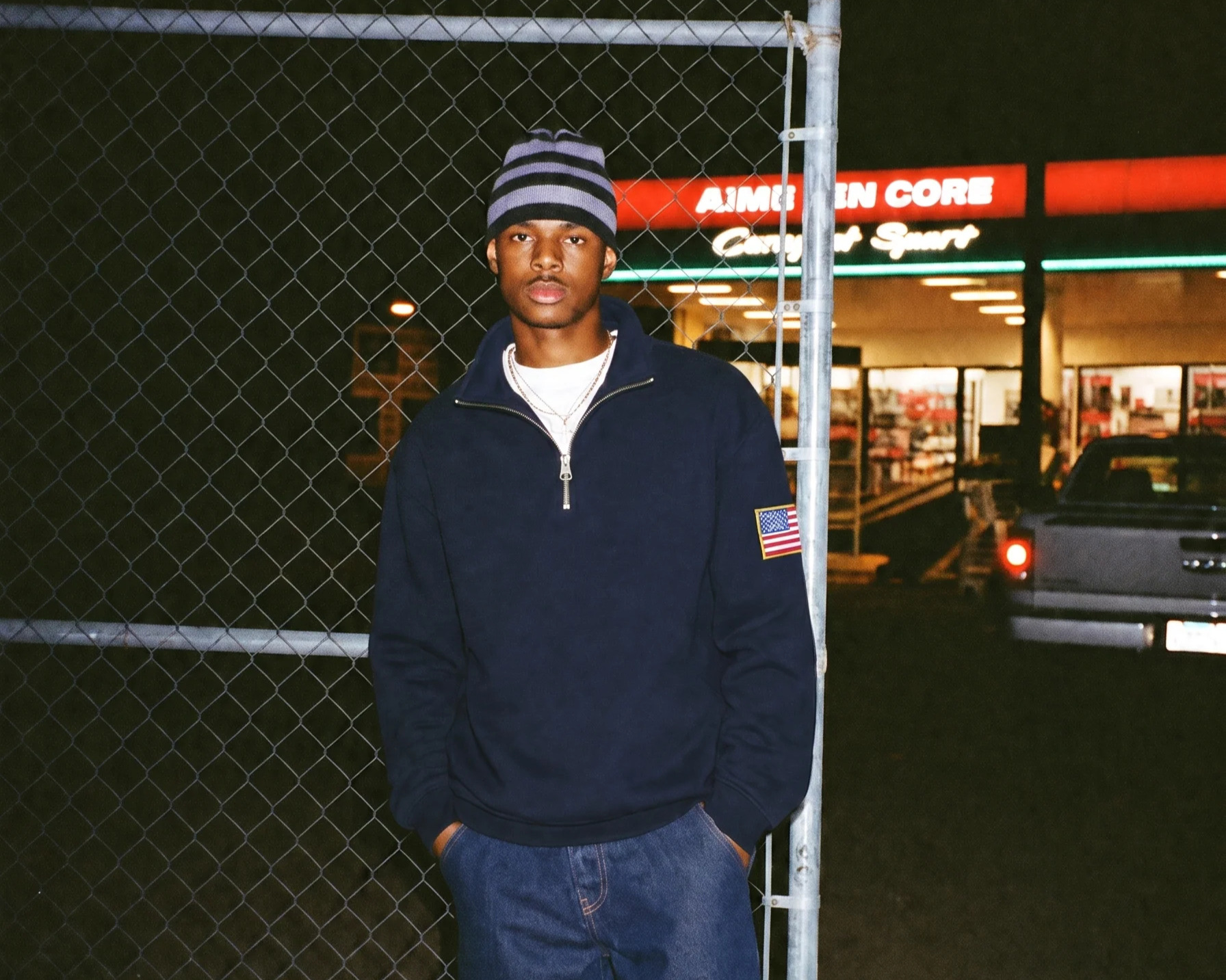
The einzip quarter zip makes that mechanism visible. The navy version is constructed in 360 GSM cotton with a structured collar, a red JEE monogram and an American flag patch on the sleeve. A white version uses a related visual language. These details do not reproduce a single archival garment literally; they reorganize the signs through which the association is communicated. The monogram becomes a logo, the flag becomes a cultural cue, and the quarter zip becomes a carrier of notoriety.
This is where the project moves beyond internet observation and into commerce. The memory is not simply examined; it is designed, manufactured and offered for sale. That distinction matters. Fashion has always absorbed symbols from politics, scandal and subculture, but appropriation is not automatically critique. A reference can expose the machinery of collective memory, or it can rely on shock as a shortcut to attention. Often it does both at once. einzip currently occupies that unresolved space.
Two Brothers Behind a Black Bar

The project’s anonymity is part of its structure. One brother leads the overall vision and develops its ideas. The other contributes programming and technical knowledge, participates in the creative direction of its videos, and handles editing, publication, orders and customer service. They describe the business as a first e-commerce venture and a practical education in search engine optimization, social media marketing and the daily realities of operating an online clothing store.
Their decision not to publish their names reflects the controversial nature of the concept. In the brand’s photography, that absence becomes visual: a black bar repeatedly covers the models’ eyes. The device gives the images a cold, documentary tension, somewhere between censorship, evidence and internet anonymity. It also protects the project from settling into the personality of its founders. einzip speaks through a name, a reference and a controlled visual system rather than identifiable individuals.
But anonymity has two meanings here. It can be understood as part of the work, consistent with a project about fragmented identities and images detached from their origins. It can also be read as distance from accountability. The same black bar that creates mystery can suggest insulation from the consequences of provocation. That ambiguity is not a flaw to be edited away; it is one of the most revealing elements of einzip’s current identity.
The photography by Andres Torres understands this tension. The supplied images place the clothing in everyday urban environments rather than theatrical reconstructions. The model is visible but not fully available to the viewer. With the eyes obscured, the face becomes another interrupted image, and the wearer becomes less a character than a surface onto which the audience projects recognition.
A Disclaimer Is a Beginning, Not a Conclusion

The founders state that einzip rejects sexual abuse and exploitation and does not endorse or excuse Epstein’s actions. That clarification is necessary. It is also not sufficient, by itself, to resolve the moral contradiction at the center of the project.
A disclaimer can establish intent; it cannot determine impact. Nor can it erase the commercial structure surrounding the reference. If an association with a convicted sex offender supplies a product with its meaning, its searchability and much of its promotional force, then condemnation and monetization coexist. The difficult question is not whether the founders approve of Epstein. They say plainly that they do not. The question is whether the project creates enough critical distance to transform the reference, rather than merely benefiting from its power to provoke.
At present, einzip’s strongest idea is also its greatest limitation. “We wear the internet’s memory” offers a credible foundation for a broader investigation of how digital culture contaminates, recodes and redistributes images. Yet the garments still depend heavily on the initial subject. The concept risks allowing Epstein to remain the most legible author in the room, even when the brand intends to study the internet that keeps reproducing him.
For einzip to become more than a single act of viral recognition, it will need to expand its visual and intellectual vocabulary. Digital memory is not one image and not one criminal. It includes the way platforms flatten history, detach symbols from consequence and convert discomfort into engagement. It includes the speed with which irony can obscure victims, and the ease with which an algorithm turns moral revulsion into market demand. A fashion project committed to that subject has rich territory to explore, but it must do more than repeat the image that granted it attention.
The Responsibility of Provocation
Provocation has a legitimate place in fashion. It can interrupt politeness, reveal hypocrisy and force culture to look at what it would prefer to leave unexamined. But provocation gains seriousness only when it accepts responsibility for the conditions it activates. Otherwise, shock becomes branding and transgression becomes a sales technique.
einzip is young, and its founders openly describe its philosophy as developing. That unfinished quality should not excuse the project, but it does make the next stage significant. The brothers have already identified the question: how much meaning belongs to an object, and how much is deposited onto it by the viewer? Their future will depend on whether they can pursue that question beyond a notorious name and build a design language capable of standing independently from it.
The most compelling reading of einzip is therefore not as an endorsement, a parody or a simple piece of internet merchandise. It is as a test of what happens when the web’s visual memory enters the wardrobe and acquires a price. The result is deliberately uncomfortable because the mechanism is uncomfortable. We do not encounter images innocently, and we do not necessarily neutralize them by wearing them ironically.
The quarter zip at the center of einzip looks conventional. Its cultural material is anything but. The brand has succeeded in making that contradiction visible. It has not yet resolved it, and perhaps no honest article should pretend that it has.
Fashion can carry difficult memory. It can interrogate symbols shaped by violence, scandal and power. But when it does, the standard cannot be attention alone. The work must give the public more than the original notoriety gave the brand.
That is the challenge now facing the two brothers behind einzip: not simply to prove that the internet remembers, but to decide what a designer owes to the people and histories contained inside that memory.
Editorial note:
einzip supplied QEditorial Magazine with written press materials and authorized photography for this feature. The founders requested anonymity and are identified as “the two brothers behind einzip.” Their statement rejecting sexual abuse and exploitation is represented above. Factual review is limited to the brand’s own statements and product specifications; the editorial framing and conclusions remain independent.
QEditorial Fashion Culture Identity

Image credit: Photography by Andres Torres. © 2026 einzip. All rights reserved. Courtesy of einzip. The black bar across the eyes is an intentional element of the brand’s visual identity and must be retained in all crops and promotional uses.



Leave a Reply