
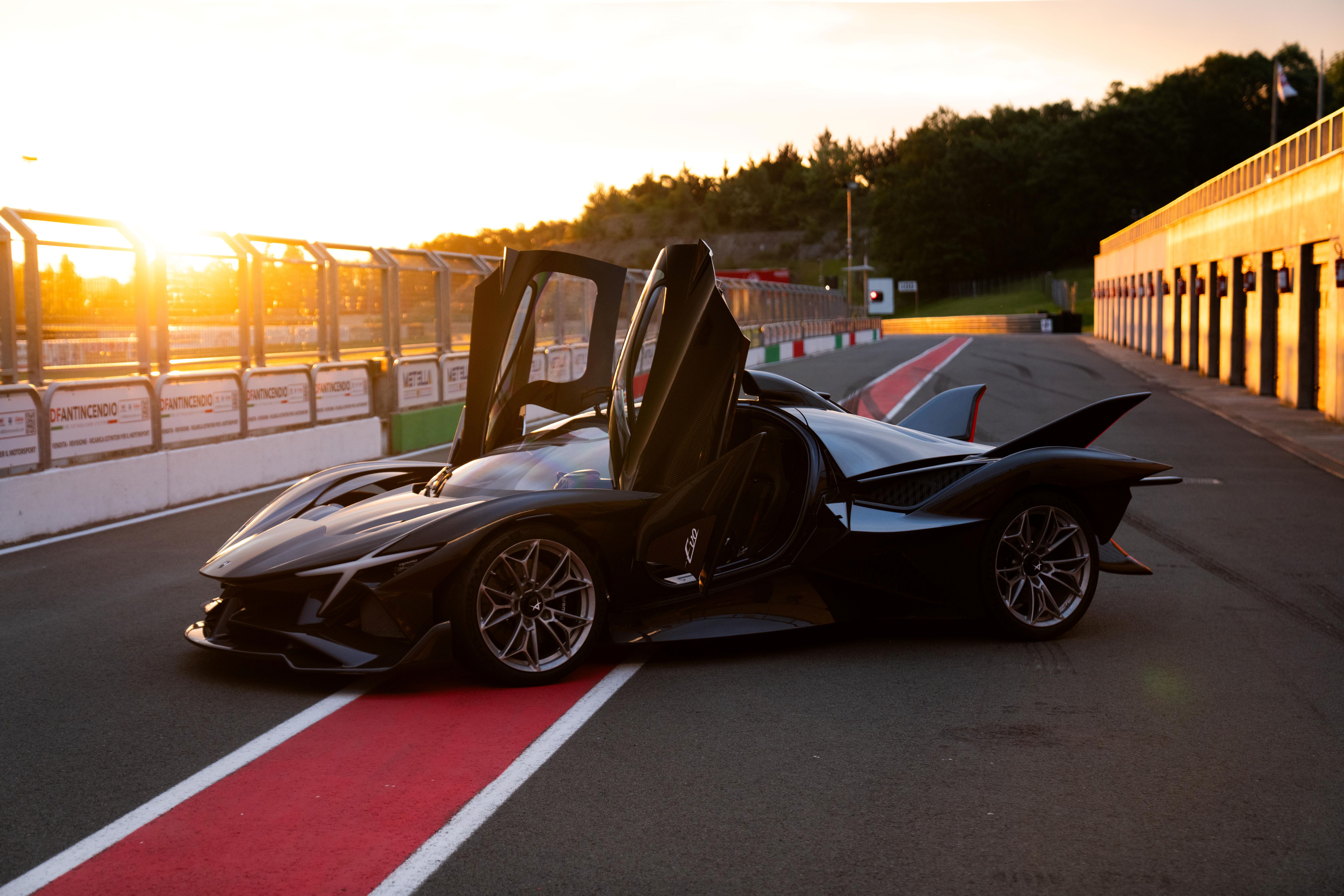
With a naturally aspirated V12 and a production run limited to ten bespoke cars, Apollo’s track-only hypercar turns structure, airflow and light into a distinctive design language.
By Nicolò Di Stefano

Some cars reveal themselves through a single continuous line. The Apollo EVO asks the eye to work differently. Its identity emerges through layers, openings and sharply defined surfaces: a composition in which the spaces between the bodywork become as important as the bodywork itself.
That makes the EVO an intriguing subject beyond its mechanical specification. It invites a reading closer to architecture, where a structure is understood through the relationship between solid and void, enclosure and exposure. Its visual drama comes from the way those relationships are arranged.
The engineering brief is equally specific. In a July 2026 corporate announcement, Apollo Future Mobility Group confirmed that the EVO is a track-only successor to the Intensa Emozione, with production limited to ten bespoke vehicles. The first customer car, named Caribbean Dragon, was delivered in June and presented at the Goodwood Festival of Speed the following month.
Those details establish an important distinction. The EVO has moved beyond the promise of a show car into a small production programme. Its extreme appearance now belongs to an object intended to be used, within the particular environment of a circuit.

A track-only car offers designers a concentrated brief. Everyday versatility becomes less central, while the relationship between performance, structure and the driver takes greater significance. For an editorial examination, the interesting question is how that purpose becomes visible.
At Apollo, visibility begins with light.
The design language introduced on Project EVO included star-shaped daytime running lights and six rear lights arranged to radiate outwards from the centre. Ideenion, which worked on the 2021 project’s interior development, engineering and finalisation, describes these features as essential elements of its visual identity.
A lighting signature can give a vehicle an identity even when its colour and surface details disappear. Here, the radial arrangement also introduces a sense of direction. The front suggests focus; the rear extends the composition outwards.
Read as design, this is an exercise in recognition. The car does not depend entirely on a badge to communicate who made it. Its geometry performs some of that work.
The treatment of the body continues the same idea. Apollo’s official project presentation identifies a floating clamshell front section, a carbon monocoque and active aerodynamic elements, including a deployable rear spoiler. The exterior is presented as a system that responds to the demands of movement.

This is where the architectural analogy becomes useful. A building’s character changes as we move around it: an opening becomes deeper, a projecting surface casts a different shadow, a structure reveals an unexpected connection. An intricately shaped car rewards a similar kind of attention.
The EVO’s visual identity is therefore difficult to reduce to a profile alone. A frontal view introduces one composition; a rear view offers another. Close photographs bring the smaller relationships into focus, allowing the reader to examine how a surface ends, where another begins and how light describes the space between them.
Such complexity carries a design challenge. Every element competes for attention, and the whole must remain legible. The most revealing question is whether the separate gestures establish a shared rhythm.
The EVO gives that discussion a clear mechanical centre: a naturally aspirated 6.3-litre V12. Apollo’s corporate disclosure also specifies a newly developed carbon-fibre monocoque, carbon front and rear subframes and dedicated carbon crash structures, with an approximate dry weight of 1,300 kilograms.
The engine configuration matters to the story because it places combustion at the centre of the car’s identity. A V12 brings an established cultural vocabulary with it: mechanical complexity, sporting ambition and the fascination of a machine designed around an exceptional powerplant.

Yet the EVO’s design deserves attention independently of that association. An engine designation explains what powers a vehicle. It does not explain why its silhouette remains in the mind, or why a particular detail invites a second look.
That distinction is particularly relevant to a limited edition. Ten examples establish scarcity, but scarcity cannot substitute for a convincing design. The object still has to justify attention through its proportions, construction and character.
For collectors, bespoke production introduces another relationship: the meeting between a manufacturer’s recognisable language and an individual commission. Personalisation becomes most interesting when it gives a coherent design a particular expression. Colour, finish and material can alter the way a form is perceived without erasing its identity.
The Caribbean Dragon marks the first production expression of the EVO programme. Its arrival gives the larger project a tangible reference point: a named car, delivered to a customer, within a defined series.

The broader appeal of the Apollo EVO lies in how many ways it can be examined. As a performance machine, it has a focused purpose. As a collectible, it has a tightly limited production run. As a designed object, it offers a vocabulary of light, surfaces and exposed relationships.
For QEditorial, that final dimension opens the richest conversation. Extreme performance has a visual culture of its own, and the EVO contributes a particularly elaborate form to it.
Its architecture makes movement imaginable before the car moves. The V12 supplies the mechanical foundation; the design gives that foundation a visible identity.
QEditorial Magazine — Fashion · Culture · Identity




Leave a Reply