
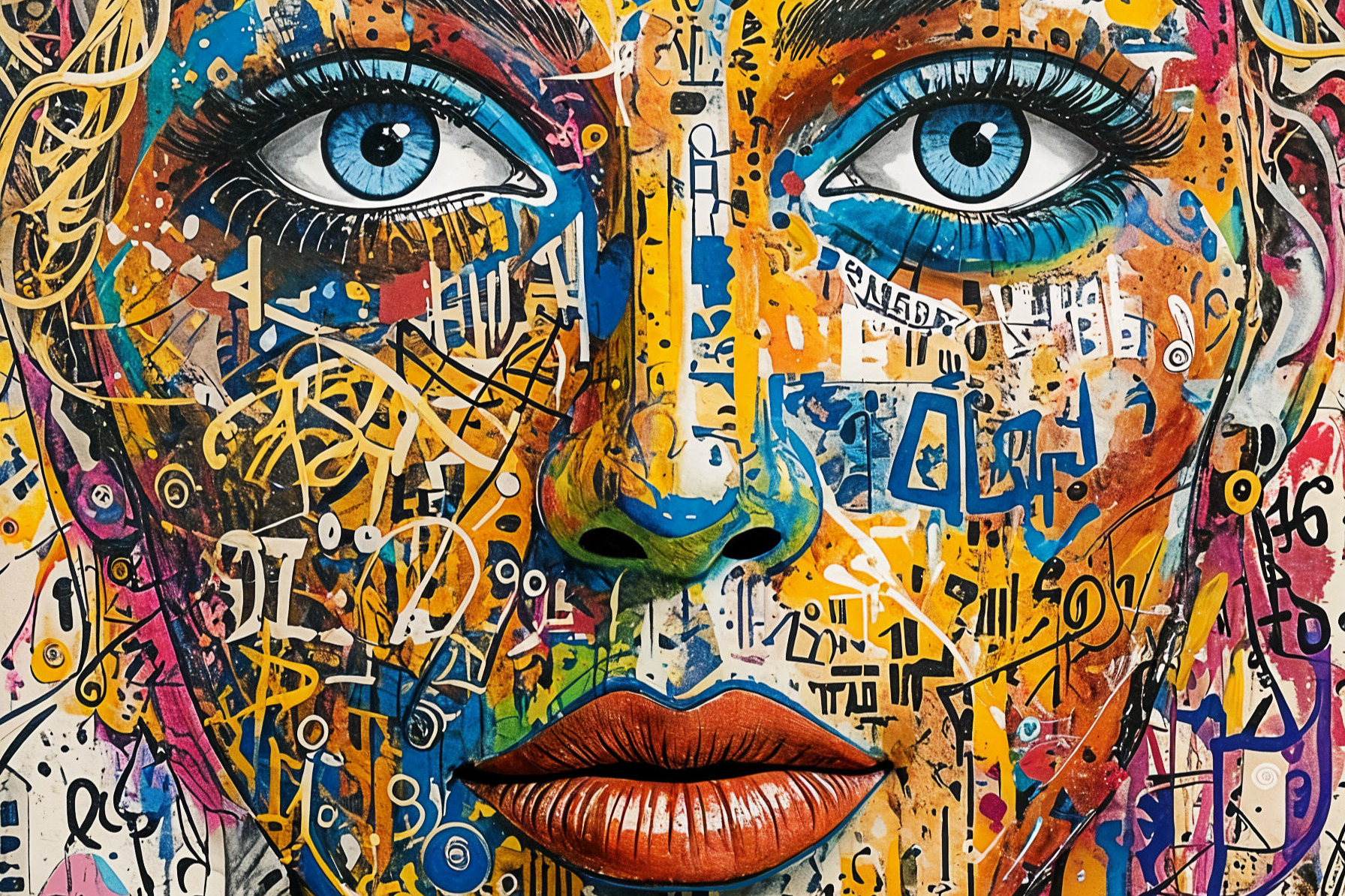
From photography and urban fragments to fractals and artificial intelligence, the Tuscan artist explores how technology can expand, rather than replace, the human imagination.

Stefano Menicagli did not leave photography behind when he entered the digital realm. He carried its discipline with him: attention to light, control of composition, sensitivity to surfaces and the ability to recognize meaning within fragments that might otherwise pass unnoticed.
Based in Tuscany and historically known as Direct2Brain, Menicagli has developed his practice across several decades of technological change. His journey began with photography before extending into digital manipulation, fractal art, three-dimensional experimentation, generative processes and artificial intelligence. These phases are documented through his official portfolio, where they appear not as separate careers, but as connected stages of the same visual investigation.
The four works presented here—Pureness, Urban Muse, Metropolis World and Atomic Hero—belong to the most recent chapter of that evolution. Although each is built around the human face, Menicagli is not primarily interested in likeness. His portraits become layered territories in which memory, painting, urban culture and technology coexist.
Learning to Build an Image
Menicagli’s photographic beginnings are essential to understanding his current work. His still-life compositions brought together books, fruit, musical instruments, pitchers and antique objects collected specifically for his images. Inspired by the atmosphere of seventeenth-century Flemish painting, these photographs depended on careful staging, controlled light and the relationship between individual forms.
Even before working digitally, Menicagli was therefore constructing rather than simply documenting reality.
His photography later moved toward abstraction. In PolaColors, polarized light interacted with transparent plastics, tape and partially burned materials to create intense fields of colour. RefleColors continued this research through reflective surfaces. In City Posters, torn advertisements, damaged typography and layers of paper found on urban walls became compositions in their own right.
This last series provides an important bridge to his recent portraits. The fragmented signs once discovered across city surfaces now appear inside the human figure. What began as photographic observation gradually became a language of digital construction.
From the Street to the Screen

The face in Menicagli’s work acts as a point of encounter between the individual and the surrounding world.
In Urban Muse, traces of graffiti, paint and typography interrupt the portrait, suggesting an identity shaped by contemporary visual culture. Metropolis World expands this relationship further, allowing architecture, clocks and industrial structures to merge with the human form. In Atomic Hero, organic features coexist with mechanical elements, while Pureness reconnects digital experimentation with the stillness and intimacy of classical portraiture.
Rather than describing each work as an isolated composition, it is more useful to see them as variations on one central question: what happens to the portrait when identity is no longer understood as something stable or purely physical?
Menicagli’s figures carry the visual environments through which they move. The city, the screen, historical imagery and technological systems do not remain outside the body. They become part of its representation.
Beauty Through Systems
Menicagli’s interest in technology predates the present debate surrounding generative AI. His exploration of fractal art introduced mathematical and algorithmic processes into his practice many years earlier. Through specialist software, formulas could be layered, masked and altered until they produced complex visual structures.
In 2007, his fractal practice appeared in IEEE Computer Graphics and Applications through the feature Beauty in Chaos. The title offers a useful way of approaching his wider body of work. Menicagli repeatedly draws visual order from dense, unstable or highly complex material.
The technology establishes possibilities, but it does not determine the final image. Composition still depends on artistic choices: what should remain visible, where the eye should rest, how the elements should relate and when the work has reached its final balance.
The Continuity of the Photographic Eye
Photoshop allowed Menicagli to move from photographic correction into digital painting and collage. Pixels could be isolated, transformed and recombined, extending the logic of the darkroom beyond what the camera had originally recorded.
Artificial intelligence represents the latest stage of that progression. According to the artist, his present process begins with a base image prepared in detail through Photoshop before being developed through personally trained AI models.
This sequence is important because it places AI inside a much longer creative history. It is not presented as a sudden replacement for photography, drawing or composition, but as another instrument within a practice already shaped by experimentation.
The most relevant question is therefore not which technology was used, but whether a recognizable artistic vision continues across those technologies.
In Menicagli’s case, that continuity can be found in his fascination with layered surfaces, controlled complexity and emotional contrast. Antique objects, reflective plastics, damaged posters, mathematical forms, urban signs and mechanical fragments all belong to an evolving vocabulary established long before the current generation of AI tools.
Between Painting and Digital Culture

Menicagli describes three principal directions within his recent production: Dystopian Realism, Creative Realism and Cyber Retro Pop.
Dystopian Realism examines the friction between humanity and technology. Creative Realism reconnects digital art with the atmosphere and emotional warmth of historical painting. Cyber Retro Pop brings together street art, typography, graphic culture and references from different technological eras.
The distinctions help explain the range of his imagery, but the strongest works often exist between these categories. A futuristic portrait may contain nostalgic elements. A digitally constructed figure may retain the composure of an old master painting. A chaotic urban surface may be organized around an intensely human gaze.
Menicagli’s art is therefore less concerned with choosing between past and future than with allowing both to occupy the same image.
A Practice Beyond the Digital Space
Although his work has developed extensively within digital-art communities, it has also entered physical and institutional settings. In 2023, Menicagli participated in Raffaella. Icona dell’arte, a collective exhibition at the Museo Civico di Bari dedicated to the cultural legacy of Raffaella Carrà. The museum identified him among the international and Italian artists included in the exhibition, which was later extended through October 15 following public interest.
The exhibition reflected another important aspect of his practice: the ability of digital work to move between screens, printed surfaces and physical exhibition spaces without losing its identity.
What Remains Beyond the Lens

The title Beyond the Lens does not imply that photography has been left behind. It identifies the foundation from which Menicagli continues to work.
Photography taught him how to select, frame and illuminate. Digital manipulation expanded the possibilities of assembly. Fractal art introduced mathematical systems capable of producing unexpected forms. Artificial intelligence opened a further space for transformation.
Across each stage, the photographic eye remains present.
Menicagli’s recent portraits suggest that contemporary identity cannot be understood through physical appearance alone. It is also formed by the images we encounter, the cities we inhabit, the histories we inherit and the technologies that increasingly mediate how we see ourselves.
His faces are not fixed representations. They are visual archives—layered, unstable and continually open to revision.
Editorial Note
Stefano Menicagli’s evolution demonstrates that new technologies do not necessarily erase the visual languages that preceded them. Photography, painting, collage, mathematics and artificial intelligence remain connected within a practice shaped by continuity rather than replacement.
By transforming the portrait into a layered field of memory, urban culture and technological imagery, Menicagli asks how the human figure can still retain emotional presence within an increasingly digital world.
QEditorial Magazine
Fashion · Culture · Identity




Leave a Reply