
Isha Ambani’s Manish Malhotra x Swadesh dress reveals how fashion categories simplify India’s complex textile identities.
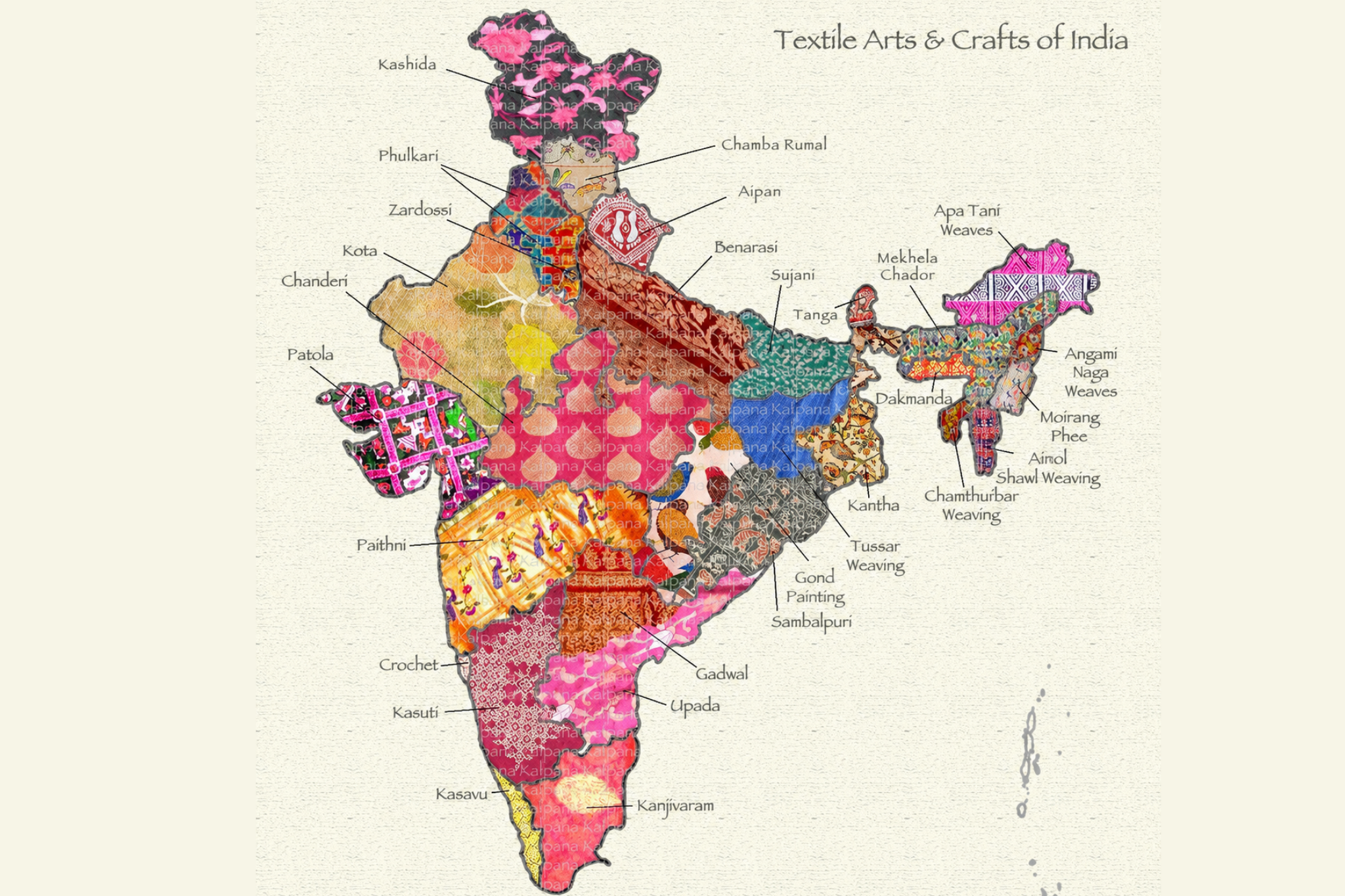
At Vogue’s 2026 First Friday pre-Met Gala party, Isha Ambani appeared in a custom Manish Malhotra x Swadesh dress composed of twenty-six textile borders representing different regions and craft traditions across India, yet its fitted silhouette appeared unmistakably Western. So what exactly are we looking at? A Western dress made with Indian textiles? An Indian dress in a Western silhouette? Most garments never force us to ask. This one does.
The answer depends on what we think gives a garment its identity. Is it the silhouette? The textile? The embroidery? The craft traditions behind it? The dress does not answer the question. It simply makes the question impossible to avoid.
That question is really a smaller version of a bigger one: what do we mean when we say “Indian fashion” at all? We use the phrase constantly—in runway reviews, brand campaigns, trend reports and conversations—as though everyone already agrees on what it represents. But the moment we stop treating it as a familiar phrase and start treating it as a real question, the confidence behind it begins to thin out.
Fashion needs shorthand to function. Countries become categories because they make fashion easier to discuss. A trend report, runway review or conversation does not have room to account for every regional difference, so fashion reaches for broader labels. The image these labels create is not complete, but it is often enough to begin a conversation.
Most of the time, that shorthand works well enough. India simply makes its limitations easier to notice.
Say “Indian fashion” and watch what happens. Someone pictures a sari. Someone else pictures gold thread, a wedding or Bollywood in slow motion. Ask which sari, and the singular already begins to slip—a Banarasi sari from Varanasi is not the same as a Patola sari from Gujarat. Ask about craft rather than drape, and it slips again: chikankari, kantha and the mirror work of Kutch belong to different regions, different hands and different histories, all gathered under the same name.
India is not alone in this. “African fashion” is used in much the same way throughout fashion media—one phrase standing in for a continent of more than fifty countries, each with its own textile histories, techniques and markets, flattened into a single aesthetic because a single aesthetic is easier to caption. The habit is not specific to India. It is what happens whenever fashion attempts to compress the histories of a country, region or continent into a phrase built for a photo caption.
Indian designers and fashion media use the phrase just as readily as anyone outside the country. This is not simply a label imposed from elsewhere; it is shorthand that everyone reaches for, insiders included, because categories are how fashion talks to itself. The category itself is not the problem. Fashion could not function without categories. The problem begins when we forget that they are only a starting point.
What begins as a starting point eventually becomes an assumption. We stop asking what belongs within “Indian fashion” and start behaving as though we already know—until a dress like Isha Ambani’s forces us to question it.
The issue is not that Indian fashion lacks a definition. It is that one definition is being asked to contain what are really dozens of them.
Twenty-six textile traditions, one silhouette, one fashion moment—and no single answer for what to call it. The dress does not expose an exception to “Indian fashion.” It exposes the limitations of the phrase itself. Not because the phrase is wrong, but because we have asked it to describe something that was never singular to begin with.
In the end, the question is not really about Indian fashion alone. It is about the way fashion makes sense of the world. Fashion depends on classification, and classification inevitably simplifies. Without it, fashion would struggle to communicate, compare or even describe itself. But simplification is not the same as definition. It creates a useful way of seeing, not a complete one.
The point is not that fashion should stop classifying. It cannot. Categories are not complete definitions, nor should they be treated as such. They are simply the first way we make sense of something more complicated. The trouble begins when we mistake that first impression for the complete picture.
Written by Aditi Dhapola, Q Voice Contributor
 Voice.


Leave a Reply