
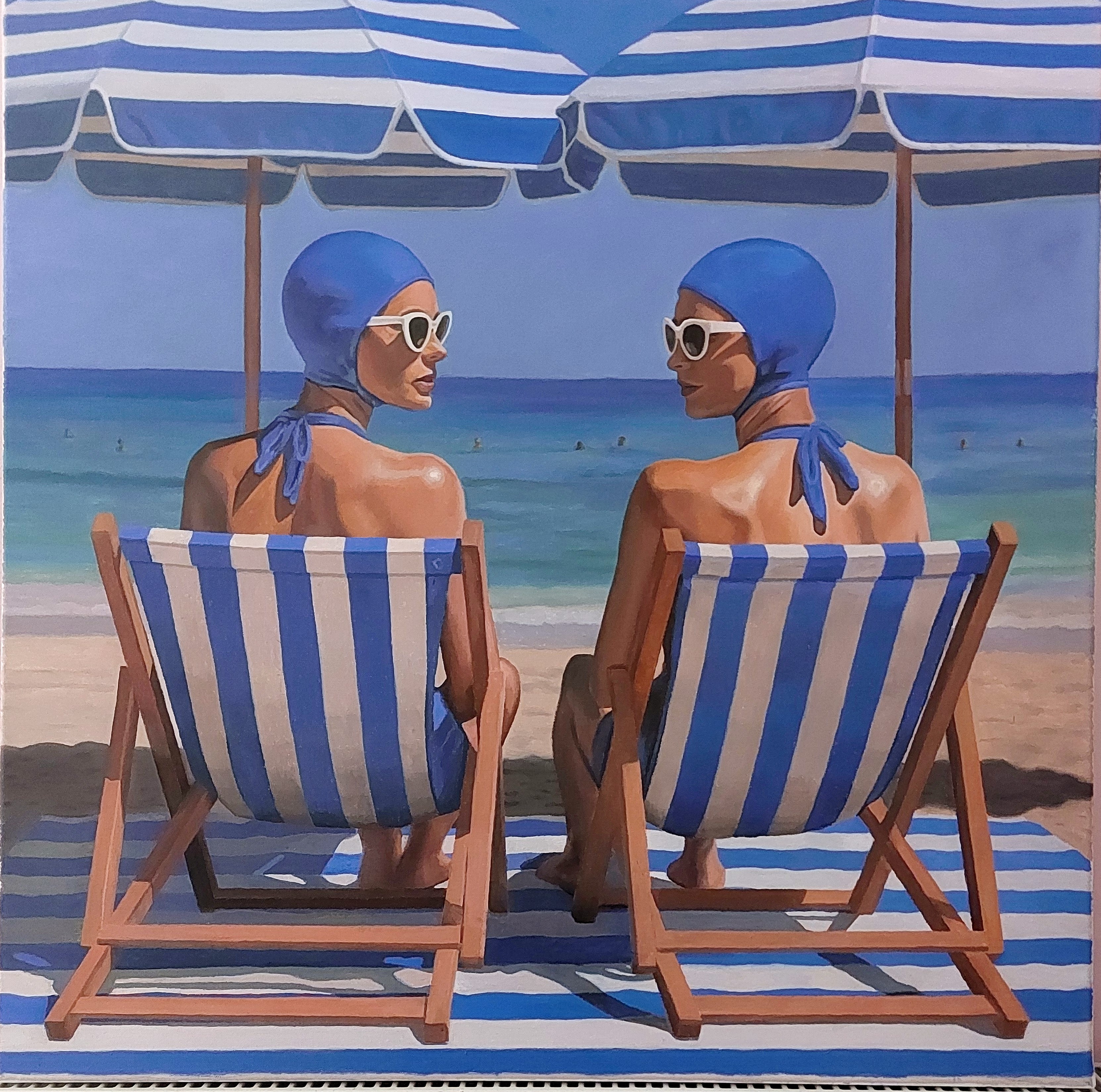
British figurative painter Allan Wilkie brings together colour, composition, memory and the human senses, turning ordinary moments into works of quiet psychological presence.

There is a particular kind of intelligence in Allan Wilkie’s painting: the ability to make brightness feel thoughtful.
At first glance, his images appear generous, almost immediately pleasurable. Women by the sea. Vintage bathing caps. Striped towels. Sunlit skin. Deck chairs, umbrellas, sunglasses, red, white and blue. The vocabulary belongs to summer, leisure and memory. Yet the longer one looks, the more one understands that Wilkie is not simply painting the beach. He is painting the structure of sensation.
His figures inhabit scenes of apparent ease, but they do not dissolve into decoration. They hold themselves with composure, privacy and a quiet resistance to being fully explained. They are present, but not exposed. Visible, but not surrendered. This is where Wilkie’s work becomes psychologically interesting: beneath the elegance of the image, there is always a deeper negotiation between body, memory, intimacy and form.
A British figurative painter of Irish and Scottish descent, Allan Wilkie spent much of his youth between Ireland and Derbyshire before studying Fine Art at Central Saint Martins College of Art in London. His work has been exhibited at the Mall Galleries in London, the Royal West of England Academy, the Holburne Museum in Bath and in commercial galleries, and his paintings are held in several private collections. He currently exhibits with galleries including The Doorway Gallery in Dublin and Gallery 1608 in Bushmills.

This biographical foundation matters because Wilkie’s painting carries the discipline of traditional figuration while avoiding the rigidity of academic realism. His works are technically controlled, carefully drawn and rooted in observation, but they do not exist merely to reproduce appearances. In a conversation with Artists & Illustrators, Wilkie described his desire to find a balance between perception and conception through observation and the arrangement of shape, tone and colour. That balance is essential to understanding his practice. The paintings begin in the visible world, but they are completed through composition.
Wilkie’s recent works are closely connected to his interest in the four elements and the five senses. Water, earth, air and fire are not treated as symbolic decoration, but as ways of thinking about how human beings encounter the world. The five senses become a means of returning painting to lived experience: sight, touch, hearing, taste, smell, temperature, atmosphere. In his beach paintings, water is never merely a background. It is distance, reflection, release, touch, memory and time.
The five beach works presented in this article operate less as separate narratives than as variations on a single sensory grammar. Wilkie returns to the beach not as a place of simple leisure, but as a field of perception: light on skin, water in the distance, fabric against the body, the silent choreography of posture, proximity and pause. The recurring caps, sunglasses, stripes and saturated colours create a visual rhythm that feels both immediate and remembered, as though the scene had passed through the filter of sensation before becoming image.

In this sense, Wilkie’s paintings are not about the beach alone. They are about how the body receives the world. The figures appear poised and self-contained, yet they are surrounded by a charged atmosphere of touch, temperature and memory. Red, blue and white do not merely describe objects; they structure feeling. The works are luminous, but their luminosity is disciplined. They give pleasure, but never casually. They ask the viewer to look slowly, to understand beauty not as surface, but as a form of attention.
This is one of the most compelling aspects of Wilkie’s language. His paintings are accessible, but they are not simple. Their clarity is not the absence of complexity; it is the result of control. The viewer may first be drawn in by colour, style and recognisable imagery, but the deeper experience of the work lies in its arrangement. Wilkie understands that composition is not only a formal question. It is psychological. A horizon line, a repeated stripe, a curve of fabric, a figure turned away from the viewer: each becomes part of a larger emotional architecture.
His use of colour is especially significant. In the artist information published by Red Rag Gallery, Wilkie is associated with a conscious interest in primary colours and primary shapes, allowing figurative painting to operate on an abstract level beyond the subject depicted. This gives his work a particular tension. The viewer sees bodies, beaches, towels and umbrellas, but beneath them there is a deeper pictorial order. Stripes become rhythm. Umbrellas become geometry. The sea becomes a plane of thought. Colour becomes structure.
This is why his images resist nostalgia. They may borrow from the visual pleasure of mid-century leisure, but they are too deliberate to become retro fantasy. The past is present in the work, but not as sentimentality. It appears instead as atmosphere, as memory, as a sensorial residue. Wilkie does not paint nostalgia directly. He paints the sensation of remembering.

There is also a subtle contemporary tension in the way Wilkie paints women. His figures are elegant, composed and physically present, but they are not passive images of display. They seem self-contained, involved in their own social and sensory world. In a reflection published by Mall Galleries, Wilkie connects his swimming paintings to water, joy, strength, vintage aesthetics, dynamic composition and the transformative beauty of primary colours and shapes. This combination is important. The paintings may use the codes of glamour, but they are not built on possession. They give the figures agency through composure.
The viewer is allowed to look, but not to consume. This distinction gives the paintings their quiet moral intelligence. Wilkie’s women do not perform for the viewer. They occupy the image. They belong first to themselves, then to the atmosphere around them, and only afterwards to the gaze that encounters them.
In a contemporary visual culture dominated by acceleration, overexposure and instant consumption, Wilkie’s paintings ask for slower attention. They do not reject beauty; they make beauty rigorous. They remind us that elegance, when handled seriously, can become a language of thought. His work suggests that pleasure does not have to be shallow, that colour does not have to be decorative, and that figuration can still carry psychological force without theatrical excess.
Wilkie’s inclusion in Five and Under at Arcadia Contemporary in New York gives this work an important international context. Presented from August 9 to September 9, 2025, the 11th annual edition of the exhibition brings together more than 150 new works by over 60 artists from around the world, each priced at $5,000 or less. In the ecosystem of contemporary representational painting, Five and Under is more than a group show. It functions as a collector-facing platform, a curatorial snapshot and an annual statement on the vitality of contemporary realism.
Arcadia Contemporary occupies a distinct place in this field. Founded by Steve Diamant, the gallery emerged with a mission to champion living representational artists and to present work defined by both technical excellence and distinctive contemporary identity. According to the gallery’s own history, Arcadia opened in Manhattan’s SoHo district in 2001 and gained recognition for its commitment to artists whose work combines skill, individuality and contemporary vision. Today, Arcadia Contemporary remains one of the most recognizable names for collectors interested in realism, figurative painting and representational practices that refuse to treat technique as a conservative gesture.
Steve Diamant’s role is central to this identity. He is not simply a gallerist working within the market of figurative art; he has become one of the figures associated with the contemporary revival and continued visibility of realist and representational painting. External profiles have described Arcadia as a leading gallery for realistic art, and Diamant’s curatorial eye is often associated with artists who combine technical mastery with emotional, narrative or psychological charge. In American Art Collector, Five and Under is described as one of Arcadia’s anticipated annual exhibitions, bringing together established gallery artists and emerging talent selected by Diamant, whose invitation can represent a meaningful moment for an artist.
This matters for Wilkie. Arcadia is not a neutral setting. It is a gallery context built around a specific belief: that representational painting remains one of the most powerful languages available to contemporary art when it is handled with intelligence, discipline and individuality. Within that frame, Wilkie’s paintings speak clearly. They do not need scale or aggression to hold the wall. Their force lies in atmosphere, control and the emotional precision of the image.
In Five and Under, where the format encourages discovery and collector engagement, Wilkie’s work enters a conversation that is both accessible and serious. The price structure of the exhibition may open the door to a wider collecting audience, but the curatorial ambition remains high. This is the strength of the format: it makes space for immediacy without sacrificing quality. For a painter like Wilkie, whose images operate through restraint rather than spectacle, the setting feels particularly appropriate.
His paintings do not shout for attention. They accumulate it.
That accumulation is the essence of his practice. The first impression may be beauty, but the lasting impression is structure. The first encounter may be colour, but the deeper encounter is silence. The figures, the water, the fabric, the repeated patterns and the saturated surfaces become part of a language in which the senses are not decorative references, but philosophical tools. Wilkie paints the body as a receiver of the world.
This is perhaps why his work feels both familiar and slightly unreachable. We recognize the scene, but not completely. We understand the setting, but not entirely. The paintings keep something private. They invite the viewer close, but maintain a distance. That distance is not coldness. It is dignity.
Allan Wilkie’s paintings remind us that ordinary moments are rarely ordinary when someone is looking carefully enough. A pause before the sea, a body under the sun, the texture of fabric, the geometry of shade, the tension between stillness and sensation: these become the materials of thought.
In these works, Wilkie gives us the beach without banality, elegance without emptiness, figuration without nostalgia. His paintings are luminous, but not superficial. Composed, but not cold. Sensual, but never obvious.
They ask us to consider beauty not as a conclusion, but as a method of attention.
And in Wilkie’s work, attention becomes its own form of intimacy.





Leave a Reply