
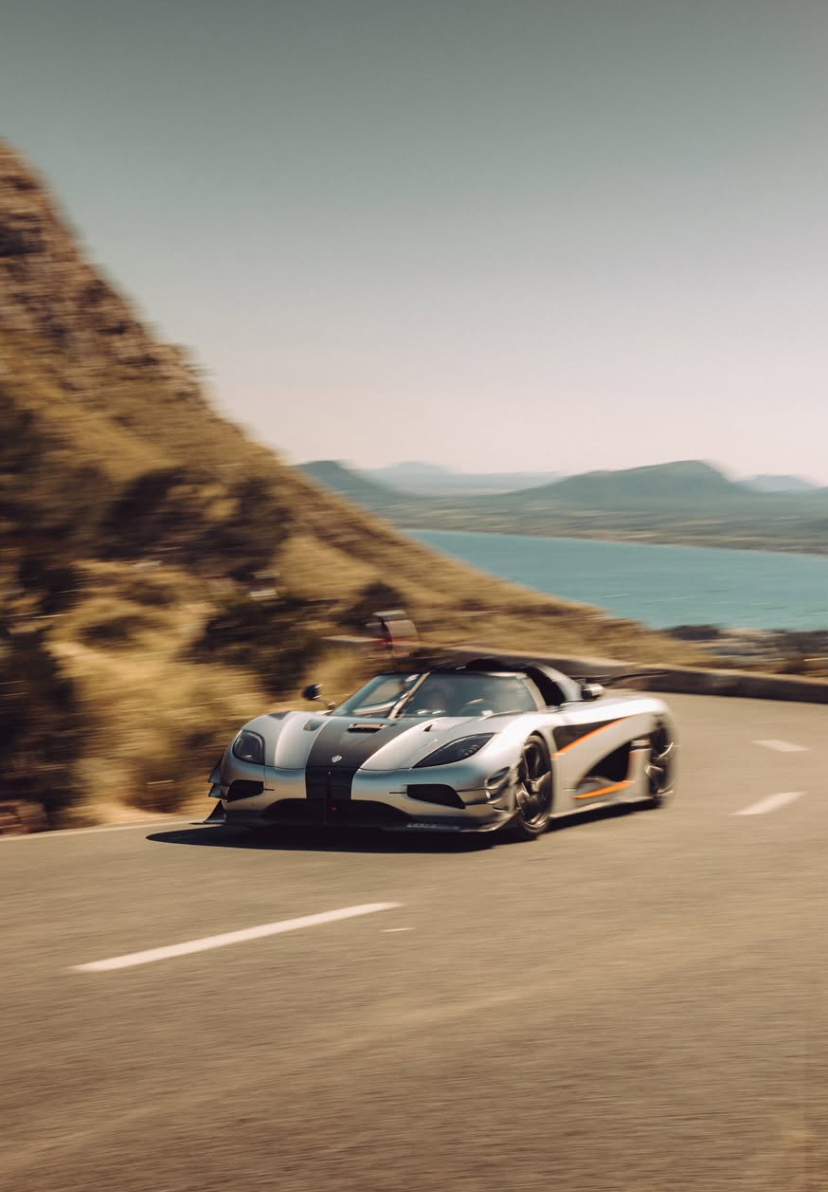
Limited to 30 examples and producing up to 1,625 horsepower, Koenigsegg’s most track-focused road car transforms lightness, aerodynamic precision and family memory into an uncompromising expression of speed.

At the edge of automotive performance, power alone is no longer enough.
The most exclusive hypercars now operate within a world of increasingly extreme figures: four-digit horsepower, carbon-fiber structures, active aerodynamics and production numbers counted in dozens rather than thousands. Yet the difference between a remarkable machine and a truly significant one is rarely found in a single specification.
It emerges through intent.
The Koenigsegg Sadair’s Spear was created with one purpose: to deliver the most focused track experience yet offered by the Swedish manufacturer while remaining legal for the road. Limited to only 30 examples, it develops as much as 1,625 horsepower from a twin-turbocharged V8 and weighs 1,320 kilograms dry.
Those numbers establish its rarity and performance. They do not fully explain its character.
Sadair’s Spear is defined by reduction: less weight, fewer distractions and a more direct relationship between the driver, the machine and the physical limits of movement.
A Name Drawn From Family Memory

The name originates far from wind tunnels, carbon-fiber laboratories or digital simulation.
Sadair’s Spear was a racehorse loved by Jesko von Koenigsegg, father of company founder Christian von Koenigsegg. Jesko spent much of his life connected to Sweden’s equine industry, and the horse ran its final race in 1976—a number that appears within the visual identity surrounding the car.
The reference introduces an unexpectedly personal dimension to a machine otherwise defined by technical extremity.
Koenigsegg has frequently connected its cars to family history. The Jesko itself was named in honor of Christian’s father, whose support was instrumental during the company’s formative years in the 1990s. Sadair’s Spear continues that narrative, but with a sharper sense of motion and competition.
A racehorse is not remembered only through speed. It is remembered through discipline, instinct, physical intelligence and the relationship formed with those who understand it.
The name therefore gives the car a character beyond mechanical achievement. It places performance within a lineage of memory.
Beyond the Jesko Attack

Sadair’s Spear begins with the architecture of the Jesko Attack, Koenigsegg’s high-downforce interpretation of the Jesko platform.
From there, nearly every system has been reconsidered.
The company’s development philosophy was based on incremental gains: slightly more power, slightly less weight, a shorter braking distance and a reduction in unwanted aerodynamic lift. Each improvement may appear modest in isolation, yet their combined effect produces a car with a more immediate and specialized identity.
This is where Sadair’s Spear separates itself from the broader culture of hypercar excess.
Its performance does not come from simply adding more. It comes from deciding what can be removed, refined or made more exact.
The process resembles the construction of an haute couture garment or a highly engineered aircraft component. Every element must justify its presence. Material, proportion and function are evaluated according to the contribution they make to the whole.
Nothing is permitted to remain neutral.
The Discipline of Lightness

The car’s dry weight of 1,320 kilograms is approximately 35 kilograms lower than that of the Jesko Attack.
In isolation, that reduction may seem relatively small within an automobile of this complexity. At this level of engineering, however, removing weight without sacrificing structural integrity, cooling capacity, safety or drivability becomes an exacting exercise.
The Sadair’s Spear uses a carbon-fiber monocoque with aluminum honeycomb construction and integrated fuel tanks. Its body combines pre-impregnated carbon fiber and Kevlar with lightweight sandwich reinforcements, while the carbon-fiber Aircore wheels reduce rotating and unsprung mass.
Lightness influences every aspect of the car’s behavior.
It changes the rate at which the chassis responds to steering inputs. It reduces the work demanded from the brakes. It allows the suspension to control the body with greater accuracy and helps the aerodynamic systems operate around a more agile physical foundation.
Weight reduction is therefore not an abstract numerical achievement. It becomes something the driver can feel.
A V8 Pushed Beyond 1,600 Horsepower

At the center of Sadair’s Spear is Koenigsegg’s 5.0-liter twin-turbocharged aluminum V8.
The flat-plane-crank engine produces 1,300 horsepower on conventional gasoline and reaches 1,625 horsepower when operating on E85 fuel. Peak torque rises to 1,500 Nm at 5,100 rpm, while the engine itself weighs only 189 kilograms.
The increased output comes through revised engine mapping and improved breathing provided by bespoke rear hood scoops. These direct additional airflow toward the powertrain at high speed, while the front cooling system has been reshaped to control temperature and contribute to aerodynamic performance.
Yet the most significant aspect of the engine may be its relationship with the car’s mass.
Sadair’s Spear offers approximately 1.23 horsepower for every kilogram of dry weight when running on E85. The figure places it within a performance territory where acceleration becomes less a conventional sense of speed than a sustained physical event.
Power is not delivered as an isolated spectacle. It works in concert with aerodynamics, gearing, braking and chassis control.
The Light Speed Transmission

Power is transmitted through Koenigsegg’s nine-speed Light Speed Transmission, a system designed to move between any gear without progressing sequentially through those between them.
In Sadair’s Spear, shifting is controlled exclusively through paddles mounted behind the steering wheel. The central shift mechanism used in other models has been removed and replaced by a key holder.
It is a small change with a clear symbolic meaning.
The cabin no longer performs the idea of mechanical interaction through a prominent central lever. Control moves directly to the driver’s hands, allowing steering and gear selection to remain concentrated in the same visual and physical space.
The decision reflects the car’s broader philosophy: symmetry, lightness and focus.
Aerodynamics as Moving Architecture

Sadair’s Spear’s aerodynamic package is among its most visually defining features.
A new top-mounted active rear wing uses a twin-profile construction optimized to generate greater downforce at lower speeds. It works with underfloor strakes, enlarged wheel-arch louvers and an extensively revised front section. Larger canards, a more prominent splitter, active underbody flaps and an enlarged hood vent regulate airflow across and beneath the body.
At 250 kilometers per hour, the car generates 850 kilograms of downforce. Its stated maximum reaches 1,765 kilograms under the manufacturer’s specified conditions.
These surfaces are not ornamental additions placed upon an existing shape.
They form an architecture that changes according to speed, braking and cornering forces. Air becomes a structural material—one that cannot be seen directly, yet determines how firmly the car remains connected to the ground.
The visual aggression of Sadair’s Spear follows from this purpose. Its silhouette communicates pressure, extraction and control.
The Body as an Instrument

The front and rear suspension systems use double wishbones, electronically adjustable gas-hydraulic dampers and Koenigsegg’s Triplex configuration. Active ride-height control allows the car to alter its position in response to different conditions, while carbon-fiber rear upper wishbones contribute to lower mass and increased precision.
The front Triplex damper is especially important to the Sadair’s Spear’s character. It helps manage aerodynamic load and provides greater stability under the forces generated during high-speed driving.
This relationship between suspension and aerodynamics allows the body to operate as an integrated instrument.
The car is not simply pushed downward by its wings. Its chassis must receive, distribute and respond to those forces without compromising steering information or mechanical grip.
The result is engineering based on communication: between air and bodywork, tires and surface, machine and driver.
Braking at the Edge of Adhesion
Stopping power is provided by carbon-ceramic brakes with 410-millimeter front discs and 395-millimeter rear discs. Six-piston calipers operate at the front and four-piston units at the rear, supported by Sport ABS and the latest generation of Koenigsegg’s layered ceramic-disc technology.
In a car of this performance, braking is not secondary to acceleration.
It is part of the same system.
A shorter braking zone permits the driver to remain at speed for longer. Stability under deceleration influences confidence during corner entry. Brake temperature affects consistency across repeated laps.
Performance is created not only through how rapidly a car gains speed, but through how late and accurately it can release it.
An Interior Built Around Concentration

The cabin preserves the identifiable craftsmanship and technology of a Koenigsegg while removing elements considered unnecessary to its track-focused purpose.
Carbon-fiber bucket seats can be equipped with six-point racing harnesses, while three-point belts remain standard. A lighter center console reduces visual mass, and the steering-mounted SmartCluster keeps essential information directly within the driver’s line of sight.
The interior remains equipped with climate control, Apple CarPlay, USB connectivity, inductive charging, parking assistance and Koenigsegg’s electro-hydraulic Autoskin system.
This balance is important.
Sadair’s Spear is not a stripped competition car requiring its owner to tolerate discomfort as evidence of seriousness. It is a road-legal megacar that concentrates luxury around function.
The vivid upholstery, visible carbon fiber and contrast stitching seen in the cabin create an environment closer to a fitted technical garment than a traditional grand-tourer interior.
The driver is held in place rather than merely seated.
Thirty Cars and the Culture of Rarity
Only 30 examples of Sadair’s Spear will be produced.
In the contemporary hypercar market, such scarcity operates on several levels. It ensures collectability, creates immediate cultural visibility and allows each example to become a highly individualized object.
Yet rarity alone does not make a car meaningful.
The industry is now populated by limited editions whose exclusivity can appear more carefully engineered than their mechanical identity. Sadair’s Spear avoids that problem because its restricted production corresponds to a highly specific purpose.
This is not merely a cosmetically differentiated Jesko.
Its reduction in weight, revised aerodynamic structure, increased output and driver-focused interior create a coherent variation on the platform. Each change supports the same objective.
The production number becomes the consequence of specialization rather than its substitute.
A Wider Koenigsegg World
The photographs surrounding Sadair’s Spear reveal that the car belongs to a culture extending beyond the individual machine.
Koenigseggs gather beside private aircraft, occupy pit lanes and travel together across coastal roads. Historic models appear beside contemporary ones, creating a mobile archive of the company’s development.
The context is undeniably exclusive. Private aviation, Mediterranean marinas and collections of rare automobiles represent a world accessible to very few.
Yet these images also reveal something more compelling: the emergence of Koenigsegg as a cultural identity.
Owners do not simply acquire a vehicle. They enter a community organized around engineering, rarity and shared experiences of movement. Cars become part of journeys, factory gatherings, track events and driving tours.
The machine is the center of that world, but not its limit.
From the CC8S to Sadair’s Spear

Koenigsegg’s visual identity has evolved considerably since the company’s earliest production cars, yet certain principles remain recognizable.
The teardrop cabin, wraparound windscreen, dihedral synchro-helix doors and compact mid-engine proportions have become recurring elements. Even as aerodynamics have grown more aggressive and power outputs have multiplied, the cars retain a sense of lineage.
Placed beside models such as the CC8S, CCR, CCX, Agera, Regera and Jesko, Sadair’s Spear becomes part of an ongoing argument about what a Swedish performance car can be.
The company has never relied upon the heritage of a historic racing marque. It has had to create its own mythology in real time.
That mythology is built through technical inventions, speed records, distinctive design and a founder whose identity remains closely connected to every car.
Sadair’s Spear adds family memory to that structure.
The Horse and the Machine
There is an elegant tension in naming a technologically advanced megacar after a racehorse.
The horse represents organic movement, instinct and physical response. The automobile represents engineered force, data and manufactured precision.
Yet racing connects them.
Both depend upon balance, endurance, control and the ability to translate power into motion without losing stability. Both require the human participant to understand signals that may be subtle at first and overwhelming at the limit.
Sadair’s Spear does not imitate the horse in any literal sense.
The reference operates emotionally. It suggests that performance can carry memory, and that an object defined by future-facing technology may still emerge from something personal and historical.
Luxury Through Purpose
Modern automotive luxury is often expressed through silence, screens, personalization and insulation from the surrounding world.
Sadair’s Spear proposes another definition.
Its luxury lies in access to an experience that has been engineered with extraordinary specificity. It offers the ability to feel aerodynamic load, mechanical grip, engine response and braking force through a machine produced in almost impossibly small numbers.
Nothing about it is universal.
Its proportions are difficult. Its performance is excessive for ordinary roads. Its potential can only be approached in controlled conditions by a driver possessing considerable skill.
That impracticality is part of its identity.
Sadair’s Spear does not attempt to become the perfect automobile for every circumstance. It seeks to become exceptional within one.
Performance Without Distraction
The most revealing statement behind Sadair’s Spear is not its horsepower figure or production limit.
It is the philosophy expressed through its development: add lightness, refine each system and remove what does not serve the objective.
The car’s identity emerges through this discipline.
Every vent directs air. Every aerodynamic surface manages pressure. Every reduction in mass changes response. Every interior decision returns attention to the driver.
Sadair’s Spear belongs to a class of automobiles frequently described through excess, yet its true achievement is one of concentration.
It demonstrates that even at 1,625 horsepower, performance can still be defined by restraint—the restraint to eliminate distraction, to pursue incremental gains and to allow engineering purpose to determine form.
The result is not simply the most track-focused Koenigsegg yet produced.
It is a machine that transforms family memory, technical obsession and physical movement into one of the rarest expressions of contemporary automotive culture.
Editorial note:
The Koenigsegg Sadair’s Spear represents an increasingly rare form of automotive luxury in which exclusivity follows engineering purpose. Through reduced weight, active aerodynamics and a highly focused relationship between driver and machine, it demonstrates how contemporary hypercar design can move beyond spectacle and become a study in precision, memory and controlled performance.
QEditorial Magazine — Fashion · Culture · Identity
Thank you for reading. Join Q Letter to stay connected with QEditorial’s latest stories and become part of a growing community supporting independent fashion and cultural journalism.

Image disclaimer:
Images are used for editorial and informational purposes only. All rights remain with Koenigsegg Automotive AB and the respective photographers or copyright holders.


Leave a Reply