
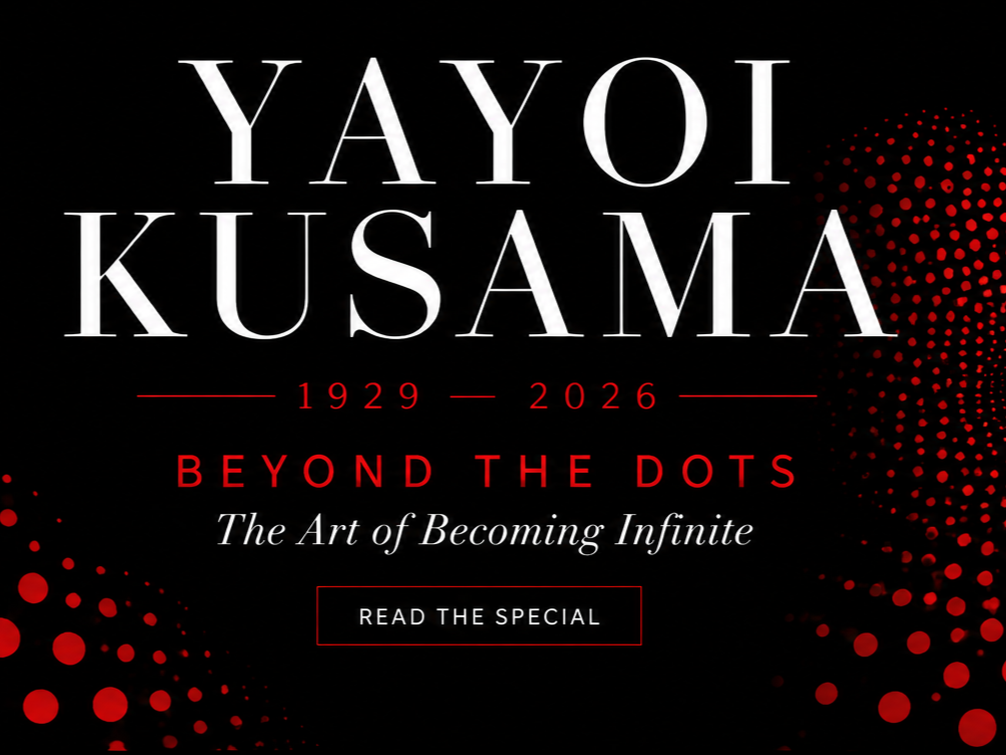
Yayoi Kusama, 1929–2026. The Japanese artist transformed repetition, fear, the body and self-obliteration into one of the most recognizable visual languages of our time. What remains is far greater than the dots.
By QEditorial
Art · Culture · Identity

There is something strangely appropriate about the fact that Yayoi Kusama’s life did not end when the world first learned of her death.
The Japanese artist died at a hospital in Tokyo on August 14, 2026. She was 97. The news was publicly announced on August 27 by Yayoi Kusama Inc. and Yayoi Kusama Studio, nearly two weeks after her death. Their statement contained a detail more revealing than almost any conventional summary of her career: Kusama continued painting until her final days, never setting aside her brush.
For an artist who spent decades contemplating infinity, disappearance, repetition, mortality and the uncertain boundary between the individual and the universe, it feels almost impossible to speak of Kusama simply in the past tense.
The paintings remain. The pumpkins remain. Mirrored rooms continue reflecting visitors into seemingly endless space. The dots that emerged from an intensely personal visual vocabulary escaped the boundaries of galleries long ago, migrating across museums, fashion, architecture and popular culture.
Yet reducing Yayoi Kusama to polka dots would be like reducing an entire language to a single word.
Behind one of contemporary art’s most recognizable visual signatures was a far more complicated proposition:
What happens when the self begins to disappear?
Before the Dots Became an Icon
Yayoi Kusama was born in Matsumoto, Japan, in 1929. Long before her work became synonymous with monumental pumpkins and mirrored environments, she developed an artistic language rooted in repetition, organic forms, accumulation and the psychological experiences that would accompany her throughout her life.
After studying traditional Japanese-style painting in Kyoto, Kusama increasingly moved toward abstraction. She left Japan for the United States in the late 1950s and settled in New York, entering a city in the middle of an extraordinary transformation in postwar art.
The New York Kusama encountered was becoming one of the centers of the international avant-garde. Abstract Expressionism had reshaped American painting, while the movements that would become Pop Art, Minimalism, performance and conceptual art were beginning to emerge.
Kusama did not comfortably belong to any single one of them.
She worked across painting, sculpture, installation, performance, film, poetry and fiction, gradually constructing an artistic universe whose components seemed capable of expanding indefinitely.
Her Infinity Net paintings are crucial to understanding what followed. Small repeated gestures accumulated across large surfaces until conventional composition began to disappear. There was no obvious center. No privileged point of entry. No clear ending.
Repetition was not merely decoration.
It was a method of dissolving boundaries.
And that distinction matters, because the visual devices that eventually made Kusama globally recognizable existed long before they became globally fashionable.
The dots were never simply dots.
They were a way of thinking about infinity.
The Disappearance of the Self
One idea runs through Kusama’s work with particular force: self-obliteration.
Patterns multiply. Dots spread across bodies and environments. Mirrors reproduce objects until the original becomes difficult to locate. Nets cover surfaces without providing the eye with a comfortable place to stop.
The concept became fundamental to Kusama’s practice. The Smithsonian’s Hirshhorn Museum describes obliteration as something that, in her later mirrored environments, could also become a meditation on death and what might exist beyond it.
This is what makes Kusama’s art psychologically more complicated than its spectacular surfaces initially suggest.
Beauty often comes first.
Color attracts us. Reflection seduces us. Repetition creates rhythm.
Then something changes.
The viewer begins disappearing into the work.
A mirror repeats another mirror. A light becomes hundreds of lights. A human figure becomes another image inside a seemingly limitless field of images. The separation between observer, object and surrounding space becomes unstable.
Kusama turned disappearance into participation.
When Infinity Became a Room
In 1965, Kusama created Infinity Mirror Room—Phalli’s Field, taking the repetitive vocabulary she had already explored through painting and sculpture and transforming it into an environment.
The conceptual shift was enormous.
Infinity was no longer something represented on a surface.
Infinity became a place.
The mirrored room would eventually become one of the forms most closely associated with Kusama. Later installations developed the idea through light, darkness, suspended objects and reflection.
In Infinity Mirrored Room—Aftermath of Obliteration of Eternity from 2009, for example, flickering golden lanterns appear to repeat into a dark and seemingly limitless space. The Hirshhorn connects the work to Kusama’s reflections on death and the afterlife, while also noting its visual relationship to the Japanese toro nagashi tradition of floating lanterns.
Today immersive exhibitions have become an industry.
Museums compete for experiential installations. Audiences photograph themselves inside artworks. Images of exhibitions circulate through social platforms, sometimes reaching exponentially more people than ever physically enter the museum.
Kusama was exploring the possibilities of immersive space decades before immersion became one of contemporary culture’s preferred forms of experience.
And that history produces one of the great ironies of her later fame.
Works concerned with dissolving the self eventually became ideal places for photographing the self.
Millions encountered infinity through a smartphone.
The contradiction does not diminish Kusama’s work. It may actually make it more relevant to the way identity is constructed today.
New York and the Woman Who Refused to Disappear
Kusama’s New York period cannot be separated from the cultural upheavals of the 1960s.
She organized happenings and performances involving bodies, public space, sexuality and political protest. Dots migrated from canvas to skin. Art moved outside conventional gallery walls.
At the same time, Kusama was attempting to establish herself within an American art world in which gender and cultural background could determine whose experimentation became central to the historical narrative and whose remained at its edges.
There is an extraordinary tension here.
An artist whose work repeatedly explored the disappearance of the individual was simultaneously fighting not to disappear from art history.
Eventually, she became impossible to overlook.
Kusama represented Japan at the Venice Biennale in 1993. Major international exhibitions followed, and her installations began attracting enormous audiences. The Yayoi Kusama Museum opened in Tokyo in 2017, creating a permanent institution devoted to preserving and presenting her work.
The outsider had become an institution.
The Pumpkin, the Dot and the Power of Recognition
Few contemporary artists have developed a visual vocabulary capable of being recognized so immediately.
A pumpkin covered with dots.
A field of reflective spheres.
A room multiplying itself through mirrors.
A red wig against intensely patterned clothing.
Recognition became part of Kusama’s extraordinary cultural power.
But recognition also carries danger.
Once an artistic language becomes universally identifiable, it can become detached from the ideas that created it. The pumpkin becomes an object to photograph. The Infinity Room becomes a destination. The dot becomes a graphic signature.
The accessibility of Kusama’s imagery was part of what allowed her work to move so successfully between the museum and popular culture.
But underneath those surfaces remained recurring questions about mortality, anxiety, sexuality, accumulation, infinity and the fragility of individual identity.
The image could be immediately accessible while the idea remained considerably more difficult.
That combination is much harder to achieve than it looks.
When the Museum Entered Fashion
Few episodes demonstrate the cultural reach of Kusama’s visual universe more clearly than her relationship with Louis Vuitton.
Her collaborations with the French house moved dots, pumpkins and other elements of her artistic vocabulary across handbags, garments, accessories, window displays and monumental installations.
The relationship between the artist and the maison ultimately became substantial enough to produce Yayoi Kusama x Louis Vuitton: Creating Infinity, a publication documenting the collaboration and connecting the fashion collection with the artistic themes underlying Kusama’s work. Louis Vuitton notes that Marc Jacobs initiated the house’s relationship with Kusama.
For some observers, such enormous commercial exposure complicated the artist’s legacy. But another interpretation is possible.
Kusama had been allowing dots to migrate beyond painting for decades.
She had placed them across objects, environments and human bodies long before luxury fashion entered the equation.
Fashion simply provided another body.
And Kusama demonstrated with unusual clarity how an artistic identity could simultaneously occupy the museum, the street, fashion and mass visual culture.
The Paradox of Yayoi Kusama
This may ultimately be one of the most fascinating contradictions of her career.
Kusama spent a lifetime exploring self-obliteration, yet became one of the most instantly recognizable artists in the world.
Her physical appearance itself became almost inseparable from the artistic universe: vivid red hair, patterned clothing, geometric silhouettes and repeated dots constructed an image identifiable even to audiences who might not know the titles of her individual works.
The woman exploring disappearance became an icon.
The artist interested in infinity developed a visual signature recognizable in seconds.
The creator whose work repeatedly questioned the boundaries of the self ultimately constructed one of contemporary culture’s strongest artistic identities.
It would be tempting to describe this simply as branding.
That would also be insufficient.
Kusama understood something fundamental about repetition: when an image appears again and again, its meaning can simultaneously intensify and dissolve.
One dot is a mark.
Thousands become an environment.
Millions become something approaching a universe.
A Legacy Should Not Be Simplified
The scale of Kusama’s achievement should not prevent a complete examination of her legacy.
In recent years, renewed attention was given to racist and anti-Black language contained in some of her past writings. Kusama subsequently issued a public apology.
SFMOMA addressed the issue directly while presenting her work, acknowledging the harmful language and reproducing Kusama’s apology, in which she expressed regret for the pain her words had caused. The museum used the controversy to raise a broader question relevant far beyond Kusama: how should cultural institutions present visionary artists whose histories also contain troubling beliefs or behavior?
It is an uncomfortable part of her history, but omitting it from a serious consideration of her legacy would create an artificially uncomplicated portrait.
Legacy is not canonization.
Cultural journalism does not need to erase contradiction when an artist dies. It should preserve enough complexity for the work—and the person who made it—to be understood.
Kusama’s contribution to contemporary art remains enormous.
So does the responsibility to examine it without turning the artist into a myth without edges.
The Last Brush
Perhaps the most affecting image surrounding Yayoi Kusama’s death is one for which there may never be a photograph.
A 97-year-old woman painting.
The official announcement from Yayoi Kusama Inc. and Yayoi Kusama Studio states that Kusama continued to paint until her final days.
There is something extraordinary about that persistence.
Long after the museum exhibitions became blockbusters, after the collaborations, queues, photographs, pumpkins, mirrors and global recognition, the fundamental act remained unchanged:
an artist facing a surface and making another mark.
And even as news of her death traveled around the world on August 27, her work remained physically present before audiences.
The Yayoi Kusama Museum confirmed that its current exhibition, KUSAMA’s POP, will continue in Tokyo through August 30. The exhibition is particularly relevant at this moment because it examines the relationship between the apparently “pop” qualities of Kusama’s work, the Pop Art environment she encountered in 1960s New York, and the intensely personal obsessions underlying her practice.
And the story does not stop in Tokyo.
Kusama’s official website lists another major exhibition opening at the Stedelijk Museum Amsterdam on September 11, 2026, where it is scheduled to remain through January 17, 2027.
The artist has stopped.
The exhibitions have not.
What Remains When the Artist Is Gone?
In the days following her death there will be countless photographs of Yayoi Kusama’s work.
There will be dots.
There will be pumpkins.
There will be rooms filled with apparently infinite light.
But perhaps the most meaningful way to remember Kusama is to look beyond the imagery she made famous.
Her extraordinary contribution was not simply the invention of an aesthetic recognizable across cultures. It was her ability to transform intensely private experiences into environments that complete strangers could enter.
Fear became repetition.
Repetition became pattern.
Pattern became environment.
Environment became infinity.
And infinity became something millions of people could briefly inhabit.
There is another detail that makes the timing particularly poignant. After KUSAMA’s POP closes on August 30, the Yayoi Kusama Museum already has its next exhibition scheduled for October 8, 2026 through January 31, 2027: The Light Spreads Out, and Glittering Things Start Appearing All Around Me.
A title conceived before her death now reads differently.
The artist spent much of her career attempting to dissolve the boundaries separating herself from the universe.
In the end, she achieved something approaching the opposite.
She became unmistakable.
Yayoi Kusama
1929–2026
Editor’s Note
At QEditorial, we have always been interested in the point where art becomes identity. Few artists embodied that intersection as completely as Yayoi Kusama. Her visual language became universally recognizable, but familiarity should never obscure the complexity beneath it. Remembering Kusama means looking beyond the dots—to repetition, vulnerability, contradiction, ambition and the extraordinary persistence of an artist who continued creating until the end.
— Nicolò Di Stefano, Founder & Editor-in-Chief, QEditorial

Editorial Reference
Official information regarding the artist’s death has been verified through Yayoi Kusama’s official website and the Yayoi Kusama Museum. Exhibition information has been verified through the respective official institutional sources.


Leave a Reply