
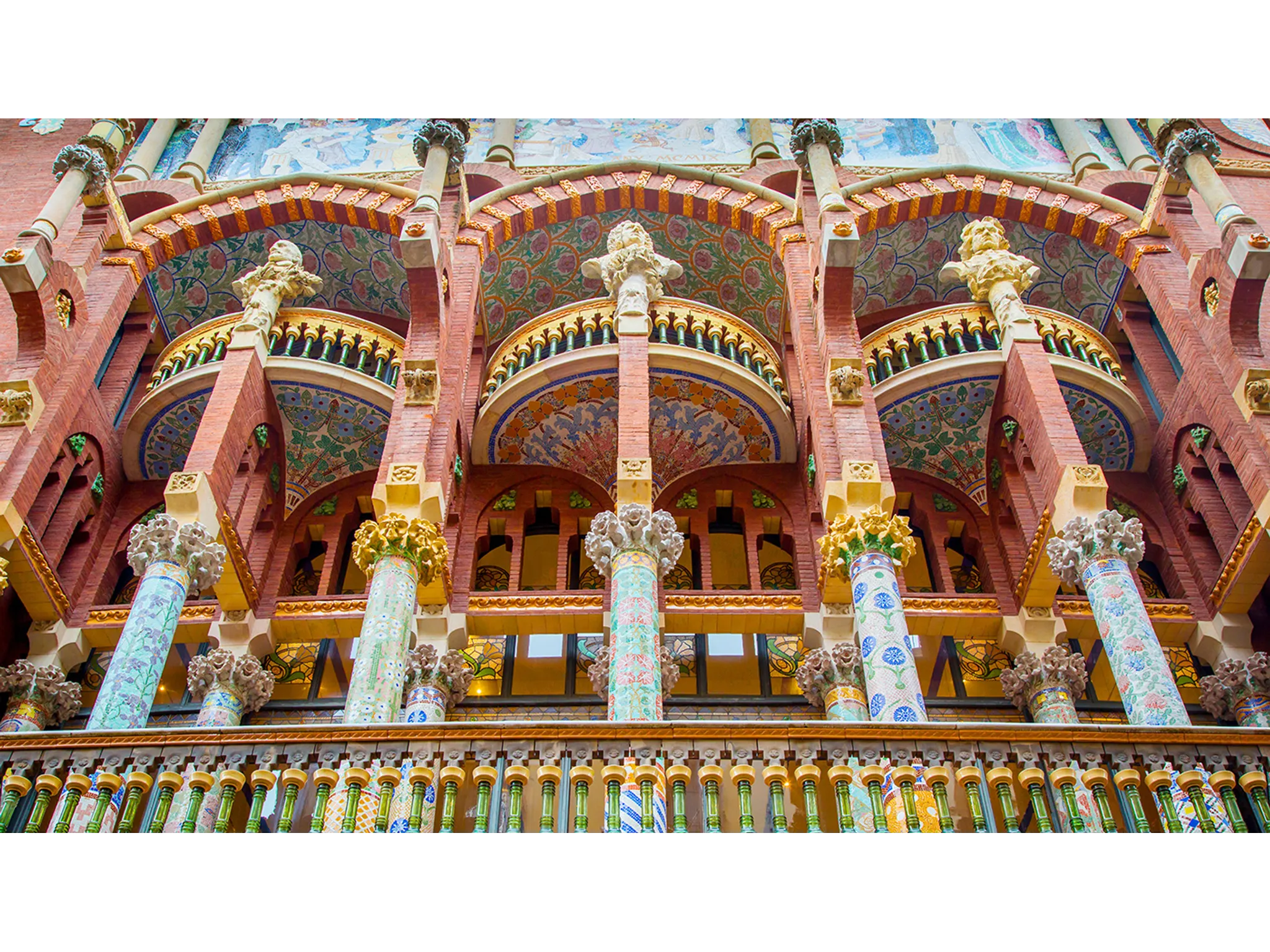
In Barcelona, a luminous masterpiece of Catalan modernism brings stained glass, sculpture and decorative craftsmanship into a remarkable conversation with sound.
by Nicolò Di Stefano

There are buildings whose most memorable feature is a façade. At the Palau de la Música Catalana, the defining gesture unfolds overhead: a stained-glass skylight curves downward into the concert hall, bringing the sky into the room through colour.
Its inverted form gives the ceiling an extraordinary presence. Light passes through a surface that seems to descend towards the audience, drawing the eye upward before a performance has even begun. Around it, mosaics, sculpture and glass create an interior where almost every direction offers another detail to discover.
Designed by Lluís Domènech i Montaner and inaugurated in 1908 as the home of the Orfeó Català choral society, the Palau is one of Barcelona’s defining works of Catalan modernism. It was inscribed on UNESCO’s World Heritage List in 1997, together with the architect’s Hospital de Sant Pau.
Its appeal reaches beyond architectural history. The building offers an unusually vivid example of how an interior can shape attention, encouraging visitors to look closely, follow a pattern and become conscious of the light around them.
A ceiling that changes the room
The concert hall’s central skylight represents the sun. Beneath it, the stage is framed by sculptural figures, including muses and Wagner’s Valkyries, while the organ gives the composition a commanding focal point. Flowers, palms and fruit appear among the decorative motifs, bringing references to the natural world into the musical setting.
The skylight introduces a fascinating reversal. A dome conventionally suggests a volume rising away from the observer; here, the glass curves into the space. Its downward movement makes the ceiling feel close and sculptural, despite the scale of the hall.
This is where the Palau becomes particularly compelling as an interior design story. Colour occupies the architecture itself. It is embedded in surfaces, carried by glass and distributed through the room by daylight. The building invites us to consider illumination as a material with its own expressive possibilities.

The innovation beneath the ornament
Behind this elaborate decorative language lies a significant structural achievement. UNESCO identifies the Palau’s steel framework as central to its architectural importance: it enabled expansive interior spaces and substantial areas of glass, opening the building to natural light.
That relationship gives the interior much of its force. The engineering creates room for transparency, while the decorative arts give those openings texture, colour and identity.
The apparent abundance is therefore supported by a clear spatial idea. Daylight connects the room to the world outside, and ornament gives that connection a distinctive character. Seen this way, the Palau’s richness has an architectural purpose: it makes the experience of light visible.

Beauty between performances
The building’s quieter spaces extend the experience beyond the auditorium.
The Sala Lluís Millet was conceived as a salon for relaxation and social gatherings. Rising through two storeys, it features large stained-glass windows with floral motifs, beyond which stands an ornamental balcony with a double colonnade. The foyer offers another atmosphere, bringing together broad brick arches, green glazed ceramics and floral decoration.
These rooms give the Palau a rhythm of its own. The concert hall concentrates attention on the stage and skylight; the salon encourages a slower examination of windows, surfaces and the relationship between interior and balcony.
Even the approach to the auditorium contributes to the experience. The grand staircase, with its glass balusters, turns movement through the building into an encounter with craftsmanship.
For an architecture feature, these transitional spaces deserve attention. They reveal how a building sustains its character beyond its most photographed room.
A cultural landmark still in use
The Palau continues to function as a concert venue, while architectural visits open its principal spaces to a wider public. Its musical purpose remains part of everyday life in the building.
This continuity matters. An auditorium acquires meaning through the people who gather there, the anticipation before a performance and the shared attention that follows. Architecture provides the setting for those experiences, and repeated use keeps that setting alive.
For QEditorial, the Palau de la Música Catalana offers a powerful subject because its beauty can be explored at several scales: the sweep of the hall, the curve of the skylight, the pattern of a mosaic and the detail of a glazed surface.
Together, they suggest a generous approach to design—one that gives technical invention and skilled craftsmanship room to speak through the same building.
Long before the first note, the room has already asked us to pay attention.
Discover the Palau de la Música Catalana

Editor’s Note
What draws me to the Palau de la Música Catalana is the way its architecture makes us look more carefully. The stained-glass skylight, the intricate mosaics and the sculptural details give each part of the interior its own presence, while bringing everything into a coherent composition.
For me, this Barcelona landmark captures something essential about exceptional interior design: the ability to create an emotional connection through light, materials and craftsmanship. Lluís Domènech i Montaner’s vision offers a beautiful expression of Catalan modernism, and a reminder of how much character human artistry can bring to a space.
At QEditorial, I want to celebrate places that expand our understanding of beauty. The Palau de la Música Catalana belongs in that conversation because its architecture invites attention, curiosity and a lasting appreciation for the details.

Photography: Palau de la Música Catalana media kit, except where otherwise credited. Images are presented for editorial and informational purposes. All copyrights remain with their respective photographers and rights holders.


Leave a Reply