
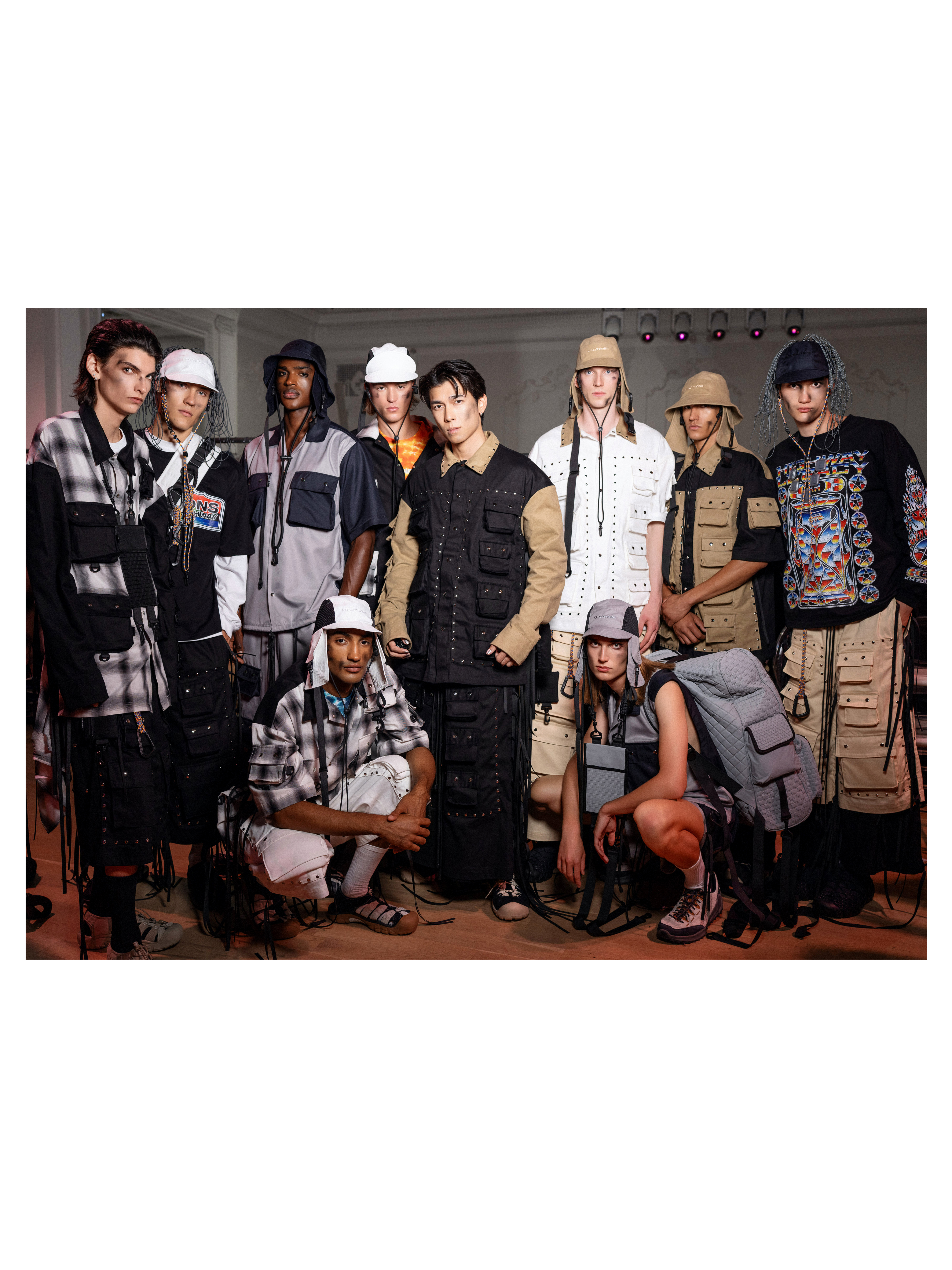
An unexpected shoot, ten collection looks, and details that brought him back to his Thai childhood. In an exclusive QEditorial interview, Toni discusses finding his perspective between the runway and the people working behind it.
by Nicolò Di Stefano

Shortly before the KH Editions show, Toni needed a wall.
The designer wanted individual photographs of the models wearing the collection. Backstage was already busy, and there was little time to establish a shooting area. Toni found a background he thought would work, moved a few objects aside, and began photographing the looks.
The opportunity had not been planned in advance. He had arrived with an assignment to photograph actor Mew Suppasit backstage; now he was making a series of all ten looks, deciding on composition and lighting while the preparations continued around him.
Looking back, it is this series that he remembers with particular satisfaction. Within a short window, he had managed to give the collection the mood he wanted.
“For me, it wasn’t simply about photographing all ten looks,” he tells QEditorial. “It was about presenting the collection through my own photographic perspective.”
That perspective began taking shape far from the press pit. Toni first photographed travel destinations and the street, before an encounter with a group of photographers working with models in the city prompted him to try fashion photography. He began attending photo walks and photography conferences in different cities. Working with models and clothes became a growing interest, then a direction he wanted to pursue.
Fashion Week required him to put that work in front of people he did not yet know. He sent emails to organisations, sharing photographs posted on his Instagram. Initially, there were no responses. Eventually, two shows offered him access to the press pit.
His first New York Fashion Week experience was crowded, unfamiliar, and demanding. Photographers were trying to secure positions; Toni was learning what it meant to photograph a show from within that group. When the models began walking, he remembers the music and, especially, the sound of his own camera shutter.
The experience made him want to return. It also introduced a working condition that would become familiar: the photograph had to be made within an event whose timing he could not control.
Moving backstage brought a different set of decisions. On the runway, he photographed the finished presentation. Behind it, he encountered the separate responsibilities that allowed the presentation to happen. Hair, makeup, styling, production, and photography were taking place in a shared space, with everyone working toward the same deadline.
When QEditorial asked which part of Fashion Week most interested him, Toni chose backstage. The front row offered the guests and the atmosphere surrounding the show. The runway brought the designer’s work together. Backstage gave him access to the people whose contributions an audience might never see individually.
“For me, those behind-the-scenes moments are especially interesting because they show the people and the work behind the final presentation.”
Access, however, does not mean that every moment should become a photograph. His answers repeatedly return to the need to understand what is happening around him before raising the camera.

Backstage access brings you close to people under pressure. How do you earn their trust?
“One of the most important things for me when working backstage is respecting everyone around me.
“Backstage is a busy environment where everyone is working under pressure, with limited time and space. I always try not to interrupt anyone’s work and to understand when it is appropriate to take a photograph.
“For example, if I see a model changing clothes, I immediately lower my camera or change my shooting direction to respect their privacy.
“I believe knowing when not to take a photograph is just as important as knowing when to capture a moment.”
That last observation gives a fuller sense of how Toni understands his role. His presence has to accommodate the people he photographs. A hairstylist finishing a look needs space; a model changing needs privacy. The photographer’s judgement includes recognising when his own work must wait.
Within those boundaries, he looks for opportunities to create an image with atmosphere. Light and shadow are central to the way he describes his photographs. He wants to communicate the clothing while allowing mood and emotion to influence how it is seen.
“I don’t believe every part of an image needs to be brightly lit to communicate fashion,” he says.
The distinction matters when photographing a collection. A clear view can explain a garment, but Toni is also interested in what a photograph makes the viewer feel. In his approach, areas of shadow can contribute depth and character. His aim is to retain the story of the clothes within that treatment.
At KH Editions, this preference had to work across ten different looks. He used full-body photographs to show the overall designs and silhouettes, and close-ups to bring particular elements forward. Light, shadow, and mood would connect the series.
Before any of those decisions, there had been a much more specific reason for his presence.

How did your involvement with KH Editions for this New York Fashion Week presentation begin? What was your assignment, and what creative freedom did you have within it?
“My involvement with KH Editions began when I was assigned by a producer to photograph actor Mew Suppasit backstage for Vogue Thailand during New York Fashion Week.
“Mew was walking in the KH Editions show, and through that assignment, I had the opportunity to meet and speak with the designer. This eventually led to me photographing the brand’s backstage moments and all ten looks from the collection.
“What I enjoy about backstage photography is the creative freedom. There are opportunities to capture models before they walk the runway and to express my own photographic style.
“At the same time, it can be very challenging. There is limited time, little space, and many people moving around. Models also need to be ready for lineup before the show.”
“It was an honor to photograph Mew Suppasit backstage at NYFW, and I’m truly grateful to Vogue Thailand for the opportunity,” Toni adds.
Toni had not known the brand before entering backstage that day. His first impression came from the clothes hanging there: black, grey, white, and brown, with what he describes as a streetwear feeling. There was little opportunity for a longer conversation about the collection.
His understanding therefore developed through photographing it. Finding the wall gave him a consistent setting; working through the looks allowed individual details to emerge.
One of those details reached beyond the immediate assignment. A large backpack reminded him of traditional Thai handicrafts he had known during childhood. Its woven texture caught his attention, and he changed the model’s position to photograph it more closely.

Choose one look that you would like QEditorial readers to examine closely. What drew you to it?
“One of my favorite looks is the one with the model carrying a large backpack.
“I was particularly drawn to the woven texture of the bag because it reminded me of traditional Thai handicrafts that I was familiar with during my childhood.
“Besides photographing the outfit from the front, I wanted to highlight the backpack because I found its design very interesting.
“I asked the model to turn around and pose at approximately a 45-degree angle.
“This allowed me to capture both the shape and the side details of the bag, showing its design from a different perspective.”
The turn was a small instruction with a specific purpose. It made room in the photograph for the object that had caught his attention.
Another accessory, worn in the final look, reminded him of a traditional Thai Buddhist amulet necklace. He describes both associations through his own background. They are personal readings of the collection, and they offer a concrete answer to a larger question running through our conversation: where does the photographer enter the image?
Here, Toni enters through recognition. His childhood influences which texture he notices and which accessory he examines. That attention then becomes a choice of angle, a closer view, or a request to the model. Personal memory has a practical consequence in the making of the photograph.
His work with Mew unfolded within the same compressed schedule. When the actor arrived, Toni recorded short clips during hair and makeup. While waiting for the complete look, he continued photographing other models. Once Mew was dressed and ready, he made photographs and additional short videos.
By then, the team was calling models to line up and making final adjustments. Toni recalls little time for conversation. He concentrated on capturing the available moments.
After photographing all ten collection looks, he moved to the front of the runway to prepare to record video of the show. The assignment carried him from preparations and individual portraits into the presentation itself.

When you reviewed the KH Editions photographs, which image stayed with you most—and why?
“I think the photographs that will stay in my memory the most are the images of all ten looks from the KH Editions collection.
“The shoot wasn’t planned in advance, and everything had to be done within a very short time.
“Being able to photograph all ten looks and achieve the mood and visual style I had in mind was something I felt very proud of.
“Technically, not every image may be 100% perfect, but I am still very happy with the results and what I was able to create under those conditions.”
His answer locates the achievement in the series as a whole. He remembers the circumstances and the satisfaction of carrying an approach through them. He also keeps a group photograph from the day as a personal memory, alongside the photographs he says were featured by Vogue Thailand.
The experience of working backstage now informs his fashion editorials. Making quick decisions about angles, composition, lighting, and communication has given him greater confidence when a shoot offers more time. He can devote that time to developing ideas, drawing on instincts exercised under pressure.
Asked what photographing other people’s creative work has taught him about his own identity, Toni describes fashion photography as a place where he can express feeling, imagination, and personal perspective.
The KH Editions assignment makes that answer tangible. His perspective appeared in the atmosphere he wanted across the ten looks, in the woven texture that recalled his childhood, and in the decision to turn a model so that a bag could be seen differently.
The wall was an available background. What Toni made against it depended on what he brought into the room.
This interview has been edited and condensed from Toni’s written responses. Selected passages have been brought together by theme.

A personal acknowledgment from Toni
“It was an honor to photograph Mew Suppasit backstage at NYFW, and I’m truly grateful to Vogue Thailand for the opportunity.”
Editor’s Note
It has been a pleasure to have the opportunity to tell Toni’s story through this exclusive QEditorial interview. Exploring his approach to fashion photography and his experience backstage at New York Fashion Week offered an insight into the person behind the camera—the memories that guide his attention, the atmosphere he creates through light and shadow, and the respect he brings to the people he photographs.
His account of photographing KH Editions and Mew Suppasit reveals how a personal perspective takes shape within the pace of NYFW backstage photography. I particularly appreciated his observation that knowing when to lower the camera matters as much as knowing when to take a photograph.
Thank you, Toni, for sharing your journey and allowing QEditorial to introduce our readers to the thought and sensitivity behind your images.

Discover Toni’s work
Website: tonychuvani.com
Instagram: @tonychuvani
QEditorial Magazine Fahion Culture Identity

Photography & Credits
All photographs featured in this article are by Tony Thanawat Chuvanichanon and are published with his permission for editorial use by QEditorial. Copyright remains with the photographer. Any further reproduction or use requires prior permission from the respective rights holders.
Models — Instagram credits provided by the photographer
@leoquantesti · @lancebrdaric · @benjireidd · @giovannircanela · @zack.carton · @sam.albano · @julianfoxriker · @mayervelli · @allanurba · @mewsuppasit


Leave a Reply