

Created by designer Sasha Selipanov, Nilu27’s first automobile combines a naturally aspirated V12 revving to 11,000 rpm, a manual gearbox, and a body shaped around its mechanical architecture.
The NILU in motion reveals the philosophy behind Nilu27: a naturally aspirated V12, lightweight engineering, and design shaped by mechanical precision. Every surface, proportion, and movement reflects Sasha Selipanov’s vision of a hypercar created for driver engagement rather than digital intervention.
Video courtesy of Nilu27. Used for editorial purposes only.
The first ignition of the NILU engine took place on June 17, 2026, in New Zealand. The naturally aspirated 6.5-liter V12, developed with Hartley Engines, produced more than 1,070 horsepower during its initial dyno testing while reaching its intended 11,000 rpm redline. For Nilu27, the young automotive company founded by designer Sasha Selipanov and his wife Inna, the milestone marks the transition from concept to a functioning prototype.
NILU enters a segment where performance is increasingly defined by hybrid powertrains, software, and advanced electronic systems. Selipanov chose a different mechanical philosophy: a naturally aspirated engine, rear-wheel drive, and a seven-speed manual transmission with an exposed open-gate shifter. Inside the cockpit, the central touchscreen has been eliminated in favor of analog gauges, physical switches, and controls placed within immediate reach of the driver.
Those decisions define the NILU more clearly than its performance figures alone. The car belongs to a small generation of hypercars designed around the physical relationship between driver and machine. The clutch, the movement of the gear lever, engine speed, and steering response all become integral parts of the driving experience. Electronics remain present where necessary without becoming the dominant language of the automobile.
From the Bugatti Chiron to an Independent Vision

Sasha Selipanov has built his career at some of the world’s leading automotive design studios. His experience includes positions within Volkswagen Group, Lamborghini, Bugatti, and Genesis before becoming Head of Design at Koenigsegg. His portfolio includes projects such as the Bugatti Chiron, Lamborghini Huracán, Genesis Essentia, and Koenigsegg Gemera.
With Nilu27, Selipanov has been able to create an automobile entirely from his own vision, without adapting it to the design language of an established manufacturer. The name NILU combines the names of the couple’s daughters, Nica and Lucia. The number 27 references one of the most recognizable racing numbers in motorsport history, associated with drivers including Gilles Villeneuve and Jean Alesi.
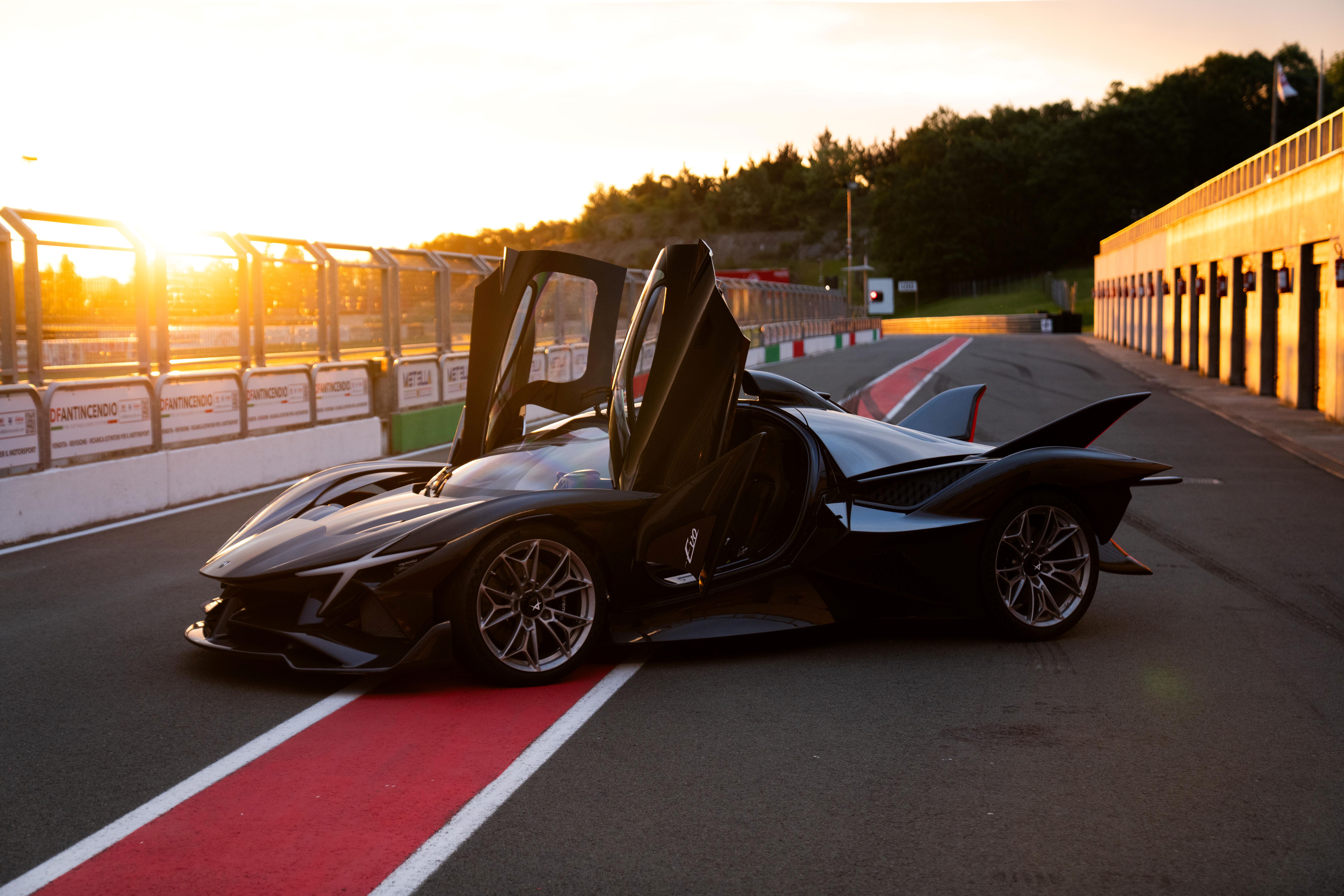
The bodywork reflects that creative freedom. A low front end is framed by large air intakes, while the sweeping windshield wraps around a compact cockpit positioned at the center of the chassis. Sculpted side surfaces rise over the wheels before flowing into a rear section that deliberately exposes the suspension, chassis structure, and mechanical components.
The engine becomes the visual centerpiece of the rear design. The twelve cylinders remain partially visible, while three high-mounted exhaust outlets emerge in a triangular arrangement. Rather than concealing the mechanical architecture beneath smooth panels, the design celebrates collectors, suspension arms, structural elements, and engineering details as part of the overall composition.
A Naturally Aspirated V12 Designed Without Compromise

The engine developed by Hartley Engines features an 80-degree, naturally aspirated V12 configuration with a displacement of 6.5 liters. It produces more than 1,070 horsepower at 11,000 rpm and delivers 860 Nm of torque at 7,000 rpm. Nilu27 originally targeted more than 1,000 horsepower, with the first dyno tests already exceeding that objective.
The absence of turbochargers defines the engine’s immediate throttle response, sound, and power delivery. Its 11,000 rpm redline places the powertrain close to the engineering philosophy of racing engines while maintaining the displacement necessary to deliver substantial torque.
Power is transmitted through a seven-speed manual gearbox supplied by CIMA. The open-gate shifter occupies the center of the cockpit, where every gear engagement remains visible and mechanical. The gear lever becomes one of the interior’s defining visual and functional elements.

The chassis combines a carbon-fiber monocoque with aluminum alloy subframes. Dry weight is approximately 1,200 kilograms, an exceptionally low figure considering the engine size and performance potential. Double-wishbone pushrod suspension, Brembo carbon-ceramic brakes, and Michelin Pilot Sport Cup 2 R tires complete the technical package.
Top speed is electronically limited to 400 km/h. Nilu27 has not released an official 0–100 km/h acceleration figure, acknowledging that performance also depends on the driver’s ability to manage the clutch, manual gearbox, and rear-wheel-drive layout.
A Cockpit Designed Around Driving

Inside, the driving position revolves around a compact steering wheel, analog instrumentation, and physical controls. The central gear lever defines the architecture of the entire cabin, while the seats integrate directly into the structural layout surrounding the occupants.
Materials follow function. Machined metal, carbon fiber, leather, and technical finishes remain visible and honest. Components are presented for what they are rather than disguised behind decorative lighting or animated digital interfaces.
Gullwing doors open a large portion of the roof structure, improving access to the carbon-fiber monocoque while revealing the relationship between the continuous exterior surfaces and the compact cockpit. The result delivers the visual drama expected of a modern hypercar while maintaining clear mechanical logic.
A Limited Production for a Select Group of Owners

The initial production program includes fifteen track-only examples followed by a series of road-legal vehicles. Earlier plans indicate 54 road-going cars, although final production specifications, pricing, and delivery schedules will be confirmed as development progresses.
The successful first engine start significantly reduces the distance between the concept unveiled in 2024 and a fully operational automobile. The next phase focuses on integrating the V12 into the chassis, dynamic development, and prototype validation at Nilu27’s European facilities.
NILU occupies a distinctive position within today’s hypercar landscape. Its significance lies in the consistency between design, engineering, and mechanical philosophy. Every component supports the same objective: creating a lightweight, naturally aspirated, manually shifted automobile that allows the driver to experience the mechanical process directly.
The project’s ultimate success will depend on testing, homologation, and Nilu27’s ability to bring such a complex machine into production. The first ignition of its bespoke V12, however, already demonstrates that Selipanov’s vision has moved beyond concept and into reality.
Editor’s Note
In an era where software increasingly defines the driving experience, projects such as the Nilu27 NILU remind us that automotive engineering remains a form of industrial design shaped by materials, mechanics, and human interaction. Whether this approach becomes a broader movement or remains the vision of a small group of manufacturers, it reflects a continuing interest in naturally aspirated engines, manual transmissions, and automobiles designed around the driver.
At QEditorial Magazine, we follow these developments because they reveal how innovation is expressed across design, engineering, and culture. Discover more editorials on luxury mobility, hypercars, and automotive design at QEditorial.com




Leave a Reply