
Inspired by Yakushima’s ancient landscape, the Japanese couturier transforms clay, silk, movement, and sound into a deeply personal language of experimental fashion.

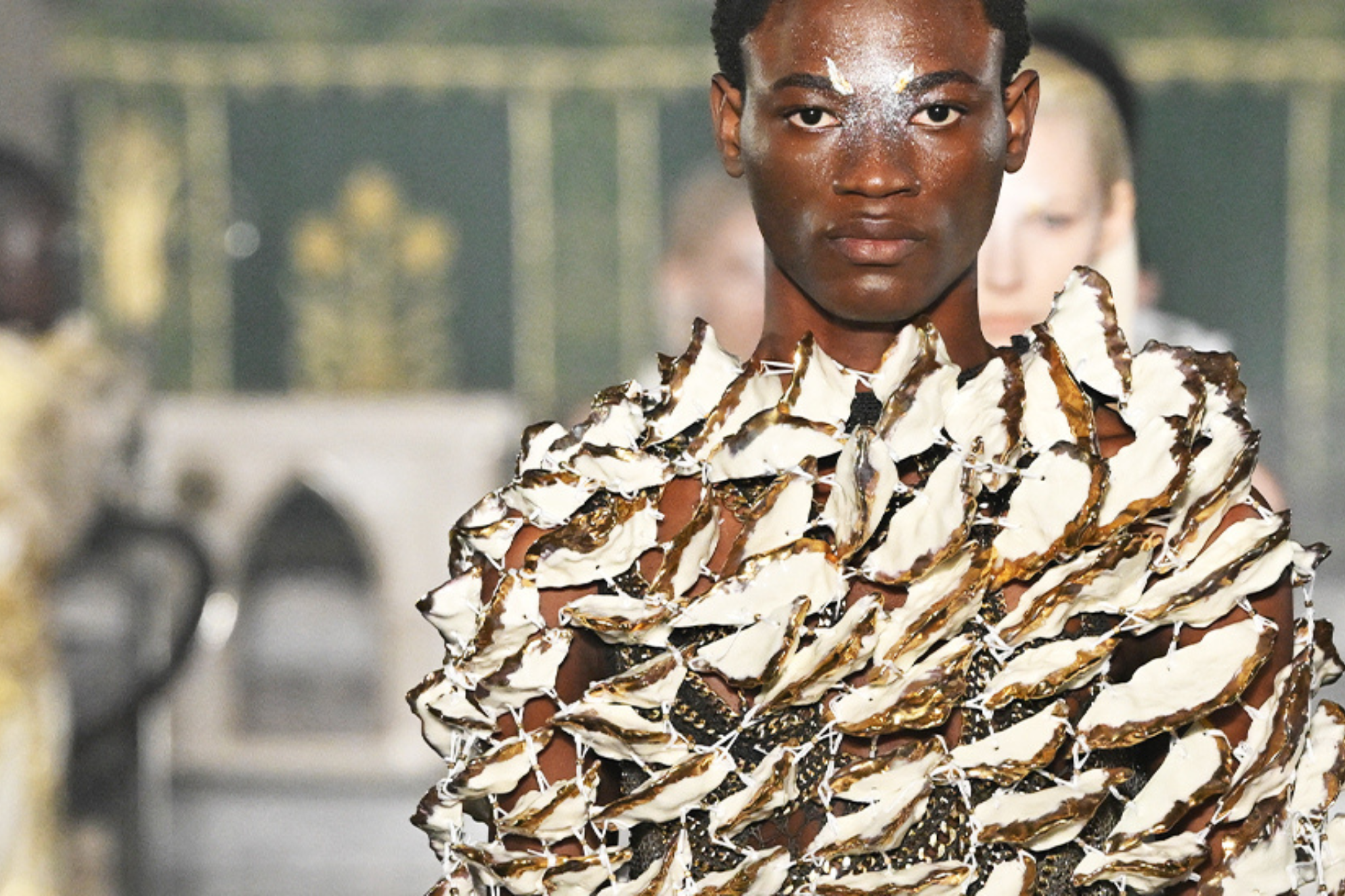
A faint ceramic sound followed each model through the American Cathedral in Paris. There was no conventional soundtrack. The rhythm of the runway emerged from the garments themselves as thousands of handmade ceramic elements shifted, touched, and responded to the movement of the body.
For his Spring/Summer 2026 haute couture collection, Silent, Japanese designer Yuima Nakazato approached clothing as a sensory experience. Clay became sound. Silk acquired structure without losing its delicacy. The body moved through the space as part of a larger composition connecting material, landscape, technology, and time.
Presented during Paris Haute Couture Week, the collection reveals what makes Nakazato’s creative language so distinctive: his ability to treat materials as active participants rather than passive surfaces.
An Independent Voice in Contemporary Couture
Born in Japan in 1985, Nakazato studied at the Royal Academy of Fine Arts Antwerp, graduating in 2008. He established his company in 2015 and began presenting on the official guest calendar of Paris Haute Couture Week the following year.
His work now extends across fashion, sculpture, performance, opera, ballet, technology, and museum exhibitions. Yet his collections remain grounded in one central question: how can clothing respond more closely to the individual body and to the world from which its materials originate?
Nakazato is no longer an emerging designer in the conventional sense. He is an independent avant-garde couturier with an established international presence, although his work continues to exist outside the scale and commercial structure of the major fashion houses.
That independence gives him space to investigate materials with unusual depth. Every collection becomes a laboratory in which traditional craft, digital processes, and natural matter are placed in dialogue.
Yakushima as a Creative Source
The starting point for Silent was Nakazato’s journey to Yakushima, an island in Japan’s Kagoshima Prefecture known for its ancient cedar forests, intense rainfall, rivers, moss-covered stones, and exceptional biodiversity.
He observed pieces of driftwood marked by visible growth rings and river stones gradually softened by water. These natural forms offered a record of movement and time. Nothing appeared completely fixed. Wood, rock, and soil continued to change through contact with weather, moisture, and surrounding organisms.
Nakazato translated these observations through construction rather than literal imagery.
The garments do not reproduce the forest as decorative print. Its presence emerges through curved surfaces, layered fragments, irregular textures, and silhouettes that shift as the body moves. Pale, translucent fabrics suggest mist and reflected light, while earthy brown, muted gold, silver, and shadowed green evoke mineral deposits, bark, water, and soil.
Each look appears to belong to the same ecosystem, though no two are identical.
This is central to Nakazato’s style. He frequently begins with a landscape, memory, or social question and allows it to determine how the material should behave. The concept is embedded within the construction of the garment.
Clay Transformed into Movement
Ceramic is the collection’s most powerful material.
Over six months, Nakazato reportedly spent more than 1,500 hours working personally with clay, forming thousands of individual components by hand. The repetitive process allowed his fingers to internalize the rounded, eroded shapes he had observed in Yakushima.
The resulting forms retain small variations. Each piece records pressure, movement, heat, and direct contact with the maker’s hand.
Nakazato attached these ceramic components to the garments so that they could move with the wearer. A material normally associated with still objects, vessels, sculpture, and architecture became flexible through its relationship with the body.
As the models walked, the ceramic pieces touched one another and generated delicate, irregular notes. Every step produced a slightly different sound.
The effect was neither decorative nor theatrical for its own sake. Ceramic became structure, ornament, movement, memory, and soundtrack at once.
This transformation explains much of Nakazato’s originality. He does not select an unusual material simply to create a striking runway image. He studies its physical characteristics and asks how they can alter the way a garment is constructed, worn, heard, and understood.
Clay retained its fragility and weight. Those qualities were never disguised. Instead, they became part of the emotional experience of the collection.
Materials That Preserve the Hand

Haute couture is defined by extensive manual labour, yet its most demanding processes are often hidden within a perfectly finished surface.
Nakazato allows the process to remain visible.
The ceramic pieces preserve the differences created by the hand. Layered textiles reveal how individual fragments have been assembled. Raw edges expose the precision of the cut. Surfaces appear organic because they retain traces of their construction.
His clothes frequently carry a tension between control and natural irregularity. The silhouette may be carefully engineered, while the individual components seem to grow, gather, or shift across the body.
This balance gives his work its recognisable character.
The garments appear futuristic without relying upon the familiar visual language of metallic costumes or technological spectacle. Their innovation comes from how materials are manipulated and connected. Ancient processes and contemporary research occupy the same object.
In Silent, the ceramic elements might resemble stones, seeds, shells, scales, fragments of bone, or objects recovered from an unknown archaeological site. Their meaning remains open, allowing the audience to form personal associations.
Silk Reshaped Through Invisible Technology
The softer dimension of the collection emerged through silk and translucent natural-fibre textiles.
As part of Nakazato’s continuing collaboration with Epson, digitally applied transparent ink was used to influence the behaviour of the fabric. The treatment helped prevent fraying, allowing silk to be cut into precise raw-edged forms while maintaining its lightness and fluidity.
The technology remains invisible on the finished garment. Its presence is revealed through what the textile becomes capable of doing.
Sections of silk curve away from the body without appearing heavy. Thin layers overlap while retaining clearly defined edges. Translucent fragments create volume through accumulation rather than conventional internal structure.
Nakazato’s use of technology is particularly refined because it rarely dominates the visual narrative. Digital processes support the material while preserving its tactile and organic identity.
The result feels advanced without becoming impersonal.
This distinguishes his work from fashion that treats technology as a theme or surface effect. Nakazato uses innovation as a tool for expanding the physical vocabulary of clothing.
The Body Activates the Garment

A Yuima Nakazato garment is rarely complete when viewed as a still object.
The body activates it.
Movement changes the arrangement of the ceramic components. Silk separates and overlaps with each step. Light passes through translucent layers. Sound appears and disappears according to the wearer’s pace.
This relationship gives the clothes a performative quality, shaped partly by Nakazato’s work in opera and ballet. He understands how a garment behaves over time and how its meaning changes when it enters a space.
In Silent, models did not simply display completed looks. Their bodies generated the final composition.
The absence of conventional runway music made this especially clear. Footsteps, fabric, breathing, and ceramic resonance became perceptible. The audience was encouraged to notice the quiet physical details normally covered by sound and spectacle.
The presentation became an act of concentrated observation.
A Couture Language Between Nature and Experimentation
Nakazato’s work occupies a rare space within contemporary couture.
His collections are grounded in nature, but they avoid romantic nostalgia. They employ technology without adopting a cold futuristic aesthetic. They preserve traditional handwork while questioning how clothing should be produced and adapted to different bodies.
These elements remain connected through his treatment of materials.
Clay is respected as clay, with its density, instability, and connection to the earth. Silk retains its softness even when digitally altered. The wearer remains visible within the garment rather than disappearing beneath technique.
This creative honesty gives his designs authority.
Nakazato allows each material to contribute its own limitations. Fragility, weight, translucency, irregularity, and movement become creative resources. The collection develops through collaboration with those qualities rather than through an attempt to control or conceal them.
The result is a form of couture that feels both ancient and speculative.
Beyond the Runway Image
The visual impact of Silent is immediate. Ceramic clusters, sculptural surfaces, translucent layers, and organic silhouettes create powerful runway photographs.
Yet the collection cannot be fully understood through images alone.
Its identity depends upon the sound produced during movement, the weight of the ceramic, the changing transparency of the textiles, and the time required for each look to cross the space.
Nakazato’s practice challenges the increasingly accelerated way fashion is consumed. His garments reward proximity and attention. The details reveal themselves gradually.
This quality also connects his fashion to installation and performance art. The clothing remains functional on the body, while creating an environment around the wearer.
In 2024, the Cité de la Dentelle et de la Mode in Calais presented the designer’s first monographic exhibition, Yuima Nakazato: Beyond Couture. In 2026, archival looks were selected for preservation by The Metropolitan Museum of Art in New York, confirming the broader cultural significance of his work.
These institutional milestones place Nakazato beyond the category of seasonal fashion. His garments belong to an ongoing investigation of craft, technology, ecology, and human identity.
What Makes Yuima Nakazato Unique

Nakazato’s originality does not depend upon a single signature silhouette.
His identity is found in his method.
He begins by examining a material, environment, or human need. He then develops techniques that allow the garment to communicate that investigation physically. Concept, construction, and presentation remain inseparable.
In Silent, the ancient landscape of Yakushima becomes visible through clay shaped by hand, silk altered through digital research, and silhouettes animated by movement. The collection never turns nature into an ornamental theme. It studies how natural processes—erosion, growth, accumulation, transformation—might become methods of making clothes.
This approach creates garments that appear alive.
Their surfaces change. Their components respond. Their sound depends upon the wearer. Their final form is never entirely static.
For Nakazato, couture becomes a relationship between material and body, maker and environment, technology and memory. The uniqueness of his work lies in the precision with which he holds these relationships together.
With Silent, he created a runway where clothing could be seen, heard, and physically sensed. Clay carried the memory of the hand. Silk held the trace of invisible technology. The body connected both materials through movement.
The collection offered a clear expression of Nakazato’s creative vision: fashion as an evolving ecosystem, built through attention to what every material is capable of becoming.
Editorial Note
Yuima Nakazato’s Silent collection demonstrates the expressive possibilities of Japanese experimental couture through a precise dialogue between ceramic, silk, technology, and movement. Inspired by Yakushima’s ancient landscape, the Spring/Summer 2026 collection translates natural processes into construction, sound, and sculptural form.
Nakazato’s distinctive style emerges from his ability to preserve the identity of each material while expanding its role within clothing. His ceramic garments, digitally treated textiles, and body-responsive structures propose a form of sustainable haute couture grounded in craftsmanship, material research, and careful observation.





Leave a Reply