
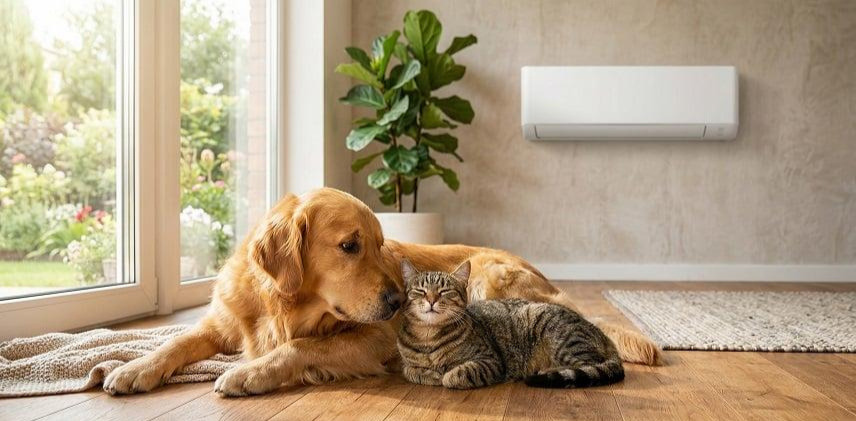
How temperature, humidity, and airflow can quietly affect dogs and cats during summer.

Can Air Conditioning Make Your Pet Sick?
You installed the air conditioner to keep everyone in your home comfortable. Your dog is sprawled on the floor nearby, your cat has found a quiet spot under the vent, and everything appears fine — maybe even ideal.
But here is the question many pet owners rarely think to ask: could the way we use air conditioning be making our pets uncomfortable, or even affecting their health?
Not in a dramatic, rush-to-the-emergency-room kind of way. More often, the issue is quiet, gradual, and easy to miss. Air conditioning itself is not the problem. In fact, during extreme summer heat, it can be an essential tool for preventing heat-related illness. The risk comes from using it without considering the animal sharing the space.
For senior pets, flat-faced breeds, cats, small animals, and pets with respiratory or joint conditions, an overly cold room, direct airflow, or very dry indoor air can create real discomfort over time.
The Science Behind the Problem: The Thermoneutral Zone
Before discussing what can go wrong, it helps to understand what “comfortable” means for dogs and cats at a physiological level.
Every mammal has a thermoneutral zone, or TNZ: a temperature range in which the body can maintain its core temperature without spending extra energy to warm itself up or cool itself down. For domestic dogs, this range is generally estimated at around 68–86°F (20–30°C). For cats, it tends to be warmer, approximately 86–100°F (30–38°C), reflecting their evolutionary adaptation to warmer environments.
This does not mean that every dog or cat must live exactly within that range at all times. Age, breed, coat type, body condition, health status, humidity, airflow, and access to warmer or cooler areas all matter. But it does help explain why a room that feels perfectly comfortable to a human may feel too cold for a pet, especially a cat.
When an air conditioner is set to 64°F (18°C), or when a pet is confined in a room with direct airflow and no warmer area available, the animal may need to spend extra energy simply to stay comfortable. In many cases, the signs are subtle: curling into a tight ball, seeking warm surfaces, avoiding certain rooms, becoming less active, or appearing stiff after long periods of rest.
Three Risks of Poorly Used Air Conditioning
Abrupt temperature changes
The transition from a very hot outdoor environment to an aggressively cold indoor space is not always neutral for pets. Veterinary guidance on heat safety focuses primarily on the danger of overheating, which remains the more immediate and serious risk. However, sudden temperature contrast can still create physiological stress, especially for older animals, brachycephalic breeds, and pets with underlying respiratory or cardiac conditions.
This is particularly relevant in urban apartments during peak summer, where the difference between outdoor heat and indoor cooling can be significant. A moderate, gradual transition is generally safer than bringing a hot, panting animal directly into the coldest room in the home.
Joint stiffness and worsened arthritis
Cold environments can contribute to muscle tightness and joint stiffness. In pets with osteoarthritis or degenerative joint disease, this may translate into increased discomfort, reduced mobility, or hesitation when standing, jumping, or climbing stairs.
Direct airflow is especially important. A dog or cat sleeping for hours in front of an AC vent may experience prolonged cold exposure in one position, particularly around hips, shoulders, elbows, or the spine. For senior animals, placing beds away from vents and using supportive bedding can make a noticeable difference.
Respiratory dryness and airway irritation
Air conditioning removes moisture from the air. When indoor humidity becomes too low, the air can feel dry and irritating to the nose, throat, skin, and respiratory tract. Research on indoor air quality generally supports a relative humidity range of about 40–60% as a healthier indoor target.
For pets, especially those with existing respiratory conditions, dry air may contribute to nasal irritation, sneezing, coughing, or throat discomfort. Cats with asthma, dogs with chronic bronchitis, animals with collapsing trachea, and flat-faced breeds may be more sensitive to these changes.
High-Risk Groups
Senior Animals and Pets With Arthritis
Older dogs and cats are among the most silently affected by cold indoor environments. A senior pet that seems to be “slowing down with age” may also be reacting to a cold floor, a drafty sleeping spot, or hours of direct AC airflow.
For senior or arthritic pets, keeping indoor temperatures around 72–75°F (22–24°C) as a practical minimum is usually a reasonable approach. Orthopedic bedding, rugs, and resting areas placed away from vents can help reduce discomfort. If stiffness seems worse after long naps in an air-conditioned room, the AC setup is worth evaluating before assuming the condition has simply progressed.
Brachycephalic Dogs and Cats
Flat-faced breeds — including Bulldogs, French Bulldogs, Pugs, Boston Terriers, Persian cats, and Exotic Shorthairs — are especially sensitive to temperature and air quality because of their anatomy. Their shortened facial structure can narrow the upper airway and reduce their ability to regulate body temperature efficiently through breathing and panting.
This creates a real paradox. These animals often need air conditioning in summer because heat and humidity can be dangerous for them. At the same time, very cold air, direct drafts, and dry indoor environments can irritate already compromised airways.
The answer is not to avoid air conditioning. The answer is calibrated air conditioning: moderate, consistent cooling, humidity control, and no direct airflow on the animal’s resting area.
Young, Small, or Underweight Animals
Puppies, kittens, small-breed dogs, and underweight or debilitated animals may lose body heat more quickly than larger, healthy adult pets. They have less body mass and may have less efficient temperature regulation.
For these animals, a temperature that feels comfortable to an adult human may still feel too cold. Warm, insulated resting spots and access to a draft-free area are important, especially if the AC runs for long periods.
Pets With Existing Respiratory Conditions
Cats with asthma, dogs with chronic bronchitis, animals with collapsing trachea, and pets with any history of respiratory disease deserve extra attention in air-conditioned environments. Cold, dry air can irritate inflamed airways and may worsen coughing, sneezing, nasal discharge, or noisy breathing.
If your pet is already being treated for a respiratory condition, ask your veterinarian what indoor temperature and humidity range is best during summer.
A Practical Guide to Pet-Friendly Air Conditioning
Keep the temperature moderate
A setting around 72–79°F (22–26°C) is often a practical range for households with pets. It keeps the space cool enough to reduce heat stress while avoiding overly aggressive cooling. When leaving pets at home, avoid allowing indoor temperatures to rise too high, especially during extreme heat, since heat stress can become dangerous quickly.
Avoid direct airflow
Do not place beds, crates, food areas, or favorite sleeping spots directly under or in front of AC vents. The goal is to cool the room, not blow cold air directly onto the animal for hours.
Give pets a choice
Dogs and cats naturally seek microclimates: a cooler tile floor, a warmer rug, a shaded corner, a sunny patch, or a different room. Whenever possible, allow them to move between spaces so they can self-regulate.
Control humidity
Use a hygrometer to monitor indoor humidity. If the air becomes too dry, a humidifier may help maintain a healthier range, especially in homes where pets have respiratory sensitivity. The target is generally around 40–60% relative humidity.
Create a transition after walks
After a walk in high heat, avoid bringing your pet directly into the coldest room. Let them cool down gradually in a moderate area with fresh water available. This helps reduce abrupt thermal contrast.
Warning Signs to Watch For
The effects of cold indoor air are often gradual, so they can be easy to dismiss. Watch for:
Musculoskeletal signs: stiffness when rising, reluctance to jump or climb stairs, limping, or discomfort that seems worse after resting indoors.
Cold-stress behaviors: curling tightly, seeking warm surfaces, avoiding certain rooms, hiding away from vents, or unusual lethargy.
Respiratory signs: coughing, sneezing, nasal discharge, wheezing, or noisy breathing that seems connected to time spent in air-conditioned spaces.
Skin and coat changes: dryness, flaking, scratching, or increased shedding in very dry indoor environments.
None of these signs are caused only by air conditioning. They can reflect many medical conditions. But if they appear or worsen during summer, indoor temperature, airflow, and humidity are worth reviewing.
Final Thought
Air conditioning is not a hazard for pets. Used well, it is one of the most important tools for protecting animals from heat-related illness, especially during extreme summer weather.
The problem begins when cooling is too aggressive, airflow is directed onto resting animals, humidity is ignored, or pets are confined without the ability to choose a warmer or cooler area.
A pet-friendly indoor climate is moderate, stable, and flexible. It considers the species, age, breed, health status, and comfort of the animal in the home. For pets with arthritis, respiratory disease, or brachycephalic anatomy, a conversation with your veterinarian before peak summer can make a meaningful difference.
Written by Dr. Aldo Grijalva, Veterinarian
For QEditorial Magazine Pets

References
American Animal Hospital Association. Heatstroke in pets: Signs, risks, and what to do. https://www.aaha.org/resources/heatstroke-in-pets/
American Society for the Prevention of Cruelty to Animals. Hot weather safety tips. https://www.aspca.org/pet-care/general-pet-care/hot-weather-safety-tips
Cornell University College of Veterinary Medicine. Summer heat safety tips for dogs. https://www.vet.cornell.edu/departments-centers-and-institutes/riney-canine-health-center/canine-health-topics/summer-heat-safety-tips-dogs
Nashville Veterinary Specialists. Pet arthritis & winter safety tips: How to keep pets comfortable in cold weather. https://www.nashvillevetspecialists.com/blog/pet-arthritis-winter-safety-tips-how-to-keep-pets-comfortable-in-cold-weather
PETT2GO. AC for dogs in summer: Cooling comfort or hidden danger? https://www.pett2go.com/blogs/outdoor-tips-and-cares/ac-for-dogs-in-summer-cooling-comfort-or-hidden-danger
Rosewood Veterinary Practice. Winter and your dog. https://rosewoodvets.com.au/winter-and-your-dog/
VCA Animal Hospitals. Brachycephalic airway syndrome in dogs. https://vcahospitals.com/know-your-pet/brachycephalic-airway-syndrome-in-dogs
VCA Animal Hospitals. Brachycephalic airway syndrome in cats. https://vcahospitals.com/know-your-pet/brachycephalic-airway-syndrome-in-cats




Leave a Reply