
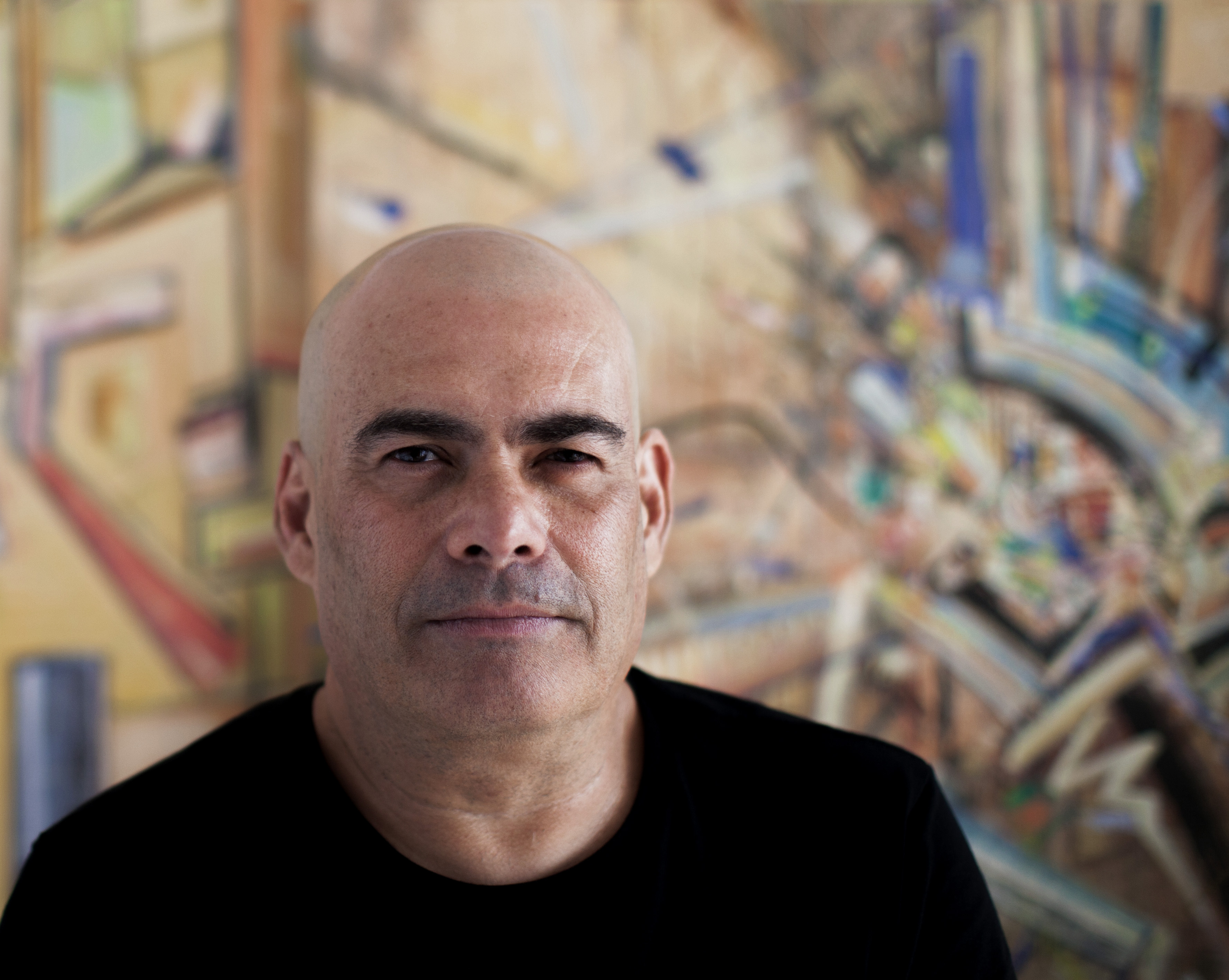
How music, movement, mathematics and digital technology shape Guillermo Arismendi’s evolving language of gesture, rhythm and abstraction.

In Guillermo Arismendi’s Carpe Diem VIII, lines appear to move before the eye has settled on them. Black marks cut across fields of electric blue; transparent planes overlap like fragments of architecture; flashes of turquoise, red and yellow interrupt the surface. Some gestures seem deliberate and measured, others arrive with the immediacy of handwriting. The image holds both impulses at once.
That tension runs through Arismendi’s work. Across Carpe Diem VII and Fiesta Roja, colour expands, lines bend and accelerate, geometric structures emerge and dissolve. The compositions suggest movement without describing a specific event. They operate through rhythm: a visual choreography in which control and improvisation continually exchange roles.
For Arismendi, this relationship has developed over more than three decades of painting and through a professional life closely connected to moving images. Born in Caracas, the Spanish artist studied Communication Arts and Advertising and has worked between Barcelona and Tenerife since 1990. His own biography records his establishment in Barcelona in 2000 and a parallel career as a senior post-production director and motion graphic designer.
Those disciplines matter when looking at his paintings. Arismendi has spent years working with images that exist through sequencing, layering, timing and transformation. His visual vocabulary has consequently developed through an unusually broad set of references. Music, dance, calligraphy and science are among the influences he identifies as central to his practice.
The result is abstraction that rarely feels static.
From Movement to Mark
In Carpe Diem VIII, movement is built through restraint. Vertical structures anchor the composition while curved black gestures stretch across a predominantly blue field. Smaller rectangles accumulate near the centre like compressed pieces of visual information. Their scale contrasts with the larger marks surrounding them, creating alternating moments of concentration and release.
Carpe Diem VII changes the tempo. Orange, yellow, purple, green and turquoise occupy a denser field, crossed by looping dark lines and energetic splashes of colour. The image carries the physical sensation of something unfolding quickly, yet its construction remains highly organised. Vertical divisions, rectangular fields and repeated directional marks keep the composition from collapsing into pure spontaneity.
Then there is Fiesta Roja. Red, coral and pink dominate the image, while thin lines, translucent geometries and small concentrations of saturated colour travel across the surface. Compared with Carpe Diem VII, its movement feels dispersed. Space becomes atmospheric. Marks appear at different visual depths, some close to the surface and others seemingly suspended behind it.
Across all three works, the eye is rarely given a single point of arrival.
Arismendi describes his creative process as a continuing dialogue with the work itself. Music and dance inform the colours and movements he introduces, while spontaneity guides gestures and palettes. Mathematics provides another kind of influence: accuracy, structure and discipline. His artist statement describes the process through a coexistence of chaos and order, allowing instinct to remain active without abandoning compositional control.
That idea gives the paintings an important internal logic. The geometry does not simply contrast with the expressive gesture. It gives the gesture somewhere to move.
Painting After the Screen

Arismendi’s relationship with digital technology developed from an existing painting practice. According to his biography, he began producing digital paintings alongside his oil works, attracted by the possibilities offered by high-resolution digital environments. He describes those tools as allowing a more experimental approach to colour and composition, while the exchange between traditional painting and digital art became increasingly important to his visual language.
This sequence matters.
The screen enters Arismendi’s practice as another working environment within a language already shaped by painting, drawing, post-production and motion graphics. His digital compositions retain many qualities associated with physical mark-making: irregularity, interruption, rhythm, transparency and the sense of one action responding to another.
Digital space, however, changes what can happen to those marks.
Layers can coexist without physically covering each other. Transparency can be adjusted rather than mixed. Elements can expand, contract, repeat, rotate or disappear. Colour can move beyond the restrictions imposed by pigment. A gesture can be preserved while the structure around it changes completely.
The screen therefore becomes less a destination than an expanded compositional field.
This makes Arismendi particularly relevant at a moment when discussions of digital art are increasingly dominated by generative artificial intelligence. His work belongs to a longer history of artists adopting technological tools as extensions of visual practice. The important question becomes less about whether an image was made physically or digitally and more about how an artist maintains authorship, intention and recognisable gesture while moving between those environments.
What remains of the gesture when the artist leaves the canvas for the screen?
In Arismendi’s work, quite a lot.
The Techspressionist Context
That relationship between emotional expression and technological process also places Arismendi within the expanding conversation around Techspressionism.
His exhibition history includes Techspressionism: Digital and Beyond at Southampton Arts Center in New York in 2022 and Hello Brooklyn: Techspressionism 2024 at Kingsborough Art Museum, according to the biography supplied by the artist.
The connection continued in 2025. Arismendi’s work was presented in Hello, Chelsea! // Techspressionism 2025 at Hudson Guild Gallery in New York, held from April 30 to June 25. The exhibition, curated by artist and Kingsborough College professor Tommy Mintz, followed the previous year’s Kingsborough museum exhibition and brought together more than 100 works by artists from over 20 countries.
Techspressionism describes a loose international movement concerned with the use of digital technologies for subjective and emotionally driven visual expression. Its significance for Arismendi lies less in supplying a label for the work than in providing a broader context for questions he has already been investigating: how technological tools can carry instinct, memory, gesture and individual visual language.
Arismendi’s trajectory is especially useful within that discussion because his artistic and professional histories overlap. Post-production, motion graphics, painting and digital image-making developed alongside one another. The distinction between technological and traditional practice consequently becomes increasingly porous.
The movement between them is visible in the work itself.
The Discipline Inside Improvisation

Look again at Carpe Diem VIII and the apparent contradiction begins to disappear.
The long black curve on the right appears immediate, almost impulsive, but it exists within an image structured by vertical axes, repeated rectangular forms and carefully controlled spatial relationships. In Carpe Diem VII, loops and splashes carry considerable energy, yet their movement is held by a framework of divisions and planes. Fiesta Roja similarly balances fine linear interruptions against broad areas of colour.
Arismendi’s interest in mathematics therefore feels less like an external intellectual reference than a compositional method. Precision gives freedom a framework.
Music offers another way to understand the paintings. Rhythm depends on both repetition and variation. Silence matters alongside sound. Dance depends on movement through an organised space.
Arismendi’s pictures behave similarly.
A line can act as an acceleration. A rectangle can function as a pause. A sudden concentration of colour creates emphasis before the eye is pushed toward another area of the composition. Shapes repeat without becoming identical. Visual events appear, disappear and return altered.
This is where the idea of choreography becomes particularly useful. Arismendi does not represent dance literally. He constructs conditions in which the viewer experiences movement through looking.
A Gesture That Survives Its Medium
Contemporary digital culture has made the production of images faster, more abundant and increasingly automated. Against that background, Arismendi’s work raises a quieter question about the persistence of individual visual language.
A tool can change. A surface can change. The logic of an artist’s gesture can remain recognisable.
For Arismendi, that continuity appears in the looping line, the collision between geometry and spontaneity, the unexpected colour combination and the continual negotiation between precision and accident. His oil paintings and digital works belong to the same evolving visual vocabulary because both originate in a process of looking, responding and revising.
Technology expands the range of possible actions available to that vocabulary. It allows marks to be layered, displaced, enlarged and recombined while preserving the improvisational energy at the centre of the work.
The resulting images occupy a productive instability. They contain the precision of designed space and the unpredictability of gesture; the temporal instincts of motion graphics and the accumulated decisions of painting.
In Carpe Diem VII, Carpe Diem VIII and Fiesta Roja, those forces remain visibly active. Lines cross without resolving into outlines. Colours collide without settling into representation. Geometry briefly imposes order before another gesture interrupts it.
The choreography continues because the image never quite stops moving.
About the Artist
Discover more about Guillermo Arismendi’s work through his official website, guillermoarismendi.com, and follow his latest projects on Instagram at @guillermo_arismendi. Both references are also listed by M.A.D.S. Art Gallery in the artist’s profile.
Editorial Note
Guillermo Arismendi’s practice contributes to an expanding conversation around contemporary abstract art, digital painting, Techspressionism, gestural abstraction and the relationship between technology and artistic authorship. His movement between oil painting, motion graphics and digital composition offers a useful perspective on how artists can work across physical and computational environments while maintaining a distinctive visual language.



Leave a Reply