
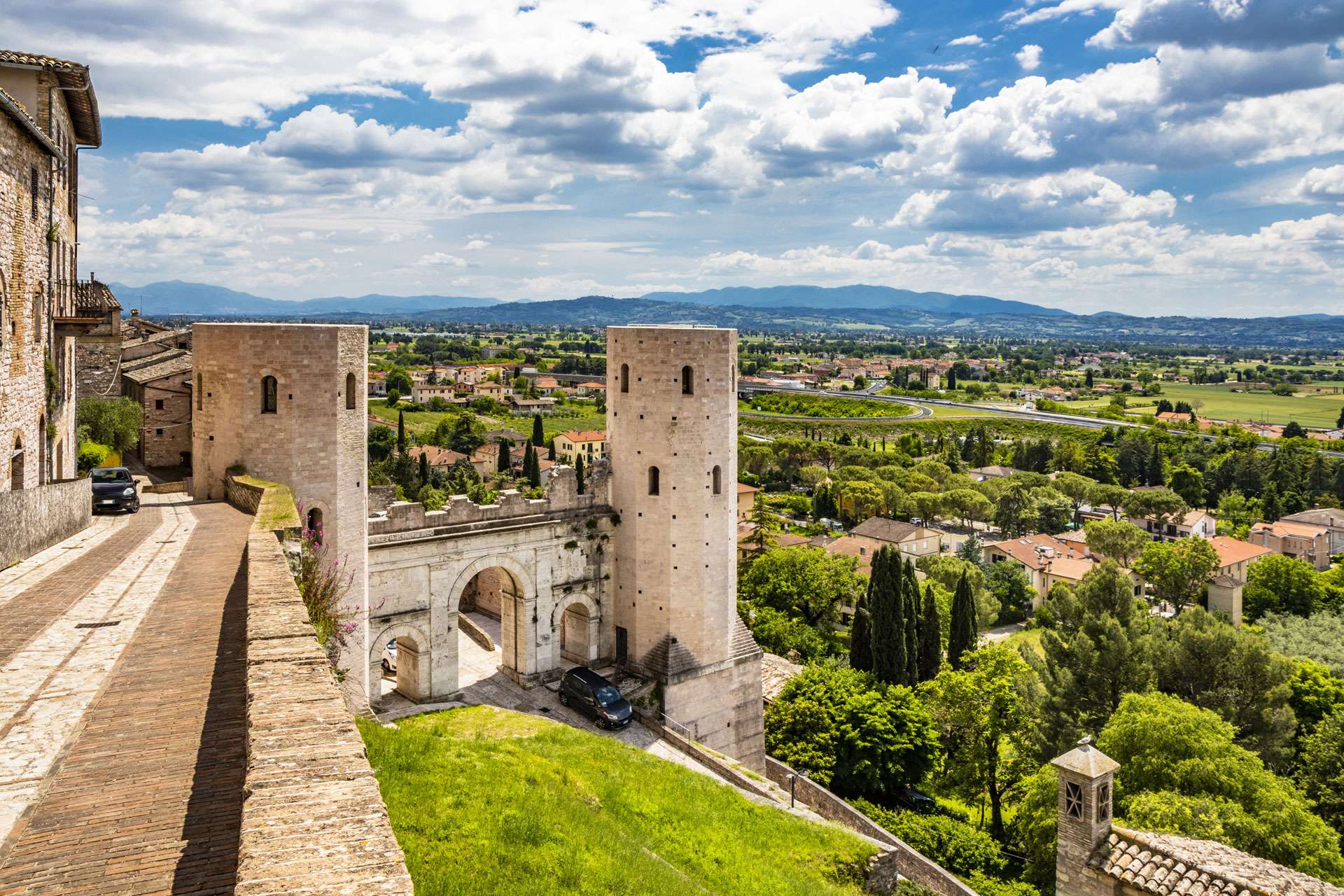
Reschio, Tenuta San Masseo, and Castello di Monterone reveal three different ways of experiencing the Green Heart of Italy: through design, silence, landscape, and history.
Umbria is not a region that reveals itself through excess. It does not need spectacle. Its luxury is quieter, older, and more interior. It lives in stone villages, olive groves, monastic silence, medieval walls, slow meals, and landscapes that seem to preserve memory rather than simply decorate it.
For QEditorial Hospitality, Umbria has already become a recurring destination of reflection. We began at the table, with Osteria dello Sportello and the spirit of Casteldilago, where hospitality appeared not as performance, but as a gesture of memory. We continued toward Trevi and the soul of Umbrian olive oil culture, where the landscape itself seemed to become an archive of agriculture, spirituality, and identity.
Now, the journey moves from the table and the olive grove to another dimension of Umbrian hospitality: the luxury stay.
Not luxury as decoration. Not luxury as noise. But luxury as belonging to a place.
Three destinations express this idea with particular force: Hotel Castello di Reschio, Tenuta San Masseo, and Castello di Monterone. Each belongs to Umbria, yet each speaks a different language of escape.
Together, they form a small map of contemporary Umbrian luxury.
Hotel Castello di Reschio: Design as Nobility

There are hotels that occupy a landscape, and then there are places that seem to have grown from it. Hotel Castello di Reschio belongs to the second category.
Set within a vast private estate in the Umbrian countryside, near the border with Tuscany, Reschio is not simply a restored castle hotel. It is an entire world built around a precise aesthetic vision: architecture, nature, interiors, horses, gardens, craftsmanship, and silence all arranged with almost cinematic intelligence.
The estate’s identity is deeply connected to the Bolza family and to the architectural language of Count Benedikt Bolza, whose work has transformed Reschio into one of the most admired hospitality destinations in Italy. What makes the property so powerful is not only its beauty, but its restraint. Nothing feels generic. Nothing feels copied from the usual grammar of international luxury. The interiors have depth, personality, and tension. They do not erase history; they reinterpret it.

The result is a rare form of aristocratic modernity. At Reschio, the past is not treated as a museum. It becomes atmosphere. The castle, the landscape, the equestrian culture, the bespoke interiors, and the rhythm of estate life create a sense of nobility that feels both ancient and contemporary.
This is why Reschio stands at the highest level of Umbrian hospitality. It is not merely a place to sleep. It is a place to enter a vision.
Tenuta San Masseo: The Luxury of Silence and View

If Reschio speaks the language of design and estate culture, Tenuta San Masseo speaks the language of intimacy.
Located in Assisi, surrounded by Umbrian hills and immersed in a private botanical park, Tenuta San Masseo offers a different idea of luxury: smaller, quieter, more contemplative. Here, the experience is not built around grandeur, but around perspective. The view is central. Assisi is not simply nearby; it becomes part of the emotional architecture of the stay.
There is something profoundly Umbrian in this relationship between hospitality and spirituality. To wake up facing the landscape of Assisi is not the same as waking up anywhere else. The Basilica of San Francesco, the hill, the silence, the light, and the surrounding countryside create an atmosphere that is difficult to separate from the region’s spiritual identity.

Tenuta San Masseo describes itself as a luxury boutique resort, with a private spa, outdoor swimming pool, romantic areas, and a sense of retreat designed around peace and nature. Yet its most important quality may be less tangible: the ability to slow the guest down.
In a world where many luxury hotels compete through accumulation, Tenuta San Masseo feels more connected to subtraction. Less noise. Less excess. More air. More view. More stillness.
Its luxury is not theatrical. It is sensory and quiet.
Castello di Monterone: Sleeping Inside History

Castello di Monterone offers another form of Umbrian escape: the romance of historical presence.
Located just outside the historic center of Perugia, along the road that leads toward Assisi, the castle carries a history that reaches back at least to the eleventh century. Its walls preserve traces of many layers of time: Etruscan urns, Roman capitals and columns, medieval coats of arms, frescoes, stone, arches, and architectural fragments that make the building feel less like a hotel and more like a vessel of memory.
This is not the polished fantasy of a newly invented medieval atmosphere. Castello di Monterone has the charm of a place that has passed through centuries and still carries their marks. Its appeal lies in that continuity. The guest is not only surrounded by beauty, but by evidence: stone, ornament, fragments, texture, and the feeling that history has not been completely domesticated.

For travelers seeking the romantic side of Umbria, Castello di Monterone offers a particularly evocative experience. It is close enough to Perugia to remain connected to the city, yet atmospheric enough to feel removed from the ordinary rhythm of travel.
Here, luxury does not come from contemporary spectacle. It comes from proximity to time.
Three Different Ideas of Umbrian Luxury
What makes these three destinations interesting is that they do not compete with one another. They represent three different ways of understanding luxury in Umbria.
Reschio is design, estate culture, and contemporary nobility.
Tenuta San Masseo is silence, intimacy, and spiritual view.
Castello di Monterone is medieval memory, romance, and historical atmosphere.
Together, they show why Umbria is becoming increasingly important in the conversation around luxury travel. The region offers something that many destinations have lost: authenticity without performance. Its beauty is not overexplained. Its hospitality is still connected to land, architecture, food, and ritual.
In Umbria, luxury does not need to become loud in order to be memorable.
It can be a castle at the edge of a private estate.
A quiet room facing Assisi.
A medieval wall outside Perugia.
A plate of truffle in a stone village.
An olive tree that has seen centuries pass.
This is the deeper meaning of Umbrian hospitality: the guest is not only welcomed into a place, but into a continuity.
And perhaps that is why Umbria remains one of Italy’s most quietly powerful luxury destinations.
Not because it asks to be seen.
Because it knows how to be remembered.
By Nicolò Di Stefano
Editor’s Reflection — QEditorial Hospitality
Umbria teaches us that luxury does not always need to announce itself. Sometimes it is found in the quietest forms: a restored castle, a private garden, a view over Assisi, a medieval wall, an olive grove, a table set with local ingredients.
After exploring Umbrian hospitality through food and olive oil culture, these three destinations allow us to see another side of the region: the art of staying. Reschio, Tenuta San Masseo, and Castello di Monterone each translate Umbria into a different experience, but all share the same deeper truth.
Here, luxury is not escape from place.
It is immersion into it.
QEditorial Magazine — Fashion · Culture · Identity
QEditorial.com



Leave a Reply