
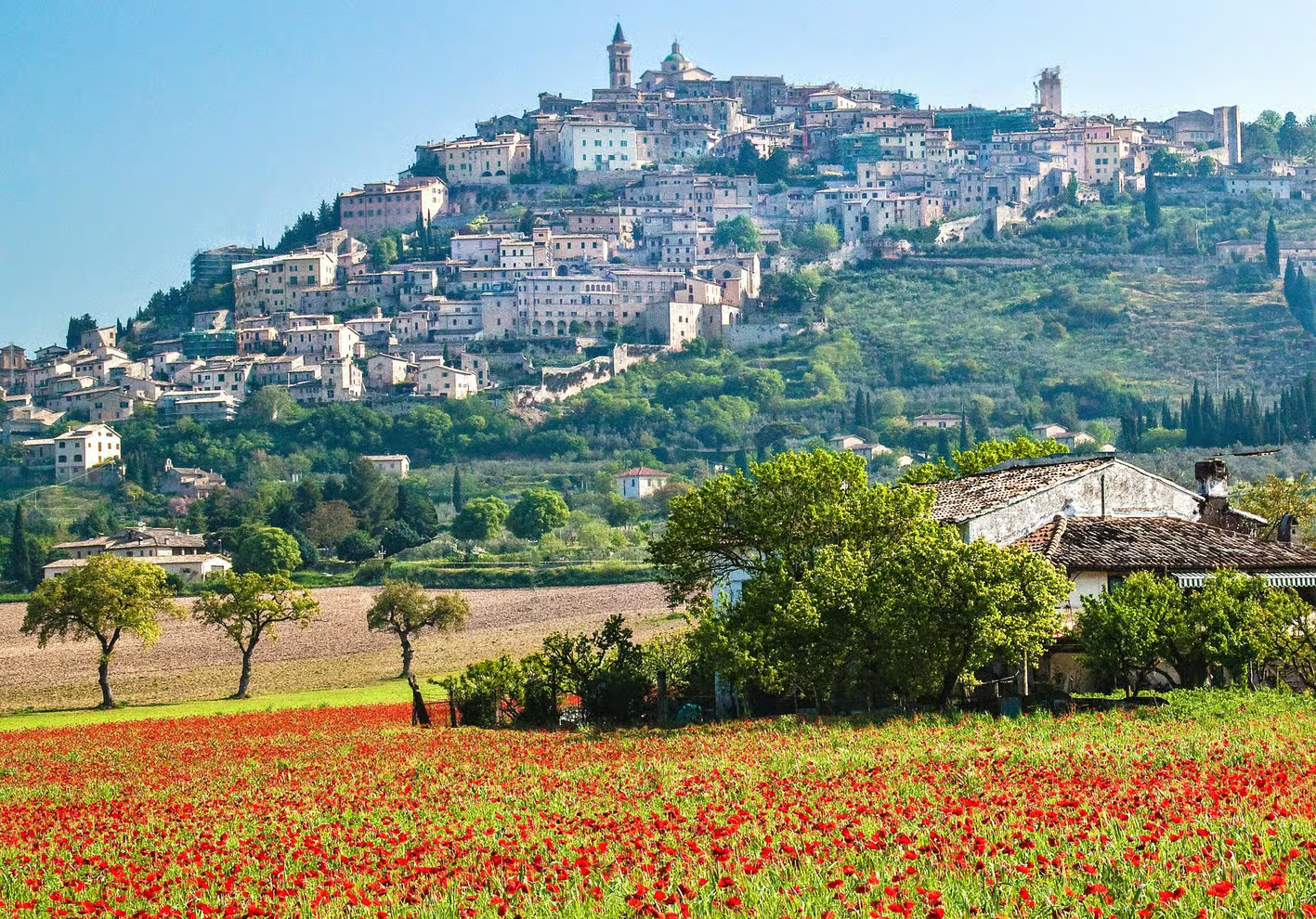
 Umbria is my native region.
A land of stone villages, olive trees, Roman roads, monasteries, rivers, silence, and a form of hospitality that still feels connected to memory rather than performance.
After beginning our QEditorial Hospitality journey in the Valnerina, among ancient villages and the atmosphere of Osteria dello Sportello, we continue north toward Trevi, following one of the oldest cultural arteries of Italy: the ancient Via Flaminia.
Built by the Romans in 220 B.C., the Flaminia was not simply a road. It was a corridor of civilization connecting Rome to the Adriatic world, crossing mountains, valleys, rivers, and Umbrian hills that still preserve traces of that ancient passage. Even today, traveling through this landscape feels less like moving through geography and more like moving through layers of history.
And it is along this route that one encounters one of the most extraordinary places in Umbria: the Tempietto del Clitunno.
Located near the crystalline springs of the Clitunno river, the Tempietto del Clitunno appears almost suspended between the Roman and Christian worlds. Small in scale yet immense in symbolic presence, the monument is today part of the UNESCO site Longobards in Italy: Places of Power.

For centuries it was believed to be a pagan Roman temple dedicated to the god Clitunno. In reality, scholars now consider it an early medieval Christian sanctuary built between Late Antiquity and the Lombard era, though constructed with a language deeply inspired by classical Roman architecture. Corinthian columns, Latin inscriptions, stone symmetry, and Christian symbols coexist here with remarkable harmony.
But perhaps what makes the Tempietto unforgettable is not architecture alone.
It is the relationship between architecture and landscape.
The water flowing quietly through the valley, the olive trees covering the hills, the soft Umbrian light, and the silence surrounding the site create the sensation that time itself slows down. It feels like one of those uniquely Italian places where nature, spirituality, and civilization remain inseparable.
Continuing toward Trevi, the road rises gently through olive groves until reaching Bovara, a small village that preserves one of the deepest symbols of Umbrian identity: the ancient Olive Tree of Sant’Emiliano.

The Olive Tree of Sant’Emiliano is considered one of the oldest olive trees in Umbria, with an estimated age of nearly two thousand years. According to local tradition, Sant’Emiliano, the first bishop and patron saint of Trevi, was tied to a young olive tree here before his martyrdom in 304 A.D.
Whether history, faith, or legend, the tree has become something larger than a botanical monument. It represents the continuity between spirituality, agriculture, territory, and memory that defines much of Umbrian culture.
And nowhere is this continuity more visible than in the olive oil of Trevi.
The hills surrounding the town are dominated by the Moraiolo olive variety, one of the most respected cultivars in central Italy. Unlike softer and more delicate Mediterranean oils, Moraiolo produces oils with structure, intensity, vegetal depth, and the peppery finish that defines high-quality Umbrian extra virgin olive oil.
Many producers in the Trevi area achieve remarkably low acidity levels, often around 0.2% or lower, well beneath the European standards required for extra virgin classification. This level of quality reflects not only the health of the olives themselves, but also the discipline of harvest timing and immediate pressing methods preserved across generations.
The result is an oil known for its vibrant green color, notes of fresh grass, almond, artichoke, and wild herbs, carrying within it the unmistakable taste of the Umbrian hills.
And then, finally, the road reaches Trevi itself.

Trevi rises above the valley like a stone crown surrounded by olive trees. Compact, vertical, and deeply atmospheric, the town preserves Roman traces, medieval walls, Renaissance palaces, narrow stairways, and quiet piazzas that seem untouched by haste.
Trevi is not a city that reveals itself immediately.
It asks to be walked slowly.
Its beauty exists in proportions, textures, shadows, silence, and perspective. Stone arches opening toward the valley. Light reflecting against pale walls. Small churches hidden inside medieval streets. Olive trees descending endlessly across the surrounding hills.

In many ways, Trevi represents one of the purest expressions of the Umbrian relationship between architecture and landscape. The town does not dominate the hill; it becomes part of it.
And perhaps this is precisely why the final destination of this journey feels so coherent.
Because inside this territory, among olive groves, ancient roads, spiritual memory, and centuries of agricultural culture, stands La Cucina di San Pietro a Pettine.

More than a restaurant, it feels like the natural conclusion of the landscape itself.
At the center of the experience is Carlo Caporicci and the historic Tenuta San Pietro a Pettine, a family reality deeply connected to the culture of the truffle. Here, hospitality is expressed quietly, without theatrical luxury or forced spectacle. The atmosphere remains warm, rural, elegant, and profoundly Umbrian.
The cuisine follows the same philosophy.
Truffle is not treated as decoration or excess, but as identity. Fresh pasta, local meats, seasonal ingredients, olive oil, and products from the territory are handled with restraint and precision, allowing the land itself to remain the protagonist.

And after crossing the Flaminia, visiting the Tempietto del Clitunno, standing before the ancient olive tree of Sant’Emiliano, and walking through the stone streets of Trevi, the experience of sitting at this table no longer feels like a simple meal.
It feels like the final chapter of a journey through the cultural landscape of Umbria itself.
Editor’s Reflection
Some territories are understood through monuments. Others through museums.
Umbria is understood through rhythm.
Through roads walked slowly, olive trees cultivated for centuries, villages built from stone, rivers crossing silent valleys, and tables where food still carries the memory of the land.
This journey from the Valnerina to Trevi reminds us that true hospitality is not created artificially. It emerges naturally when landscape, history, agriculture, architecture, and human presence remain connected to one another.
And perhaps this is why Umbria continues to feel timeless.
Not because it resists the modern world, but because it never abandoned itself in order to follow it.
— QEditorial Hospitality



Leave a Reply