
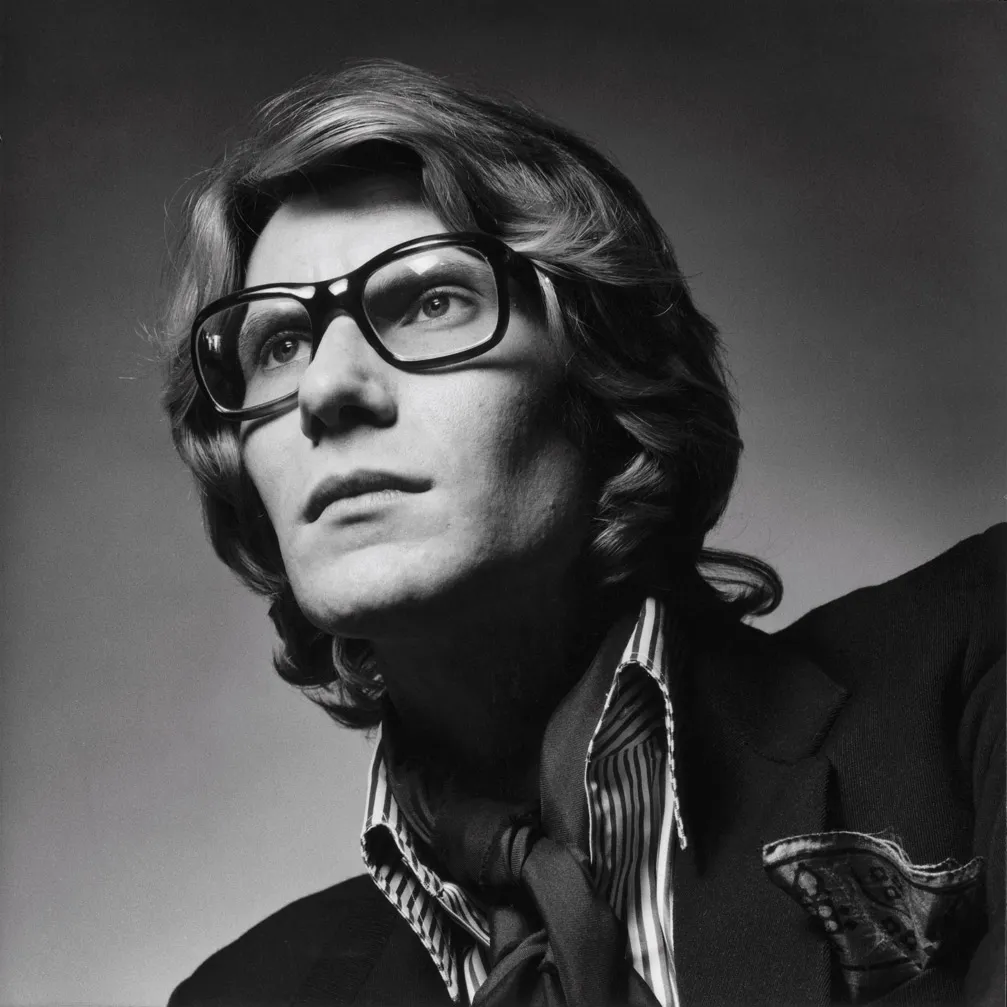
How photography became one of fashion’s greatest instruments of mythmaking.

Fashion has always depended on visibility. But long before social media, digital campaigns, and algorithmic storytelling, Yves Saint Laurent understood something that many luxury brands would only later realize: fashion is remembered through images.
Clothes may live in ateliers, wardrobes, museum archives, or collector vaults. But fashion history survives because somebody photographed it.
Today, the International Center of Photography in New York revisits exactly this relationship with Yves Saint Laurent and Photography, an exhibition on view from June 11 through September 28, 2026. Organized in collaboration with the Musée Yves Saint Laurent Paris and the Fondation Pierre Bergé – Yves Saint Laurent, the exhibition brings together hundreds of photographs and archival objects that reveal how deeply photography shaped the mythology of one of fashion’s most important houses.
This matters because Yves Saint Laurent was never the loudest designer in the room.

Unlike the theatrical personalities that later came to dominate fashion, Saint Laurent was famously private, often fragile, deeply shy, and intensely introspective. Yet paradoxically, he possessed an extraordinary understanding of public image. He knew that fashion was not simply about garments — it was about mythology.
An image could become memory.
A silhouette could become identity.
A photograph could become history.
And perhaps no designer of the twentieth century understood this with more precision.
The exhibition traces this visual discipline through extraordinary works by photographers who helped shape the mythology surrounding Saint Laurent’s universe. Figures such as Richard Avedon, Helmut Newton, Cecil Beaton, Irving Penn, Guy Bourdin, Horst P. Horst, William Klein, Annie Leibovitz, Steven Meisel, and others transformed collections into emotional narratives, where clothing became inseparable from atmosphere, seduction, tension, and cultural imagination.
The famous 1965 Mondrian dress demonstrates this perfectly. Technically, it is a simple dress inspired by geometric abstraction. Yet photography transformed it into something far greater: a symbol of the modern woman, graphic elegance, and the optimism of a changing decade. Without the image, the garment may have remained simply beautiful. Through photography, it became immortal.
The same can be said for Saint Laurent’s revolutionary Le Smoking tuxedo. One of the exhibition’s most striking images captures the now-iconic tailoring in an atmosphere of urban solitude and cinematic tension. It is not merely a photograph of clothing. It is a photograph about power, femininity, and transgression.

In many ways, Yves Saint Laurent anticipated the logic of contemporary branding decades before the digital age.
Luxury today depends heavily on image construction. Instagram campaigns, cinematic short films, celebrity styling, campaign storytelling, and editorial partnerships all function as extensions of brand mythology. Yet Saint Laurent instinctively understood that a fashion house must exist not only in garments, but inside imagination.
He understood something profound:
People rarely remember collections.
They remember images.
The woman walking alone at night in a perfectly cut tuxedo.
The graphic geometry of a dress that looked like modern art.
The impossible elegance captured in black and white.
Fashion, ultimately, is not memory-proof. Photography is.
This may explain why Yves Saint Laurent remains culturally present decades after his most defining collections. His clothes belonged to fashion history, but his images entered collective memory.

For younger generations raised inside digital culture, Yves Saint Laurent and Photography feels unexpectedly relevant. In an era dominated by content, visibility, and visual identity, Saint Laurent’s legacy appears strangely contemporary. He understood personal branding before branding became language.
And perhaps that is the exhibition’s quiet revelation:
Yves Saint Laurent was never only designing clothing.
He was designing how fashion would be remembered.
QEditorial Magazine — Fashion · Culture · Identity


Leave a Reply