
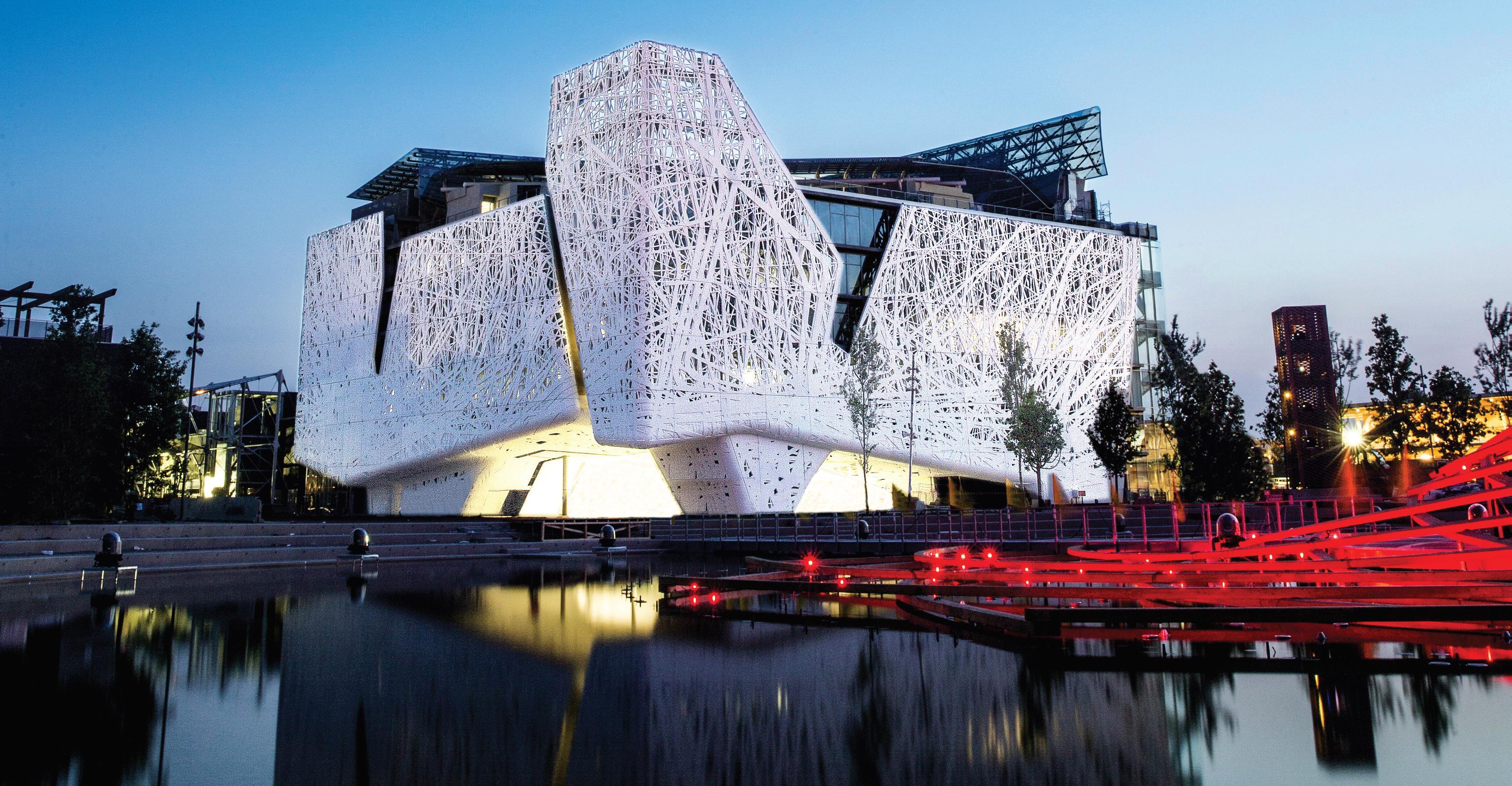
At Milan’s Palazzo Italia, architecture stopped being passive. Covered in photocatalytic cement activated by sunlight, the building became an experiment in whether design could do more than look beautiful — whether it could actively respond to the environmental crisis surrounding it.

There are buildings that symbolize an era.
And then there are buildings that attempt to challenge it.
In Milan, one structure quietly proposed a radical question: what if architecture could clean the air?
Long before sustainability became a fashionable marketing language repeated across luxury campaigns and architectural statements, Palazzo Italia — originally designed for Expo Milano 2015 — introduced an idea that felt almost improbable. A building not simply conceived to occupy space, but to react to the environment surrounding it.
Its exterior was designed to behave almost like a living surface.
The result was one of the most visually ambitious architectural projects in contemporary Italy: a structure wrapped in nearly 9,000 square meters of photocatalytic cement, engineered to help reduce certain atmospheric pollutants through exposure to sunlight.
But what makes Palazzo Italia culturally relevant today is not only the technology itself.
It is the philosophy behind it.

When Architecture Stops Being Passive
For decades, architecture has largely been judged through aesthetics, scale, luxury, or symbolism.
Can a building become iconic?
Can it dominate a skyline?
Can it become desirable?
Palazzo Italia proposed another possibility.
Can architecture participate?
Designed by Nemesi & Partners, the building emerged as the centerpiece of Italy’s pavilion for Expo 2015. Rather than relying on traditional glass façades or monumental gestures, the architects created a porous, almost organic skin inspired by the branching structures found in nature.
The facade resembles a network of intertwined roots, veins, or coral-like geometries — a structure that feels less industrial and more biological.
The project can still be explored through architectural references available via ArchDaily, which documented the design and construction process of the pavilion: https://www.archdaily.com/630901/italy-pavilion-milan-expo-2015-nemesi

What appeared sculptural from a distance, however, was also deeply functional.
The Cement That Reacts to Sunlight
The material used for Palazzo Italia was developed by Italcementi, which introduced a biodynamic and photocatalytic cement containing titanium dioxide (TiO₂).
This matters because titanium dioxide reacts to ultraviolet light.
When exposed to sunlight, the surface activates a chemical process capable of helping break down certain pollutants — particularly nitrogen oxides (NOx), substances commonly associated with urban traffic and smog.
In simpler terms, sunlight activates the facade, allowing the material to contribute to reducing some airborne pollutants present around the structure.
More technical information about the material and architectural application can be found through architectural documentation from World Architects: https://world-architects.com/en/nemesi-studio-roma/project/palazzo-italia-italy-pavilion-expo-2015
Of course, social media tends to exaggerate the story.
No, Palazzo Italia does not “clean the air of Milan” in a dramatic city-wide sense.
The reality is more nuanced.
The facade contributes to improving environmental quality locally and symbolically. Its effect depends on variables such as sunlight intensity, humidity, pollutant concentration, and exposure. Yet the idea itself remains culturally significant: a building designed not only to consume resources, but to respond to ecological conditions.
And perhaps that distinction matters more than perfection.
When Sustainability Becomes Cultural Language
What Palazzo Italia anticipated was something contemporary design increasingly understands: sustainability is no longer merely technical.

It is cultural.
Luxury hospitality now speaks about regenerative landscapes. Fashion increasingly discusses material responsibility. Automotive design experiments with alternative materials. Architecture, too, is shifting from monumentality toward environmental intelligence.
Buildings are slowly being asked to do more than exist beautifully.
They are being asked to participate.
That may ultimately be Palazzo Italia’s real legacy.
Not simply the photocatalytic cement.
Not the engineering.
But the idea that architecture could evolve from object to organism.
Because perhaps the future of architecture is not only about what buildings look like.
But about what they do.
Editorial Note
As sustainability continues reshaping architecture, Palazzo Italia remains one of the most compelling examples of experimental environmental design in Milan. Combining photocatalytic cement, titanium dioxide technology, and biomimetic architecture, the project demonstrates how buildings may increasingly evolve from static structures into active participants in urban ecosystems. In an era increasingly defined by climate anxiety, Palazzo Italia asks a provocative question: can architecture become part of the environmental solution rather than merely part of the landscape?
QEditorial Magazine — Fashion · Culture · Identity




Leave a Reply