
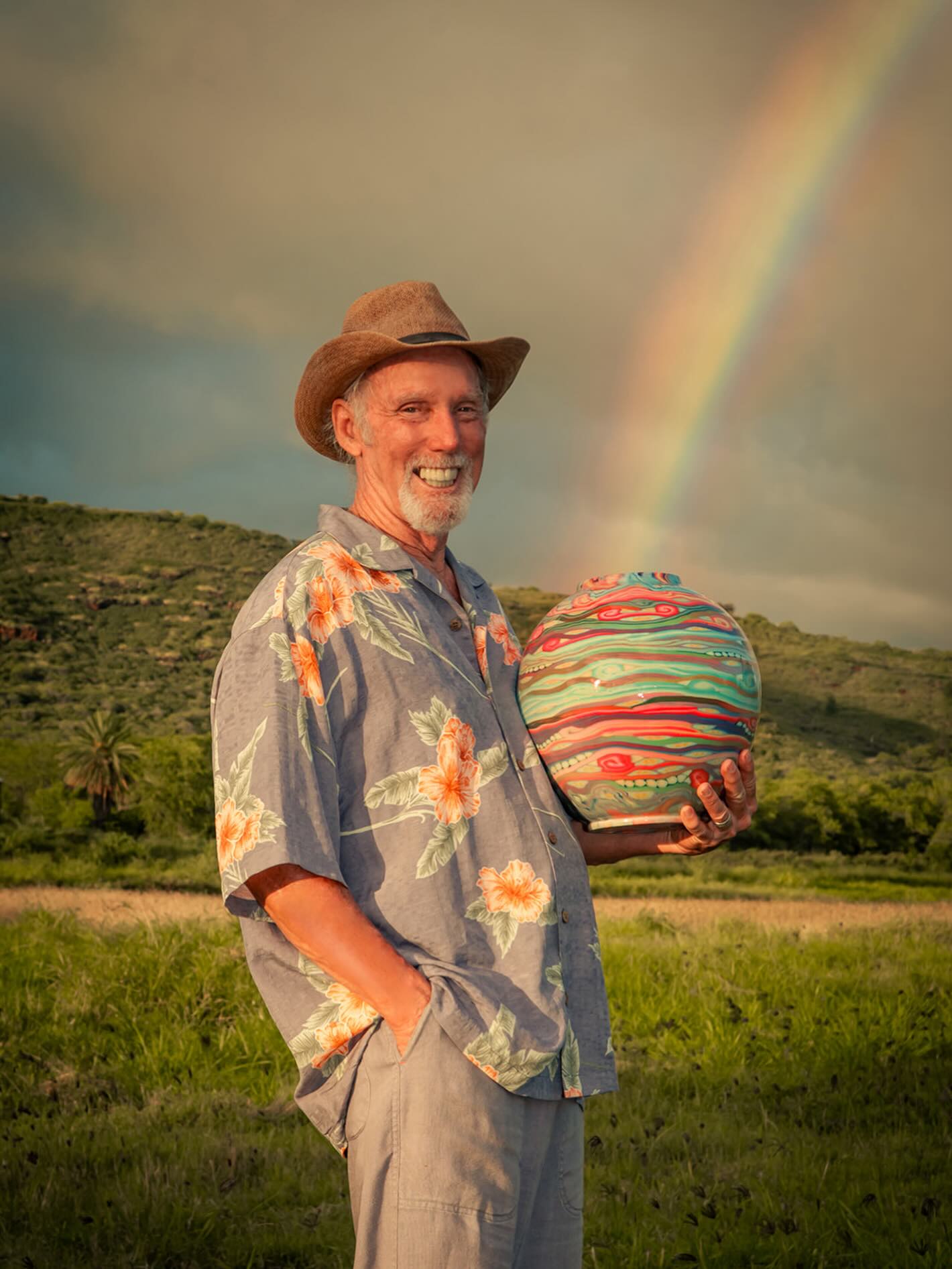
Discover how Dean McRaine and LightWave Pottery are redefining contemporary ceramic art through kaleidoscopic clay techniques and collectible craftsmanship.

There are artists who decorate objects.
And then there are those who transform the object itself into an experience.
The work of Dean McRaine belongs unmistakably to the second category.
In an era increasingly shaped by digital aesthetics, visual speed, and industrial perfection, McRaine’s ceramics feel almost radical. Not because they reject beauty, but because they insist on something slower, stranger, and infinitely more human: patience.
Through his studio, LightWave Pottery (https://www.lightwavepottery.com), based in Kauai, Hawaii, Dean McRaine creates ceramic works that seem almost impossible at first glance. Bowls, sculptural vessels, and hand-thrown forms erupt into kaleidoscopic landscapes populated by butterflies, winding serpentine motifs, flowers, sacred geometries, and dreamlike colour transitions. Yet what appears painted is not paint at all.
The imagery lives inside the clay itself.
That distinction matters.
Because what McRaine creates is not decoration applied onto a surface, but visual storytelling embedded into material.
According to the artist’s own technical notes published through LightWave Pottery’s process archive (https://www.lightwavepottery.com/pages/technical-information), his work relies heavily on the highly complex cane technique, a process related to millefiori traditions and ceramic methods such as nerikomi, where coloured clay bodies are meticulously assembled into larger visual structures before being sliced into thin sheets. Those sheets are then laminated onto wheel-thrown forms, allowing imagery to emerge organically from the ceramic body itself.

The result feels almost surreal.
At first glance, McRaine’s ceramics resemble digital manipulations or AI-generated visual worlds translated onto pottery. But the reality is far more extraordinary. Every butterfly, every transition of colour, every intricate motif emerges from manually layered clay, assembled by hand with an almost obsessive level of precision.
Time, in Dean McRaine’s universe, becomes visible.
Some clay canes reportedly require weeks — sometimes even months — to fully construct before they are sliced and transformed into finished works, a process described further through the studio’s technical documentation (https://www.lightwavepottery.com/pages/technical-information). In a culture increasingly obsessed with immediacy and mass production, such devotion to slowness feels quietly rebellious.
And perhaps that is precisely what makes his work feel culturally urgent today.
Across fashion, interiors, hospitality, and collectible design, contemporary culture is rediscovering craftsmanship. Luxury increasingly belongs not simply to scarcity or branding, but to labor, patience, and material devotion. We are witnessing a return to objects that visibly carry the hand of their maker.
Dean McRaine belongs naturally within this shift.
His works function less like decorative ceramics and more like emotional environments. Looking at them evokes something strangely intimate — nostalgia, wonder, sensory memory, even fragments of childhood imagination. One sees echoes of 1960s psychedelia, Japanese ceramic traditions, sacred symbolism, and folk visual language, yet none of these references overpower the work entirely. The vocabulary remains unmistakably his own.

What makes LightWave Pottery (https://www.lightwavepottery.com) particularly fascinating is its refusal of contemporary minimalism.
For more than a decade, luxury aesthetics have been dominated by restraint: monochromatic palettes, clean lines, and visual silence. McRaine moves deliberately in the opposite direction. His ceramics embrace abundance. Pattern becomes narrative. Colour becomes emotion. Complexity becomes language.
Yet despite their visual intensity, the works never feel chaotic.
There is rhythm inside them.
A hidden order.
A meditative discipline beneath the excess.
That tension — between maximalism and control — is perhaps what elevates McRaine’s work beyond craft and into the territory of contemporary collectible art.
At a moment when so many objects feel increasingly detached from human touch, Dean McRaine reminds us of something unexpectedly important: making can still be sacred.
Clay, after all, remains one of humanity’s oldest materials.
And in the hands of the right artist, it can still surprise us.

For QEditorial Magazine, Dean McRaine represents something larger than contemporary ceramics. Through LightWave Pottery’s evolving artistic practice (https://www.instagram.com/lightwavepottery/), he embodies a growing cultural desire to reconnect with process, patience, tactility, and material truth — a reminder that beauty sometimes asks us not to move faster, but to slow down enough to truly see.
Editorial Note
As visual culture becomes increasingly accelerated by digital platforms and artificial aesthetics, artists like Dean McRaine remind us that craftsmanship still possesses the power to astonish. His work exists at the intersection of sculpture, ceramics, design, and sensory storytelling — a language that feels especially relevant at a moment when contemporary culture appears to be searching once again for tactility, patience, and meaning.
QEditorial Magazine — Fashion · Culture · Identity


Leave a Reply