
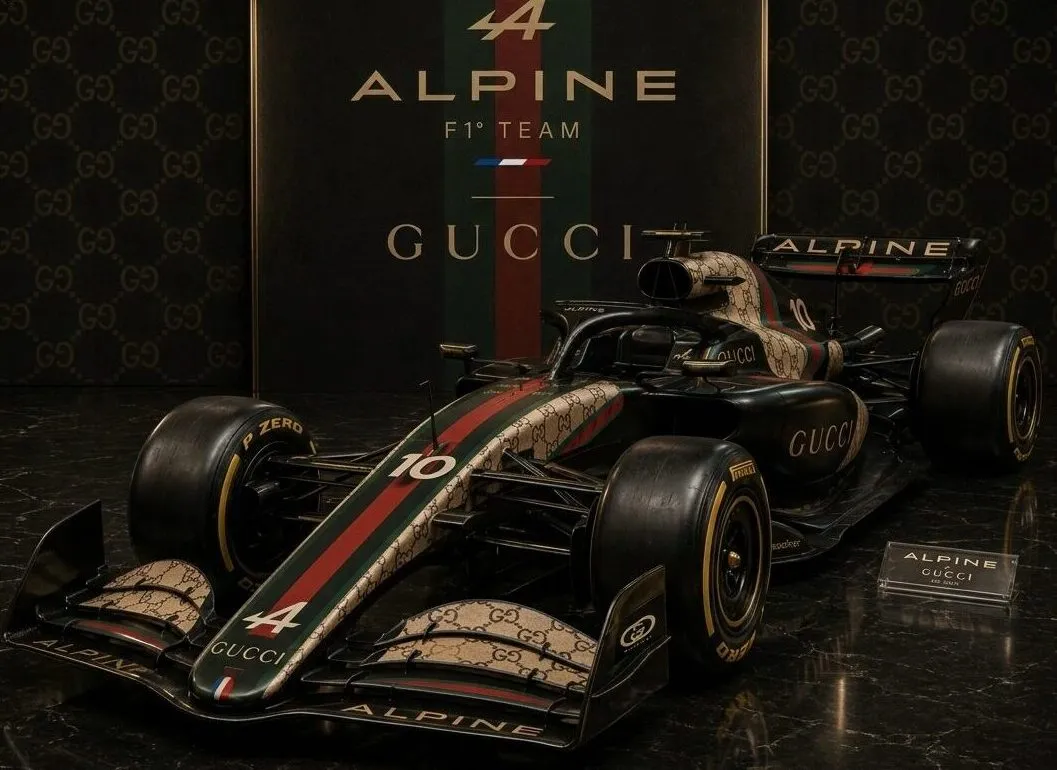
There was a time when fashion sat quietly in the front row of sport.
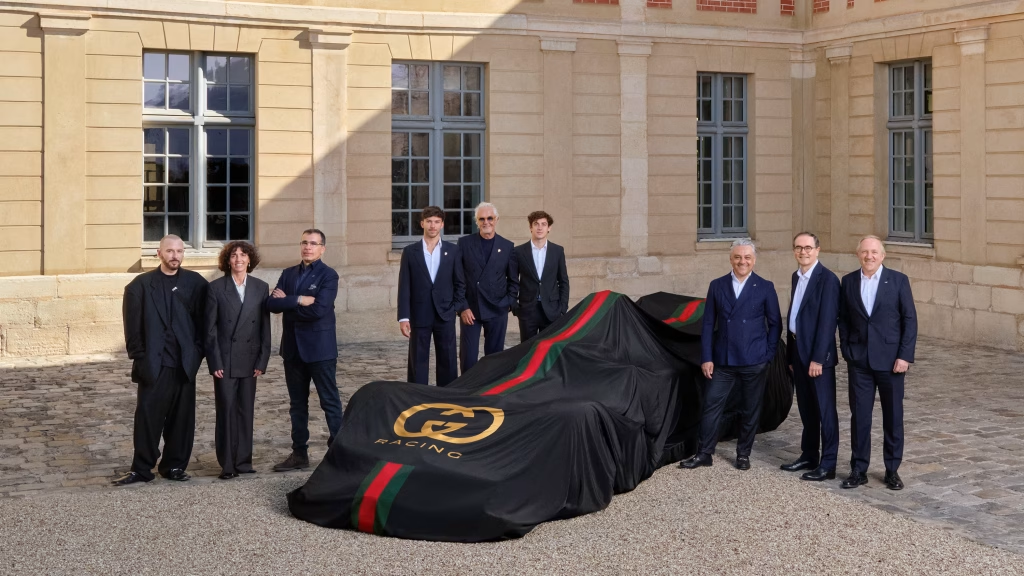
Luxury brands sponsored events, dressed athletes for ceremonies, appeared discreetly on watches, luggage, or hospitality lounges — close enough to absorb prestige, but distant enough to preserve exclusivity.
That distance no longer exists.
Fashion is no longer observing Formula 1 from the paddock.
It is entering the race itself.
The newly announced partnership between Gucci and Alpine Formula 1 is not simply another luxury sponsorship. It may represent one of the clearest signals yet that Formula 1 has evolved into something much larger than motorsport.
It has become culture.
And increasingly, luxury wants ownership inside that culture.
According to the official Formula 1 announcement, Gucci will become Alpine’s title partner beginning in the 2027 season, with the team set to compete under the name Gucci Racing Alpine Formula One Team. Formula 1 confirmed the partnership directly, positioning it as one of the most significant intersections yet between luxury fashion and elite motorsport.
Source: https://www.formula1.com/en/latest/article/gucci-announced-as-alpine-title-partner-for-2027-season.1nrLuAEzWMeTMVJsec79lw

Industry reporting from Sports Business Journal further suggests the agreement could be worth approximately $150 million over three years, potentially extending through 2030 — although financial details have not been publicly confirmed by Gucci or Alpine themselves.
Source: https://www.sportsbusinessjournal.com/Articles/2026/05/28/alpine-f1-gucci-title-deal-worth-about-150m-over-three-years/
Formula 1 is no longer merely a sporting competition.
It has quietly transformed into one of luxury’s most sophisticated emotional ecosystems.
The shift did not happen overnight.
For decades, Formula 1 belonged primarily to engineering, mechanical excellence, and masculine technical prestige. The language surrounding the sport revolved around horsepower, lap times, pit strategy, and national rivalry.
Today, the atmosphere feels profoundly different.
Fashion editors sit beside athletes. Hollywood actors fill the paddock. Luxury hospitality brands design entire experiences around Grand Prix weekends. Watchmaking maisons compete for visibility. Streetwear labels reinterpret racing aesthetics. Celebrities arrive not simply to watch the race — but to become part of the visual theater surrounding it.
The Formula 1 paddock has quietly become one of the world’s most powerful luxury stages.
And luxury brands understand something essential:
Modern consumers no longer buy only products.
They buy worlds.
Few cultural moments accelerated this transformation more than Netflix’s Drive to Survive, which introduced Formula 1 to audiences who had never previously followed racing. Suddenly, drivers became personalities, rivalries became narratives, and Grand Prix weekends became cinematic experiences rather than technical events.
Formula 1 stopped feeling inaccessible.
It became emotionally legible.
Luxury noticed.
The expansion of fashion and luxury inside Formula 1 already tells the story clearly. The broader partnership between Formula 1 and LVMH strengthened the presence of luxury maisons across the sport, while brands such as TAG Heuer and Louis Vuitton increasingly occupy spaces where performance, prestige, travel, and lifestyle naturally intersect.
Source: Footwear

Gucci entering Alpine therefore feels less like disruption and more like inevitability.
The real question is not why Gucci?
The real question may be:
Why did it take this long?
For years, Gucci has existed at the intersection of fashion, celebrity, nostalgia, sport, and visual spectacle. Across different creative eras, the house has consistently transformed cultural symbols into aspirational language.
Formula 1 offers exactly that possibility.
Speed becomes identity.
Performance becomes aesthetics.
Competition becomes storytelling.
And storytelling, more than anything, is what modern luxury increasingly sells.
This matters because luxury itself has changed.
The era of pure product obsession is fading. Prestige alone no longer guarantees emotional relevance. Consumers increasingly seek experiences, belonging, visual identity, and cultural participation.
Luxury is becoming immersive.
In this context, Formula 1 represents something uniquely valuable: a living ecosystem where fashion, travel, hospitality, celebrity, technology, design, and exclusivity already coexist naturally.
Few sports offer that kind of environment.
The paddock today often feels closer to Fashion Week than traditional sports culture.
A Grand Prix weekend now includes Michelin-star hospitality, private lounges, luxury travel itineraries, celebrity fashion moments, branded experiences, and endless digital storytelling.
Formula 1 no longer sells speed alone.
It sells atmosphere.
And atmosphere has always been luxury’s most powerful currency.
If Gucci and Alpine move forward together, the partnership may ultimately say something much larger about the future of fashion itself.
Luxury no longer wants to sit beside culture.
It wants to drive it.
Editorial Note — QEditorial Magazine
Formula 1 is no longer simply a sport of engineering and speed.
It has become one of contemporary culture’s most sophisticated intersections between luxury, celebrity, hospitality, travel, fashion, and identity. Gucci’s arrival inside Formula 1 through Alpine may ultimately represent more than a partnership — it may reveal how luxury fashion increasingly seeks emotional ecosystems rather than traditional visibility.
As luxury brands continue to move closer to motorsport, the paddock itself is evolving into a new cultural runway where performance, storytelling, exclusivity, and aesthetics coexist.
At QEditorial Magazine, we remain interested not only in fashion itself, but in the places where fashion changes meaning.
Related themes explored by QEditorial Magazine include luxury hospitality, fashion culture, identity, contemporary luxury, Formula 1 lifestyle, celebrity culture, and the evolving relationship between fashion and sport.
QEditorial Magazine — Fashion · Culture · Identity – qeditorial.com


Leave a Reply