
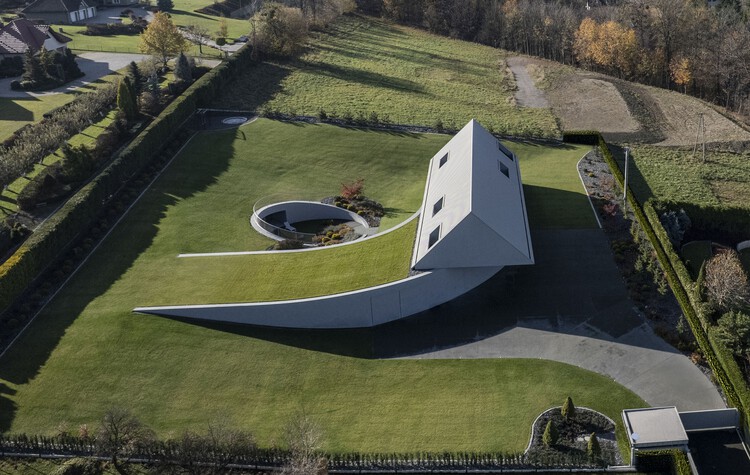
In Poland’s Beskid Mountains, Robert Konieczny and KWK Promes create a house that refuses to dominate nature — choosing instead to turn with it.

There was a time when architecture sought to conquer landscapes.
Houses were often designed as objects imposed upon nature — rigid geometries planted onto hills, forests, coastlines, or mountains as symbols of control. Yet contemporary architecture increasingly asks a different question: what happens when a building chooses not to resist the land, but to listen to it?
In the southern region of Poland, nestled within the sloped terrain of the Beskid Mountains, Yaw House by architect Robert Konieczny and the studio KWK Promes offers one possible answer. Rather than forcing the landscape into submission, the residence appears to bend itself to the terrain, rotating its form in response to the natural slope, solar orientation, and the quiet rhythms of the surrounding environment.
According to the architectural publication ArchDaily, the house was designed through a rotated gabled form that follows the site’s topography while separating technical and entrance areas from the open living spaces facing the landscape. The result is a residence that feels less like an intrusion and more like an extension of the earth beneath it. Read the original architectural coverage on ArchDaily: https://www.archdaily.com/1041503/yaw-house-robert-konieczny-plus-kwk-promes

At first glance,appears almost surreal.
Its sharply angled roof emerges from the land with an unusual geometry — neither entirely hidden nor aggressively monumental. Seen from above, the structure feels sculptural, almost geological, as though shaped by wind rather than human intervention. A circular courtyard punctuates the landscape while the surrounding green roof softens the transition between architecture and environment.
Yet what makes Yaw House compelling is not simply visual experimentation.
The project reveals a growing architectural language centered around restraint. Large glazed openings frame the surrounding scenery rather than compete with it, while the material palette remains intentionally subdued. Concrete, muted surfaces, and carefully measured proportions avoid excess in favor of atmosphere. In many ways, the house speaks the language of silence.

This architectural sensitivity has increasingly become part of a broader contemporary movement — one that values emotional experience as much as formal innovation. Publications such as Designboom have highlighted how Yaw House responds directly to the contours of the mountain terrain, allowing the building to function as part shelter, part observation point, and part landscape intervention rather than a conventional residence. Read more via Designboom: https://www.designboom.com/architecture/kwk-promes-yaw-house-contours-poland-mountain-terrain/
The idea feels surprisingly relevant to the present cultural moment.

After decades dominated by spectacle, oversized gestures, and algorithm-friendly design, architecture appears to be rediscovering something quieter: intelligence through adaptation. Increasingly, luxury no longer announces itself through excess, but through thoughtful spatial experience — light, proportion, silence, and a sense of belonging within place.
Yaw House embodies this shift.
It does not seek attention through ornament. Instead, it earns attention through discipline.
The house feels almost philosophical in its refusal to overpower the mountain. Its most radical gesture may simply be humility.
And perhaps that is precisely where contemporary architecture is heading.
Not toward domination of nature, but toward coexistence with it.
In an era increasingly shaped by environmental anxiety and visual overstimulation, the most intelligent buildings may no longer be the loudest ones — but those capable of disappearing just enough to allow the landscape to speak again.
Image Credits: Photography by Jakub Certowicz. Architectural project by KWK Promes / Robert Konieczny. Additional project references available via ArchDaily and Designboom.

Editorial Reflection
Some architecture impresses immediately. Other architecture stays with you quietly. Yaw House belongs to the second category — the kind of design that does not ask to be admired loudly, but slowly reveals its intelligence through restraint. There is something deeply reassuring in seeing architecture choose dialogue with nature rather than control over it.
Image Credits: Photography by Jakub Certowicz. Project by Robert Konieczny + KWK Promes. Source: ArchDaily and Designboom.
QEditorial Magazine — Fashion · Culture · Identity – qeditorial.com



Leave a Reply