
Fashion no longer ends on the runway, nor does it stop at the boutique door. Today, luxury wants to be lived more completely: worn, photographed, entered, tasted. In recent years, some of the world’s most recognizable fashion houses have moved into hospitality with increasing confidence, creating cafés and restaurants that extend the brand universe beyond clothes and accessories into ritual, atmosphere, and social performance. , Louis Vuitton, Prada, Gucci, Dior, and Armani have each developed spaces where dining becomes part of the language of the house.
What is happening is more than a marketing trend. It is a cultural shift in the way luxury understands itself. A fashion brand once sold aspiration through image; now it seeks to choreograph entire moments of life. The café and the restaurant are no longer side projects. They are immersive spaces where identity is performed with greater softness and intimacy. A branded dining room allows the customer not merely to purchase an object, but to briefly inhabit a world. That is why these places matter: they transform fashion from possession into experience.
Among the clearest examples is Ralph Lauren, which understood earlier than many of its peers that hospitality could become a natural extension of lifestyle. Ralph’s Coffee now has official locations in New York, including Madison Avenue and Rockefeller Center, and the brand has built a recognizable ritual around coffee, cups, and branded accessories that feel inseparable from the Ralph Lauren universe. The effect is subtle but powerful: even a simple espresso becomes part of a curated American dream.

In New York, Le Café Louis Vuitton offers a particularly revealing expression of this evolution. Located on the fourth floor of Louis Vuitton’s 57th Street store, the café is presented by the maison as its first library café in the United States and as a “cultural meeting place.” That wording is important. It suggests that luxury no longer wants merely to host customers; it wants to frame culture itself, surrounding food with books, design, and symbolic atmosphere. The meal becomes part of a larger branded environment.
And then there is the plate itself. In many of these fashion-led spaces, branding does not stop at interiors or tableware. It enters the presentation of food. Louis Vuitton’s own café materials highlight creations such as Chocolate Monogram and Hazelnut Flower, making the house motifs visible not only in décor but in the language and visual identity of the menu. This is one of the most telling signs of the times: the logo no longer belongs only to leather goods or packaging. It can now appear as garnish, as dessert, as a visual code embedded directly into the act of dining.

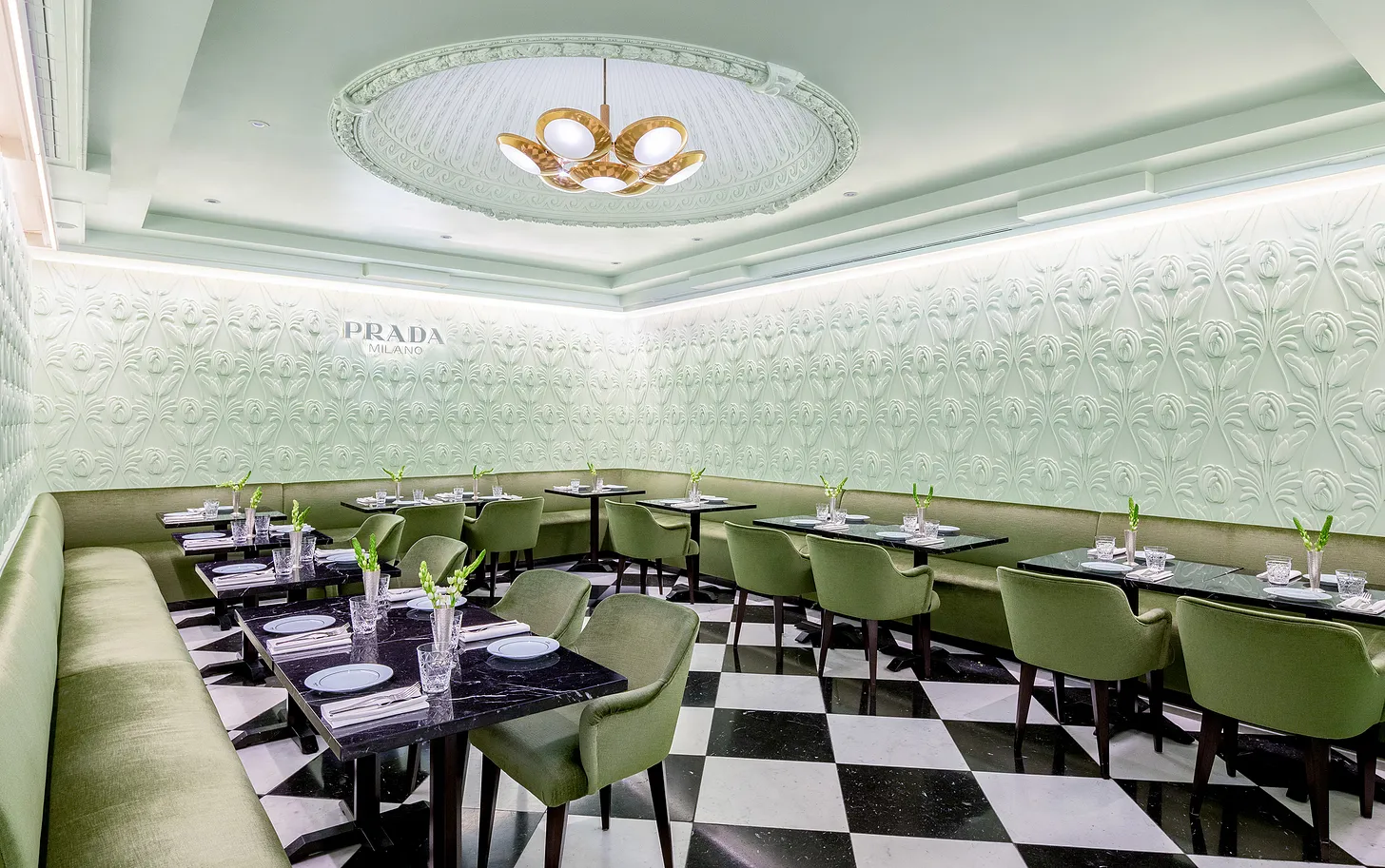
In London, Prada Caffè at Harrods may be one of the most elegant examples of fashion translating itself into hospitality design. Prada described the space as a project created to add “a new dimension to the brand,” and emphasized that everything — from the décor to the menu, tableware, and atmosphere — reflects Prada’s language. Harrods likewise notes the café’s black-and-white flooring and its Milan references, showing how even architecture and surface become part of the maison’s visual grammar. Here, the table is not just where one eats. It is where brand codes are staged with precision.


In Paris, Dior has approached the idea with couture-level refinement. At 30 Montaigne, the historic address of the house, Dior officially integrates Monsieur Dior, Le Jardin, and the café into a broader vision of art de vivre. The symbolism is unmistakable: gastronomy is placed inside the very architecture of the brand’s heritage. Under the direction of Yannick Alléno, these spaces are presented not as decorative appendices, but as part of Dior’s way of living, where food, memory, design, and history are made to speak the same language.

In Milan, the relationship between fashion and dining feels almost inevitable, and Armani remains one of the most coherent interpreters of this fusion. Armani/Ristorante at Armani Hotel Milano officially describes itself as a refined destination on the hotel’s seventh floor, combining panoramic views with a highly controlled aesthetic atmosphere. Emporio Armani’s restaurant and caffè in Milan extend this same logic into a more urban register. In both cases, food becomes another expression of Armani discipline: elegant, measured, polished, and deeply aligned with the brand’s idea of sophisticated simplicity.

Gucci Osteria da Massimo Bottura represents a different but equally significant path. Rather than operating as a beautiful branded café alone, it has built an international culinary concept with locations in Florence, Tokyo, and Seoul, while the Florence address opened in 2018 in Piazza della Signoria. Gucci presents the project as a series of contemporary Italian restaurants linked by creativity, elegance, humor, and sensuality. This language is revealing. It shows fashion not only decorating hospitality, but attempting to construct a genuine culinary identity of global relevance.

There are also adjacent cases that help explain the wider mythology of this phenomenon. In Miami Beach, Gianni’s at The Villa Casa Casuarina is often associated with the world of Versace because it operates inside the former Versace mansion. The property itself states that it was purchased by Gianni Versace in 1992 and today functions as a luxury hotel, restaurant, and event venue. It is important, however, to be precise: this is not an official current Versace-branded restaurant in the corporate sense. Its power comes instead from memory, setting, and the continued glamour of the designer’s legacy.

One should also mention Marchesi 1824, part of Prada Group, because it reveals another route through which fashion enters hospitality: not always by inventing a café from scratch, but by absorbing and elevating an existing institution of taste. Prada Group describes Marchesi as a Milanese icon, with historic roots and stores in Via Monte Napoleone, Galleria Vittorio Emanuele II, and London. This matters because it shows luxury’s broader ambition: to occupy not just fashion space, but the social rituals that surround elegance itself.

Taken together, these spaces say something very clear about contemporary luxury. Fashion no longer wants only to sell beautiful things. It wants to shape the environments in which beauty is consumed. It wants the coffee break, the lunch reservation, the polished dessert, the monogrammed moment, the image shared from the perfect table. In that sense, the restaurant has become a continuation of the campaign, and the café a softer form of retail — one where desire is generated not by urgency, but by atmosphere.
The runway, then, has not disappeared. It has simply changed form.
Today, it may begin at the boutique entrance, pass through a marble dining room, arrive on a porcelain plate, and end in a cup of coffee served beneath a logo. Fashion, once content to dress the body, now seeks to choreograph the entire experience of living. And perhaps that is the ultimate ambition of modern luxury: not merely to be worn, but to be inhabited.
Editor’s reflection:
Luxury becomes most powerful when it stops behaving like a product and begins acting like a world. What these fashion cafés and restaurants reveal is not only a new commercial strategy, but a new ambition: to make branding feel like culture, and consumption feel like belonging.



Leave a Reply