
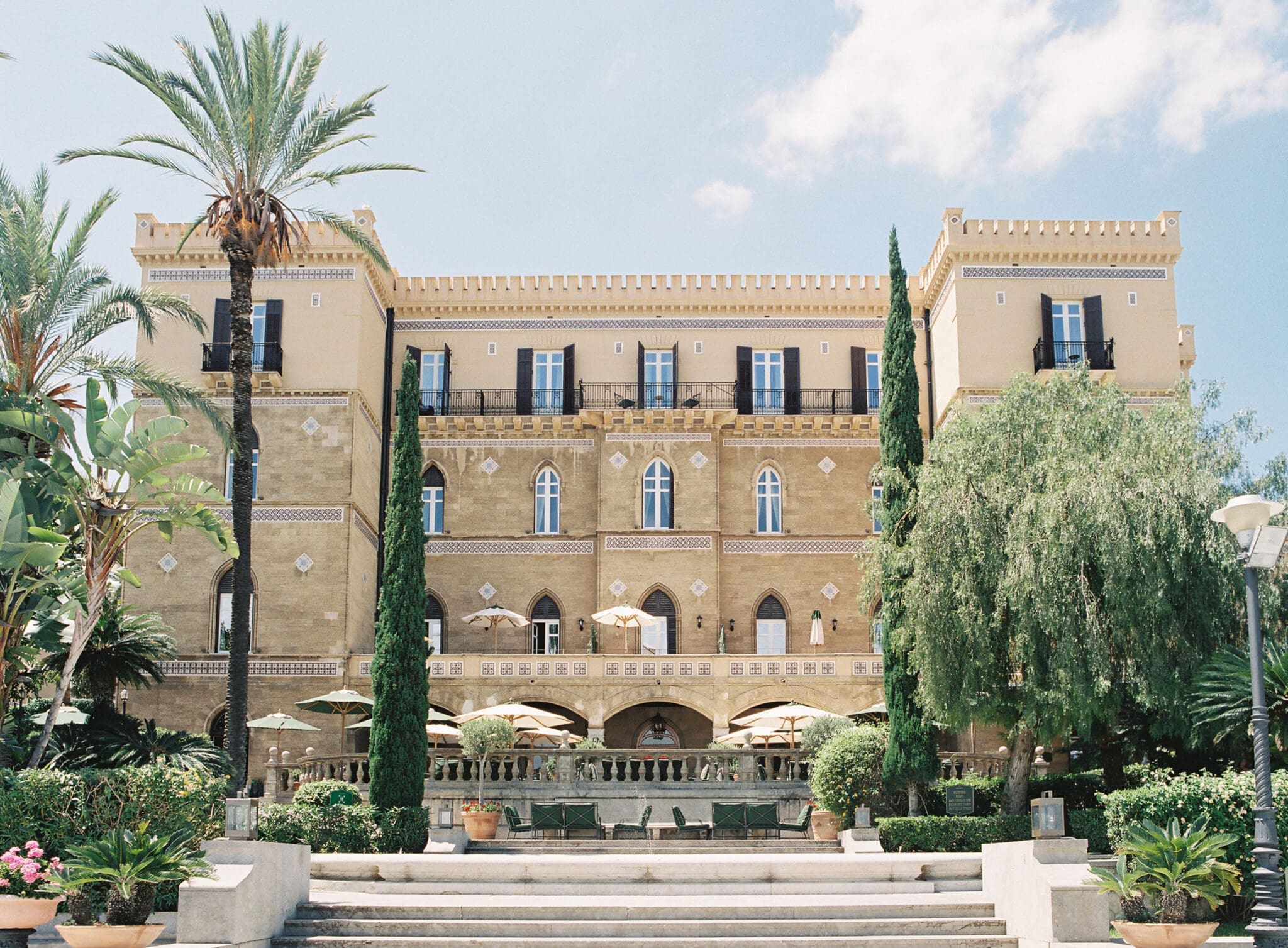
Overlooking the Gulf of Palermo, Villa Igiea preserves the glamour of the Florio era through Art Nouveau interiors, frescoed salons, terraced gardens and a contemporary vision of Mediterranean hospitality.

At Villa Igiea, the Mediterranean is never merely a view.
It enters through open terraces, reflected light and the movement of air across rooms facing the Gulf of Palermo. It appears in the pale blues and mineral tones of the interiors, in gardens descending toward the port and in the sense that the palazzo belongs simultaneously to the city and the sea.
Positioned at the foot of Monte Pellegrino, the late-nineteenth-century residence offers a form of hospitality shaped by geography, architecture and memory. Villa Igiea is a hotel, yet it also remains an expression of the period in which Palermo stood at the center of an ambitious cultural and commercial world.
Its restoration has not attempted to erase that history. Instead, the property’s Art Nouveau heritage, decorative craftsmanship and relationship with the Sicilian landscape have become the foundation of its contemporary identity.
A Palazzo Between Palermo and the Sea
Villa Igiea occupies an unusual position on the edge of Palermo.
Close enough to participate in the energy of the Sicilian capital, it remains visually separated from the city by its gardens, coastal setting and expansive views across the Tyrrhenian Sea. Rocco Forte Hotels describes the property as an urban resort placed between Palermo, Monte Pellegrino and the water—a location that allows it to feel both connected and removed.
This duality defines the experience.
Palermo is a city of crowded markets, Baroque façades, Arab-Norman architecture and layered cultural memory. Villa Igiea offers an alternative rhythm: terraces, shaded paths and long horizons. The city remains present, but it is encountered from a distance that allows its complexity to settle into atmosphere.
The hotel’s tiered gardens extend toward the port, visually connecting the palazzo to the sea. The result is neither an isolated beach resort nor a conventional city hotel. Villa Igiea exists between both identities.
The Florio Vision
The history of Villa Igiea is inseparable from the Florio family, one of Sicily’s most influential commercial dynasties.
The Florios helped shape Palermo’s social and economic life through interests that included shipping, wine and industry. In 1899, the family acquired the property that would become Villa Igiea and entrusted its transformation to the Palermo architect Ernesto Basile.
Basile was central to the development of Sicilian Art Nouveau, known locally as Stile Liberty. At Villa Igiea, architecture became a means of communicating the Florios’ modernity, international ambition and cultural refinement.
The residence was conceived during a period when Palermo attracted aristocrats, artists, entrepreneurs and international visitors. Its salons, terraces and gardens offered more than accommodation: they staged a vision of Sicily as cosmopolitan, cultivated and connected to the wider Mediterranean world.
Villa Igiea’s early years coincided with the final decades of the Belle Époque. Royal visitors, dignitaries and figures from international society passed through its rooms, helping establish the palazzo as one of the island’s most recognizable social destinations.
Sala Basile and the Art of the Interior

The most significant expression of Villa Igiea’s artistic identity is the Sala Basile.
Located on the first floor, the grand hall was designed under Ernesto Basile’s direction and decorated by the painter Ettore De Maria Bergler. Its frescoes, elongated windows and ornamental details form one of the property’s clearest connections to Palermo’s Art Nouveau heritage.
The room does not rely on excess alone. Its elegance emerges from the relationship between painted surfaces, natural light and architectural proportion.
Bergler’s frescoes introduce figures and botanical forms into a space already opened toward the surrounding gardens. The paintings therefore do not function as isolated decoration. They extend the landscape inward, allowing nature, mythology and architecture to occupy the same visual field.
The floor-to-ceiling windows are equally important. As daylight changes, the room changes with it. Frescoes appear softer in the morning, more theatrical during the afternoon and almost atmospheric as evening approaches.
This sensitivity to light gives Sala Basile a quality that photographs alone cannot entirely reproduce. The room is not static. It participates in the rhythm of the Sicilian day.
A Mediterranean Language of Color

Throughout Villa Igiea, the interiors draw from the landscape without reproducing it literally.
Blue appears in softened tones rather than obvious nautical motifs. Greens recall gardens, shutters and Mediterranean vegetation. Terracotta, warm stone and natural timber connect the rooms to the material character of Sicily.
The restored palazzo combines historic elements, local craftsmanship, antiques and contemporary furnishings. Rocco Forte describes the project as a fusion of heritage features, regional craft and modern comfort, preserving the building’s character while returning it to active use.
This balance is essential.
A restoration that treated Villa Igiea as a museum would have risked freezing it in the past. A completely contemporary redesign might have detached the hotel from the history that gives it meaning.
Instead, the interiors allow several periods to coexist. Historic architecture creates the structure; contemporary design makes the space livable.
The result feels collected rather than manufactured.
Rooms Framed by the Horizon

The relationship with the sea continues through Villa Igiea’s rooms and suites.
Many accommodations face the coastline, while selected suites include private terraces overlooking the sapphire-colored waters of the Gulf of Palermo. The hotel’s sea-view rooms are designed to make the landscape part of daily life rather than a distant backdrop.
The Igiea Suite, for example, combines contemporary furnishings, curated artworks and a terrace positioned to receive natural light and sea air. Its design evokes a private Sicilian residence rather than a standardized hotel interior.
This residential quality is important to the character of the property.
Luxury is not communicated only through scale, service or material value. It appears in the ability to inhabit the view slowly: opening a terrace door, noticing the changing color of the water or allowing the sound of the port to remain faintly present beneath the calm of the room.
Villa Igiea’s most persuasive luxury is time experienced through place.
The Gardens as Architecture
The hotel’s terraced gardens are not secondary to the palazzo. They form part of its architecture.
Paths, stone walls, palms and Mediterranean planting soften the transition between the building and the coastline. From certain angles, the gardens frame the sea as carefully as the windows of the interior.
The grounds also reinforce Villa Igiea’s identity as a seaside sanctuary. They create areas of privacy while maintaining a continuous visual connection with Palermo’s port and the open horizon beyond it.
In summer, this movement between interior and exterior becomes central to the hotel’s atmosphere.
Guests pass from frescoed rooms to terraces, from shaded gardens to the pool, and from the stillness of the palazzo toward the movement of the water. The property is experienced as a sequence rather than a single architectural object.
Each transition reveals a different version of Sicily.
Hospitality as Cultural Memory

Villa Igiea’s history includes periods of glamour, disruption and reinvention.
During the World Wars, the property was requisitioned and used at different times as a hospital. After peace returned, it was acquired by Banco di Sicilia and resumed its role as a destination for international society. Gala evenings returned during the 1950s, when guests in Pucci and Dior once again gathered on the terraces overlooking the Conca d’Oro.
These chapters prevent the hotel from being understood only as a monument to Belle Époque privilege.
Villa Igiea has changed according to the pressures of history. Its architecture has accommodated celebration, conflict, recovery and renewed hospitality.
The contemporary hotel inherits all these layers.
To stay there is not to return to one perfect historical moment. It is to enter a place that has repeatedly adapted while retaining recognizable traces of its identity.
The Return of a Sicilian Landmark
The Forte family’s restoration brought Villa Igiea back into active cultural and hospitality life.
The renewed property combines historic interiors with contemporary accommodation, seasonal Sicilian cuisine and an Irene Forte Spa. The aim has been to recover the palazzo’s social energy without turning its past into theatrical nostalgia.
This distinction matters.
Historic hotels often market memory as spectacle, reducing complex places to decorative themes. Villa Igiea is most convincing when its history is allowed to remain embedded in the structure itself: in the proportions of a corridor, the curve of a staircase, the surface of a fresco or the relationship between a terrace and the sea.
The building does not need to imitate its own past.
It already contains it.
Palermo Beyond the Gates

Villa Igiea’s atmosphere may feel self-contained, but its identity depends on Palermo.
The city’s markets, churches, museums and architectural layers provide the cultural context through which the hotel can be fully understood. The property’s official experiences extend into local food traditions, craft, art and excursions across western Sicily.
This relationship is especially important because Palermo resists simplified ideas of Mediterranean beauty.
It is elegant and worn, formal and chaotic, monumental and intensely lived. Villa Igiea reflects a more controlled expression of Sicilian identity, yet the tension between refinement and complexity remains part of its appeal.
The hotel offers serenity without pretending the city around it is quiet.
It is precisely this proximity to Palermo’s contradictions that gives the property depth.
The Sea as More Than Scenery
At many coastal hotels, the sea is treated as a visual amenity.
At Villa Igiea, it functions as part of the building’s identity.
The water explains the orientation of the terraces, the placement of the gardens and the importance of light within the interiors. It recalls the Florio family’s maritime connections and Palermo’s historic relationship with trade, travel and cultural exchange.
The sea is therefore geographical, historical and emotional.
It places Villa Igiea within a wider Mediterranean story—a region shaped by movement between cultures, languages and forms of beauty.
From the palazzo’s windows, the horizon may appear calm. The history it represents is anything but still.
A Living Expression of Sicilian Luxury

Villa Igiea demonstrates that contemporary luxury does not require the removal of age.
Its frescoes remain visible. Its architectural irregularities contribute to its character. Its gardens preserve a relationship with the sea that cannot be recreated through interior design alone.
The hotel’s most memorable spaces derive their power from continuity: the feeling that hospitality has taken place here across different generations, even as its forms have changed.
This is what distinguishes Villa Igiea from a newly built resort.
Its beauty is inseparable from time.
The palazzo does not present Sicily as a decorative fantasy of citrus trees, blue water and aristocratic nostalgia. It reveals a more complex identity shaped by ambition, art, commerce, conflict and reinvention.
At Villa Igiea, the Mediterranean enters the architecture through light, color and movement. Palermo remains close enough to be felt, while the sea opens the property toward something larger.
The result is a hotel that belongs neither entirely to the past nor exclusively to the present.
It exists where both meet—on a terrace above the Gulf, beneath the painted walls of a Sicilian palazzo, in the changing light of summer.
Editorial note:
Villa Igiea represents a distinctive model of contemporary Mediterranean hospitality, where architectural preservation, Sicilian cultural memory and the coastal landscape remain inseparable. Through its Art Nouveau interiors, historic frescoes and renewed relationship with Palermo, the hotel demonstrates how restoration can sustain identity without reducing history to nostalgia.
QEditorial Magazine — Fashion · Culture · Identity
Image disclaimer:
Images are used for editorial and informational purposes only. All rights remain with Villa Igiea, Rocco Forte Hotels and the respective photographers or copyright holders.




Leave a Reply