
For Fall–Winter 2026/27, Robert Wun transforms toys, fairy tales and childhood memories into a surreal meditation on innocence, fear and the passage into adulthood.

Childhood is often remembered as a place of innocence, but its visual language has never belonged exclusively to joy. Fairy tales introduce danger alongside wonder. Toys become guardians, companions and private witnesses. Animals speak, shadows acquire personalities, and fear is given a face long before it can be fully understood.
For his Fall–Winter 2026/27 Haute Couture collection, Childsplay, Robert Wun returns to this unstable territory, using the technical discipline of couture to reconstruct the imagination of childhood on an extraordinary scale.
Presented in Paris on July 8, 2026, as part of the official Haute Couture Week calendar, the collection moves through saturated color, monumental tailoring, familiar storybook figures and distorted forms. Yet Childsplay is not an exercise in nostalgia. It is a study of how childhood fantasy continues to shape adult identity—and how innocence becomes more complicated once we understand the fears hidden within it.
A Mirror Held Against the Dark

Wun has long been associated with a darker visual language: damaged surfaces, cinematic tension, concealed faces and silhouettes that hover between glamour and unease. Rather than rejecting that description, the designer used Childsplay to examine its origins.
During a preview reported by Vogue Runway, Wun described the collection as a mirror held against his so-called dark side, asking what might exist on the other side of it. His answer was childhood—not as a place of uninterrupted happiness, but as the first world in which fear, imagination and emotional contradiction become inseparable.
This approach is consistent with the creative identity of the London-based Robert Wun label, founded in 2014 after the Hong Kong-born designer was discovered through his London College of Fashion graduate collection in 2012. The maison defines its work through storytelling, craftsmanship and narratives of visibility and liberation, treating fashion as a vehicle through which identity can be protected, revealed and transformed.
In Childsplay, those ideas are expressed through a universe in which the body becomes a character and the runway becomes a psychological landscape.
Fairy Tales Without Their Safe Endings

The collection unfolds like a gathering of characters remembered from childhood, but Wun refuses to reproduce them literally. Instead, he dismantles familiar archetypes and rebuilds them through proportion, tailoring and couture construction.
A deep cobalt gown appears suspended beneath two birds frozen in motion, evoking the visual language of Snow White. A crimson hooded silhouette recalls Little Red Riding Hood, its sharply controlled volume transforming vulnerability into command. A gray figure with pointed shoulders and an animal-like mask turns the Big Bad Wolf into an imposing exercise in architectural tailoring.
Elsewhere, the anatomy of a skeleton becomes the striped surface of a long tailored coat, while a horned black figure advances beneath a translucent veil. The stories are recognizable, but their emotional roles have shifted. Victims acquire authority. Villains become elegant. Creatures once confined to the margins of children’s stories occupy the center of the stage.
The collection also draws upon the work of Japanese filmmaker Hayao Miyazaki, whose animated worlds frequently use childlike imagery to confront questions of violence, responsibility, humanity and hope. Wun was attracted to this contradiction: the possibility that stories appearing to belong to children may carry the most enduring truths about adult life.
Through this lens, Childsplay becomes less a fantasy about childhood than an examination of what childhood teaches us before we possess the language to explain it.
The Serious Construction of Play

Wun’s central achievement lies in the way he treats playful imagery with uncompromising technical seriousness.
The collection’s balloons, animals, exaggerated shapes and toy-like surfaces could easily have become decorative spectacle. Instead, each element is integrated into the architecture of the garment.
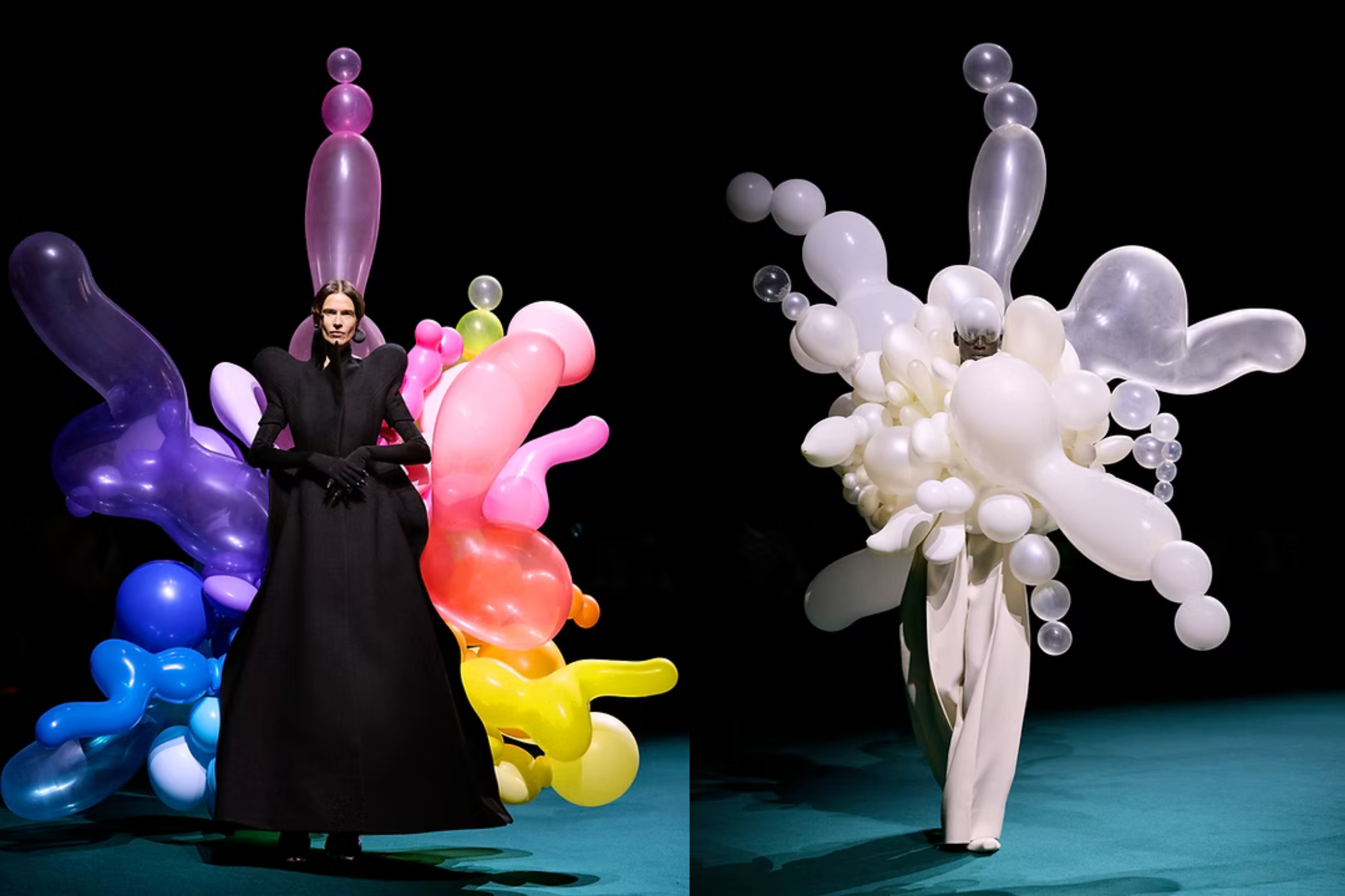
A tailored black coat stands before an eruption of brightly colored balloon forms, turning the contrast between discipline and disorder into a complete silhouette. Another figure is almost consumed by pale inflated structures, as though the body were disappearing into a sculpture made from childhood celebration.
Yet the apparent lightness is deceptive. These balloon forms do not simply decorate the wearer; they expand the body, obscure it and destabilize its proportions. Play becomes transformation.
The same discipline is visible in the collection’s tailoring. Jackets rise into enormous shoulders. Lapels extend into sharp planes. White and black formalwear is broken into geometric surfaces that resemble folded paper, masks or improvised childhood constructions. Long trains sharpen the silhouette rather than softening it.
Wun summarized this creative tension by describing his intention as being inspired by the unserious while creating seriously. That distinction defines the collection. The imagery may originate in toys, cartoons and fantasy, but the execution belongs unmistakably to couture.
Color as Emotional Memory

Color gives Childsplay much of its immediate force.
Hot pink, cobalt blue, vivid yellow and saturated red appear with an intensity associated with toys, crayons and illustrated storybooks. However, Wun does not use color simply to suggest optimism. Each shade carries its own emotional charge.
A monumental fuchsia coat and matching suit create a figure of almost exaggerated confidence, while a flower enclosed within a transparent circular headpiece introduces vulnerability into the composition. The wearer appears simultaneously protected and exposed.
The yellow gowns extend into long, fluid trains beneath sharply geometric headpieces. Their brightness suggests sunlight and fantasy, yet their obscured faces create distance. The blue silhouettes are cooler and more severe, with angular planes dividing the body into fragments.
Red becomes both romance and warning. Blue suggests dream and isolation. Pink moves between softness and artificiality.
The familiar palette of childhood is therefore transformed into a vocabulary of adult emotion.
Toys, Animals and the Construction of Identity

Animals recur throughout the collection as masks, companions and extensions of the body.
A white sculptural rabbit appears both as an object held against the torso and as a visual continuation of the wearer’s silhouette. In another look, rabbit ears rise from the head while a fitted gown expands into a rhythmic, folded hem. The distinction between person, costume and toy becomes increasingly difficult to locate.
One of the collection’s most emotionally charged figures is a large white horned creature carrying a similarly horned stuffed animal. Wun identified the character as Bambi’s mother, placing the image within one of childhood storytelling’s most enduring experiences of loss.
The stuffed animal is particularly significant. For a child, such an object may function as protection, memory and emotional substitute. By enlarging and transforming that language through couture, Wun gives physical form to the private mechanisms through which children process absence and fear.
These figures do not represent childhood as passive innocence. They show identity being constructed through imagination.
A child may use a toy to become braver, an animal mask to become someone else or a story to make danger understandable. Wun translates these emotional acts into clothing.
The Body Between Character and Disguise

Throughout Childsplay, the face is repeatedly covered, interrupted or replaced.
Masks resemble animals, folded paper, flowers and abstract geometric forms. Headpieces project outward, cutting across the face and limiting direct recognition. Veils create distance between the wearer and the audience.
This concealment does not erase identity. It intensifies presence.
The models become archetypes rather than individuals: the wolf, the princess, the skeleton, the rabbit, the monster and the child who imagines them. The garment provides each figure with a temporary identity while withholding any complete explanation of who exists beneath it.
This relationship between protection and visibility has long been central to Robert Wun’s creative practice. The house describes its work as questioning established categories while using storytelling to empower and liberate identity. In Childsplay, disguise becomes one of the ways in which identity is explored rather than concealed.
The mask permits transformation. The costume makes an internal emotion visible.
When Childhood Begins to Darken

As the collection progresses, its fantasy becomes more unsettling.
The storybook colors give way to black surfaces, skeletal imagery, veils and figures that appear closer to nightmares than toys. The emotional movement reflects the uneasy passage from childhood toward adulthood—a period in which familiar stories begin to reveal meanings once hidden beneath their surfaces.
The black gown constructed with a glossy, irregular texture appears almost liquid, its horned headpiece and veil transforming the wearer into a creature of mourning or authority. The skeletal tailoring turns the body inside out, placing anatomy on the surface of the garment.
This shift is essential. Wun does not divide innocence and darkness into separate worlds. He suggests that they have always existed together.
Children’s stories have historically used forests, monsters and transformations to give structure to difficult emotions. Childsplay follows the same logic. Fear is not introduced as an interruption of childhood; it is already present within its imaginative architecture.
The collection becomes a passage through that realization.
Couture as a Place for Wonder

The scale of the presentation reinforced this sense of entering a constructed world. At the Dôme de Paris, a monumental inflatable character overlooked a runway populated by fairy-tale figures, sculptural gowns and distorted toys. The staging created an environment closer to immersive theatre than a conventional fashion presentation.
Yet beneath the spectacle lies a serious argument about the role of couture.
Couture cannot resolve political conflict, environmental instability or social fear. It can, however, preserve the human capacity for imagination. For Wun, wonder is not a trivial escape from reality; it is something increasingly fragile and therefore worth protecting.
This idea gives Childsplay its cultural relevance. The collection arrives at a moment when childhood imagery is frequently reduced to commercial nostalgia, collectible objects and algorithmically repeated references. Wun instead asks what these images still contain emotionally.
His toys are not products. His fairy tales are not innocent. His fantasy is not without consequence.
Wonder becomes a way of remaining emotionally awake.
Growing Up Without Abandoning the Imaginary

The final silhouettes do not resolve the collection’s contradictions.
A monumental black figure surrounded by an explosion of balloons suggests both celebration and emotional burden. The shape is joyful, absurd and slightly threatening. The balloons seem capable of lifting the figure upward, yet they also crowd the body and limit its movement.
This ambiguity captures the central idea of Childsplay: adulthood does not require the destruction of the child within, but neither can childhood be recovered unchanged.
Memory alters it. Experience darkens it. Loss gives its symbols new meaning.
Through fairy tales, toys, tailoring and surreal form, Robert Wun presents growing up as a process of carrying these earlier selves forward. The characters of childhood remain with us, but their identities evolve as our understanding of the world becomes more complex.
In this collection, couture is the medium through which that transformation becomes visible.
The result is neither pure fantasy nor simple nostalgia. It is an exploration of how imagination survives experience—and how the stories once used to understand fear may continue to shape who we become.
Robert Wun’s Childsplay reminds us that the child does not disappear when adulthood begins.
It remains beneath the surface, still inventing characters, still negotiating darkness and still searching for wonder.
Editorial note:
Through Childsplay, Robert Wun expands the language of contemporary haute couture by transforming childhood imagery into a sophisticated exploration of memory, fear and identity. Architectural tailoring, surreal characters and monumental proportions allow fantasy to become more than spectacle: it becomes a cultural and emotional language through which the designer examines how imagination survives the passage into adulthood.
——————————————————————————————————
QEditorial Magazine — Fashion · Culture · Identity – QEditorial.com
 Image disclaimer:
Images are used for editorial and informational purposes only. All rights remain with Robert Wun and the respective photographers or copyright holders.


Leave a Reply