
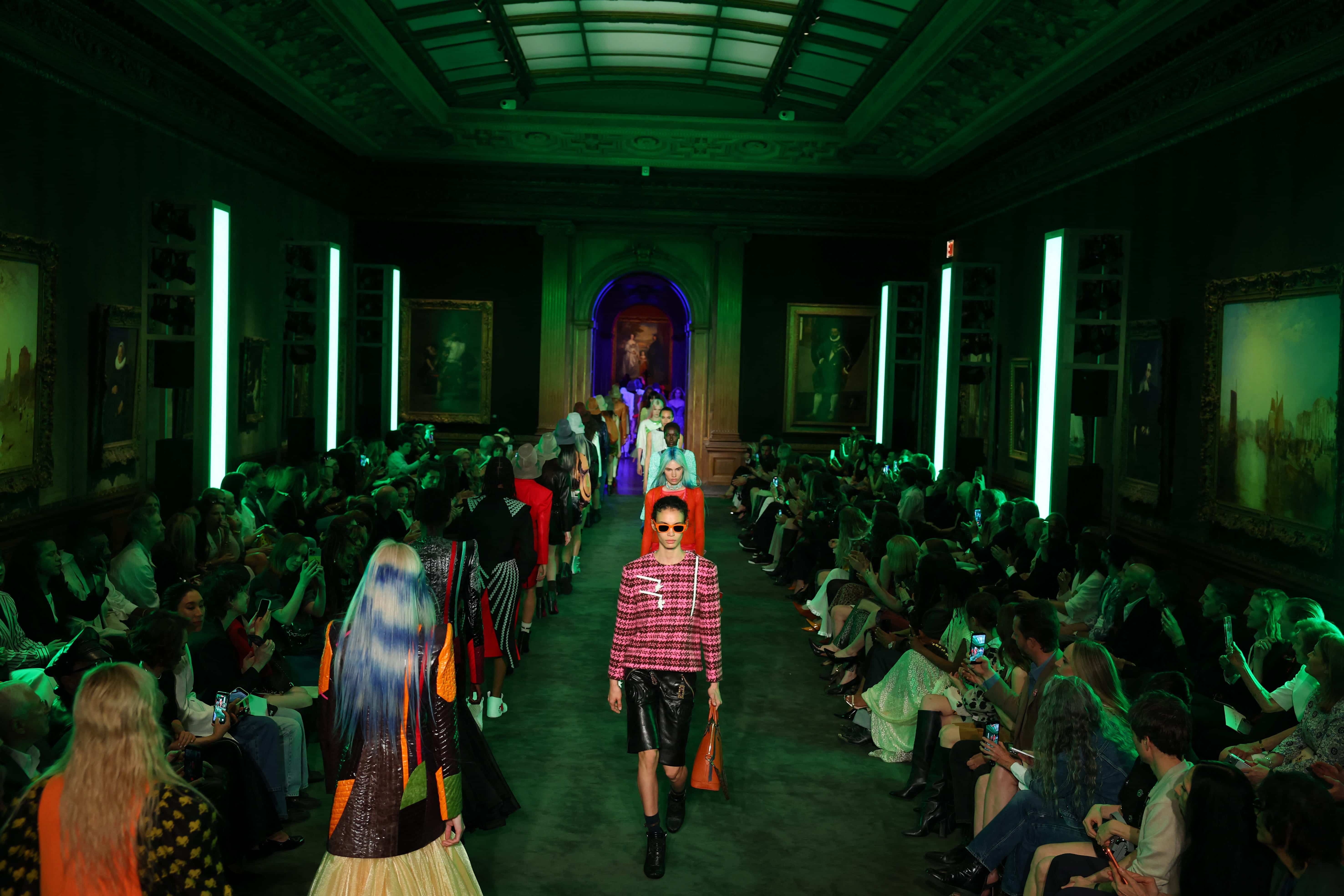
On the evening of May 20, 2026, Nicolas Ghesquière presented Louis Vuitton’s Cruise 2027 collection inside The Frick Collection on Manhattan’s Upper East Side — becoming the first fashion house in history to activate the museum’s first-floor galleries for a runway show. The setting: a Gilded Age mansion housing Vermeers, Fragonards, and Goyas. The soundtrack: Peaches’ Boys Wanna Be Her. The front row: Zendaya, Emma Stone, Cate Blanchett, Anne Hathaway, Emily Blunt, Misty Copeland, artist Tschabalala Self, and global ambassadors including Felix of Stray Kids and Chase Infiniti. The show marked the launch of a three-year principal cultural sponsorship of the Frick by Louis Vuitton — funding three major special exhibitions, a program of free monthly public evenings, and a two-year curatorial research position. The collection drew from a 1930s Louis Vuitton suitcase hand-drawn by Keith Haring in 1984, a piece acquired by the house’s archive in 2020 and carried by the opening model onto the runway that night.
This was not just a cruise show. It was an institutional declaration — and one of the most carefully constructed fashion arguments made in years.
Three Shows. One Statement About Where Luxury Fashion Is Going.
The Louis Vuitton Cruise 2027 show did not happen in isolation. In the span of one month, three of the world’s most powerful luxury houses showed in the United States, and all three chose art as their central argument.
Jonathan Anderson brought Dior to LACMA’s newly opened David Geffen Galleries in Los Angeles — a collection steeped in Hollywood cinema and a collaboration with American pop artist Ed Ruscha. Demna took Gucci to the center of Times Square in New York, citing Robert Longo’s Men in the Cities as his conceptual point of departure, turning the world’s most commercial address into something that felt, briefly, like a gallery wall. And Ghesquière chose the Frick.

Three houses. Three American cities. Three institutional art partnerships. One season.
This is not coincidence. In a cultural moment defined by algorithm-driven content, AI-generated imagery, and the collapse of traditional media, taste has become one of the few remaining forms of genuine cultural currency. Luxury fashion has recognized this — and responded not with subtlety but with institutional commitment. What we witnessed across this US resort season was fashion actively repositioning itself as culture’s custodian, filling a vacuum left by weakened public arts funding and a fragmented media landscape. When a luxury brand becomes the principal sponsor of one of New York’s most prestigious museums, it is not simply marketing. It is a claim on cultural authority.
The question worth asking — and the one QEditorial is most interested in — is what fashion intends to do with that authority once it holds it.
The Venue as Ideology: Thirteen Years of Deliberate Choices
Ghesquière has never chosen a cruise venue casually. Since presenting his first Louis Vuitton cruise collection in Monaco in 2014, the artistic director has built a body of work across locations that reads, in retrospect, as a coherent intellectual argument: the Niterói Contemporary Art Museum in Rio de Janeiro designed by Oscar Niemeyer; the Miho Museum outside Kyoto designed by I.M. Pei; the Bob Hope estate by John Lautner in Palm Springs; the TWA Flight Center at JFK by Eero Saarinen; Park Güell in Barcelona; the Palais des Papes in Avignon. Each one a monument to architecture, culture, and the kind of institutional beauty that accumulates over centuries.

The Frick is the most ideologically charged venue on that list. Henry Clay Frick built his fortune in steel and coke production, and became one of the most notorious industrialists of the Gilded Age — a man remembered both for the art he collected with obsessive precision and for the labor disputes that defined his era. His Fifth Avenue mansion now holds one of the most remarkable private art collections ever assembled: Vermeers, Rembrandts, Velázquezes, Fragonards, arranged as Frick originally lived with them, in rooms that feel less like gallery spaces and more like the interior of a very specific kind of ambition.
Choosing this building requires something to say. Ghesquière chose it, and then filled it with Keith Haring. That single decision — that particular pairing — is the entire argument of Cruise 2027, made before a single look walked the runway.
The Suitcase: When the Archive Proved the Point
In 1984, Keith Haring — the American artist and activist whose chalk drawings began on subway walls and whose work became one of the defining visual languages of 1980s New York — drew on a Louis Vuitton suitcase. The bag itself was from the 1930s, simple and utilitarian, without the house’s signature monogram. Haring drew on it and gave it to a roommate. It sold at Bonham’s in 2020 for approximately $35,000, at which point Louis Vuitton acquired it for its archive.
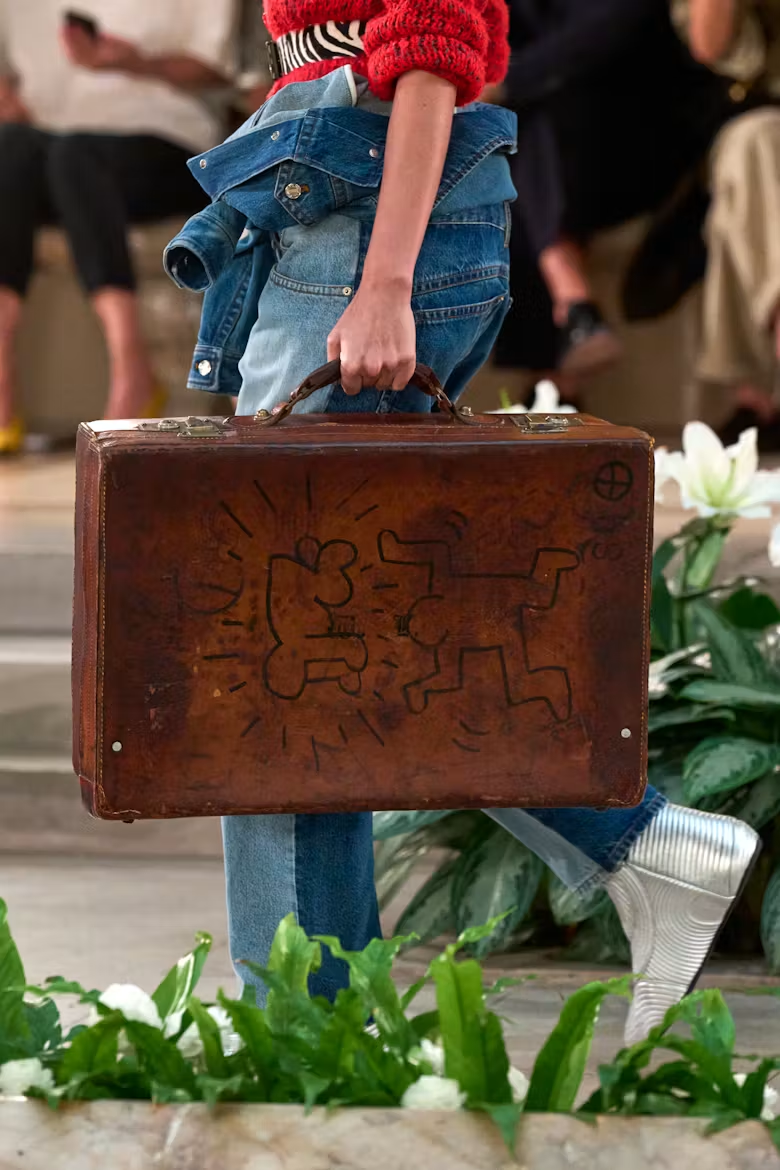
Then Ghesquière was working on Cruise 2027. He had already decided to collaborate with the Keith Haring Foundation. He discovered the suitcase — this piece that proved the relationship had existed long before anyone formalized it. Haring had drawn on Louis Vuitton luggage forty years earlier, not because of a commissioned partnership, but because he believed art should be everywhere. On subway walls. On T-shirts. On whatever surface was available.
The street had already claimed the house. Ghesquière was simply acknowledging it.
Simon Castets, executive director of the Keith Haring Foundation, noted that Haring “really valued ubiquity, and so he wanted to have his art on as many things as possible.” That instinct — democratic, generous, anti-hierarchical — is what Ghesquière brought into the Frick on May 20, 2026. Into the most hierarchical room imaginable. Not as provocation. As a genuine question about what luxury fashion is for.

The Collection: Contradictions Made Wearable
The clothes themselves were precise instruments of the argument — each look constructed to hold two things simultaneously that fashion usually keeps apart.

The Opening Look
The first model walked the runway carrying the Haring suitcase — the original object, on loan from the archive, its black marker drawings still visible against the aged leather. She wore a red knit cardigan, slouchy jeans, and a zebra-printed belt. Ghesquière called this combination “uniquely American casual.” In the Frick’s gilded salons, it was also a statement of intent: this collection was going to bring the street into the mansion and let them coexist without resolution.

The Patchwork Leather Jackets
Several jackets were constructed from leather patchworks built in the visual style of Haring’s paintings — bold, graphic, color-saturated. The craftsmanship was unmistakably Louis Vuitton atelier work: precise, labor-intensive, built to last. The visual language was unmistakably downtown New York: urgent, energetic, democratic. These were pieces that could have been framed on the Frick’s walls and held their own there. That is not a small achievement.

The Elizabethan Collars on Athleisure
Capri leggings appeared throughout the collection — practical, body-conscious, contemporary — paired with jackets topped with bouncy, frilly collars that mirrored the Elizabethan ruffs visible on portraits hanging in the museum’s rooms. The Renaissance absorbed into sportswear. Five centuries compressed into a single silhouette. This was Ghesquière at his most playful and most serious simultaneously: the uptown girl wearing the museum, the downtown girl wearing tomorrow, and the question of whether they were ever different women at all.

The Haring Accessories
The collection’s most discussed pieces were the objects: a miniature version of the Haring suitcase rendered in Louis Vuitton’s finest leatherwork; bags shaped like New York takeout containers and vinyl records; Louis Vuitton monogram boxing gloves worn slung over models’ shoulders. Lace-up boxing booties anchored most of the looks. These were objects designed to generate desire and cultural conversation in equal measure — Haring’s democratic instinct made available in the most exclusive material language.

The Pop Art Surfaces
Haring’s barking dogs, radiant babies, and graphic UFO linework appeared across boxy origami-folded shirts, leather pieces, and bags. The imagery was placed with care — positioned as you would position a work on a wall. In the Frick’s rooms, surrounded by Old Masters, these pieces read not as intrusion but as continuation. Art has always appeared on surfaces. Haring simply chose different ones than Fragonard.

The Closing Sequence
The show ended where the building began: a series of frilled peplum tops and ruffled silhouettes that could have walked directly out of a Gilded Age daguerreotype, worn with the collection’s contemporary shoes and modern confidence. The circle closed. The uptown and downtown exchange completed. The Frick, briefly, held both.
The Three-Year Partnership: Fashion as Cultural Infrastructure
Every other review of this show mentioned the Louis Vuitton–Frick sponsorship in a paragraph. QEditorial treats it as the most important thing that happened that evening — because a show lasts fifteen minutes, and a three-year institutional commitment shapes something far larger.
Louis Vuitton will fund three major special exhibitions at the Frick, beginning with Siena: The Art of Bronze, 1450–1500 this autumn — the first exhibition to fully position Siena as a center of sculptural excellence during the Italian Renaissance. Spring 2027 will bring the first exhibition dedicated to French enameler Suzanne de Court. Louis Vuitton First Fridays will offer free public access on the first Friday of most months through May 2027. And a two-year curatorial research position — held by Yifu Liu, whose scholarship focuses on artistic exchange between Europe and China in the eighteenth century — will support the museum’s curatorial department.
That last detail is the one almost no publication reported. Yifu Liu. Europe-China artistic exchange. In 2026, when the global conversation about cultural identity and soft power is more consequential than it has been in decades, Louis Vuitton is not just making museum access more democratic. It is quietly shaping what one of New York’s most prestigious institutions researches, and which conversations it enters.
This is fashion operating as cultural infrastructure. As public arts funding continues to erode and luxury houses fill the resulting vacuum, a structural question emerges: who holds cultural authority in this new arrangement? And what do they want in return? There is no simple answer — the complexity is worth sitting with rather than resolving too quickly.

The Room They Built Around the Show
A brief note on the front row — not as celebrity coverage, but as composition. Ghesquière’s guest list at the Frick was as deliberately constructed as the collection itself. Zendaya as house ambassador, bridging Hollywood and Generation Z. Emma Stone, Cate Blanchett, Anne Hathaway, Emily Blunt, Amy Adams — the most critically serious generation of Hollywood actresses, gathered in a single room. Misty Copeland of American Ballet Theatre. Artist Tschabalala Self, drawing a direct line to contemporary New York art. Felix of Stray Kids, Chase Infiniti, Hoyeon — the global pop generation now driving luxury consumption across Asia and beyond. Alana Haim, who crossed from the front row onto the runway — from audience to participant — in a gesture that quietly collapsed the boundary between watching and belonging.
Louis Vuitton did not invite celebrities to the Frick. It invited a portrait of the world it believes fashion should speak to. The room was the argument, continued.
What Ghesquière Proved
In the same season that Demna chose the center of Times Square — spectacle, noise, fashion as public event — Ghesquière chose a private room with a Vermeer. Both choices are coherent. Both are correct. They are simply different answers to the same question luxury fashion is being asked in 2026: what are you for?
Demna’s answer is fashion as democratic performance — the street as runway, the crowd as audience. Ghesquière’s answer is fashion as cultural custodian — the archive as foundation, the institution as stage, the clothes as the most durable form of storytelling a house can produce.
Louis Vuitton’s CEO told Elite Traveler that “Vuitton is not a fashion brand.” After thirteen years of cruise shows in UNESCO heritage sites, Oscar Niemeyer museums, and Gilded Age mansions — after acquiring a Keith Haring suitcase and waiting six years to understand what it meant — that statement no longer sounds like corporate positioning.
“After all these years,” Ghesquière told WWD, “it’s not a search for perfection, but you always look for the next collection. That’s something that is very artistic that I wanted to express since I was a kid.”
Thirty years in the industry. One suitcase from the 1930s. A marker drawing made in 1984 by an artist who believed art should be everywhere. A room full of Vermeers that had never seen a fashion show until May 20, 2026.
That is the story. The collection was just how it was told.
Q Editorial Magazine covers fashion as cultural dialogue. Read our review of Gucci Resort 2027 at Times Square. Explore our ongoing series on luxury fashion identity: “Do Luxury Brands Still Have an Identity?” and “When Culture Dresses Fashion, and Fashion Dresses Culture.”

Leave a Reply