
How Ellie Liu Translates Decades of Womenswear Experience into a Refined Wardrobe for the Modern Dog

A herringbone wool overall, cut close to the body and finished with leather-trimmed pockets, would feel entirely at home in a carefully considered autumn wardrobe. At BONDIR, the wearer simply happens to have four legs.
Founded by designer Ellie Liu, the pet-fashion label brings more than three decades of experience in high-end womenswear into a category that has often been shaped by novelty, costume and seasonal amusement. BONDIR approaches the canine body through the disciplines of fashion: proportion, construction, fabric, movement and detail. Its collections include tailored coats, embroidered linen shirts, structured overalls, knitwear, leather walking sets and accessories designed to form a coherent wardrobe.
The result reflects a broader shift in how people understand life with animals. Dogs increasingly occupy the same domestic, social and visual spaces as their owners. They travel, enter restaurants, accompany people to studios and offices, and appear throughout the images that document contemporary life. Their belongings have followed them into this expanded world. The pet coat, collar and leash now participate in questions of material, design and personal taste.
BONDIR belongs to this more mature phase of pet fashion.
From Womenswear to the Canine Form
Liu’s background provides the foundation of the brand. After working in high-end women’s fashion for more than 30 years, she applied that experience to clothing and accessories developed specifically for dogs. Her approach preserves the vocabulary of traditional fashion while adjusting it to another anatomy. BONDIR’s coats carry the references of human outerwear—trench structures, tweed surfaces, generous collars and polished hardware—yet their patterns must accommodate the chest, spine and changing rhythm of a moving animal.

This translation is visible in the Vellure Overall, one of the brand’s most distinctive pieces. Constructed from 100 percent herringbone wool tweed, it combines a full-body silhouette with adjustable shoulder straps, vegan-leather pocket trims and metal hardware. The fabric brings the texture and structure associated with heritage tailoring, while the open construction around the legs allows the dog’s body to remain visually present.
The garment demonstrates one of the central challenges of pet fashion. A strong design must retain its identity without restricting the wearer or overwhelming its natural shape. The successful piece frames the animal rather than turning it into a prop.
BONDIR’s quieter designs follow the same principle. The Metis Embroidered Linen Shirt, for example, uses breathable navy linen, white embroidery, a soft cotton lining and a Velcro chest closure. Its visual language recalls resort shirts and artisanal summer clothing, while its construction responds to warmth, contact with fur and ease of dressing.
These details move the conversation beyond miniature versions of human clothing. Designing for dogs requires a different understanding of comfort. Seams sit against fur and skin. Closures must remain accessible. Necklines cannot interfere with breathing or movement. The garment must stay balanced while the wearer walks, sits, stretches and changes direction.
The Wardrobe as a Shared Visual World
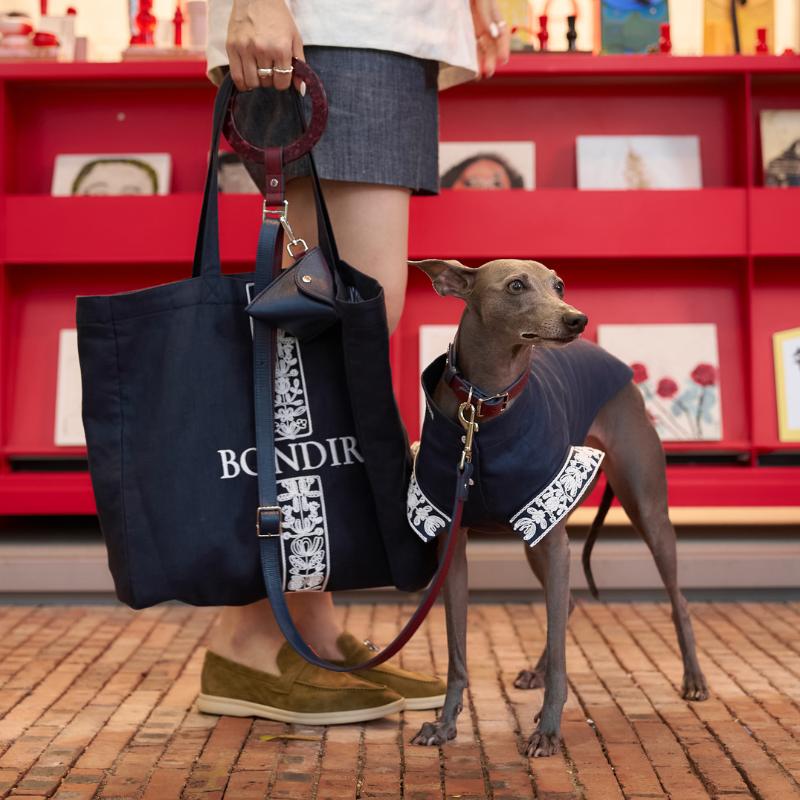
BONDIR’s collections also explore the relationship between the dog’s wardrobe and that of the person holding the leash. Some pieces are accompanied by human accessories, allowing colors, textiles and details to move between both sides of the relationship. The coordination remains restrained: a matching tote, a shared embroidery motif or an acetate leash handle can create continuity without reducing the pairing to costume.
This shared visual language has become one of the defining developments in contemporary pet fashion. Owners are no longer choosing only what looks charming on an animal. They are selecting objects that can enter the architecture of their homes, the palette of their wardrobes and the routines of their daily lives.

A leather collar may sit beside a handbag. A tweed coat can echo the texture of an owner’s jacket. A leash becomes part of the silhouette created during a city walk. Pet accessories now occupy a visible position within personal style, particularly in urban environments where animals and their owners spend much of the day together.
BONDIR responds to this environment through designs that draw from familiar fashion categories rather than overt pet motifs. Its catalogue includes trench coats, capes, sweaters, shirts, overalls, hats and coordinated leather goods. The brand also produces clothing for a broad range of body sizes, presenting its collections for breeds extending from Chihuahuas to Golden Retrievers.
The ambition is significant. Scaling a design across canine bodies involves more than enlarging a pattern. A dachshund, Italian Greyhound, French Bulldog and Golden Retriever have profoundly different proportions. The length of the back, depth of the chest, placement of the shoulders and volume of the neck all influence how a garment sits and moves.
Luxury Measured Through Use
Pet luxury carries a particular responsibility because its wearer cannot choose the garment or explain discomfort. Quality must therefore be assessed through use as much as appearance.
BONDIR describes its pieces as a balance of fashion and function, with premium materials, close quality control and attention to seams, buttons and construction. Its leather collection includes handmade collars, leashes and waste-bag holders intended to coordinate as complete walking sets. The brand also uses minimal packaging and states that a portion of every order is directed to animal shelters or charities selected in different parts of the world.
Its values are also embodied by BONE, a rescued Chinese native mixed-breed dog who became one of the label’s muses. BONDIR presents her story as part of a wider commitment to rescue, adoption and the belief that visibility and care should never be reserved for pedigree animals. In the brand’s imagery, BONE wears tailored coats and understated separates while retaining the alert, individual presence that first attracted the team to her.
The story introduces a useful counterpoint to the polished surface of luxury pet fashion. Clothing alone does not improve an animal’s life. Its value depends on the care surrounding it: appropriate sizing, comfort, freedom of movement, responsible supervision and respect for the dog’s tolerance. Style becomes meaningful when it exists within that larger relationship.
A More Considered Pet Fashion
BONDIR arrives at a moment when the pet market is being reconsidered by both established luxury houses and independent designers. Ellie Liu has observed that the expansion of pet products by companies such as Louis Vuitton and Hermès reflects the growing place of animals within affluent households. Independent labels, however, can often explore this category with greater focus, treating the animal as the primary wearer rather than as an extension of an existing accessories business.
BONDIR’s relevance lies in its understanding that pet fashion can possess its own design intelligence. The strongest pieces do not depend on spectacle. A line of embroidery, the weight of a wool tweed, the position of a fastening or the curve of a leather collar is enough to establish character.
The dog remains visible inside the clothing. Its posture, movement and personality complete the garment.

That balance may define the next chapter of pet fashion: a field where design acknowledges the emotional place animals hold in contemporary life while respecting the physical reality of the bodies wearing it. BONDIR offers a wardrobe built around that intersection—fashion experience translated into another scale, another silhouette and another form of companionship.
Discover the collections at BONDIR.
Editor’s Note
Pet fashion has developed into a serious design category shaped by tailoring, material research, comfort and the changing relationship between people and companion animals. BONDIR’s luxury dog clothing illustrates how established fashion knowledge can be adapted to canine anatomy through wool tweed coats, embroidered linen shirts, leather dog collars and coordinated walking accessories. Its work reflects a wider movement toward designer pet apparel that values construction and individuality alongside visual identity.
This article is an independent editorial feature. Product suitability depends on an individual dog’s measurements, physical needs and tolerance for clothing. Animals should be supervised while wearing garments or accessories.




Leave a Reply