
Times Square does not belong to fashion. It belongs to tourists, to billboards, to the specific kind of organized chaos that makes actual New Yorkers cross the street to avoid it. It smells like roasted nuts and diesel. It is loud in the way that has nothing to do with energy and everything to do with volume. It is, by almost every measure, the last place you would stage a luxury fashion show.
Which is exactly why Demna chose it.
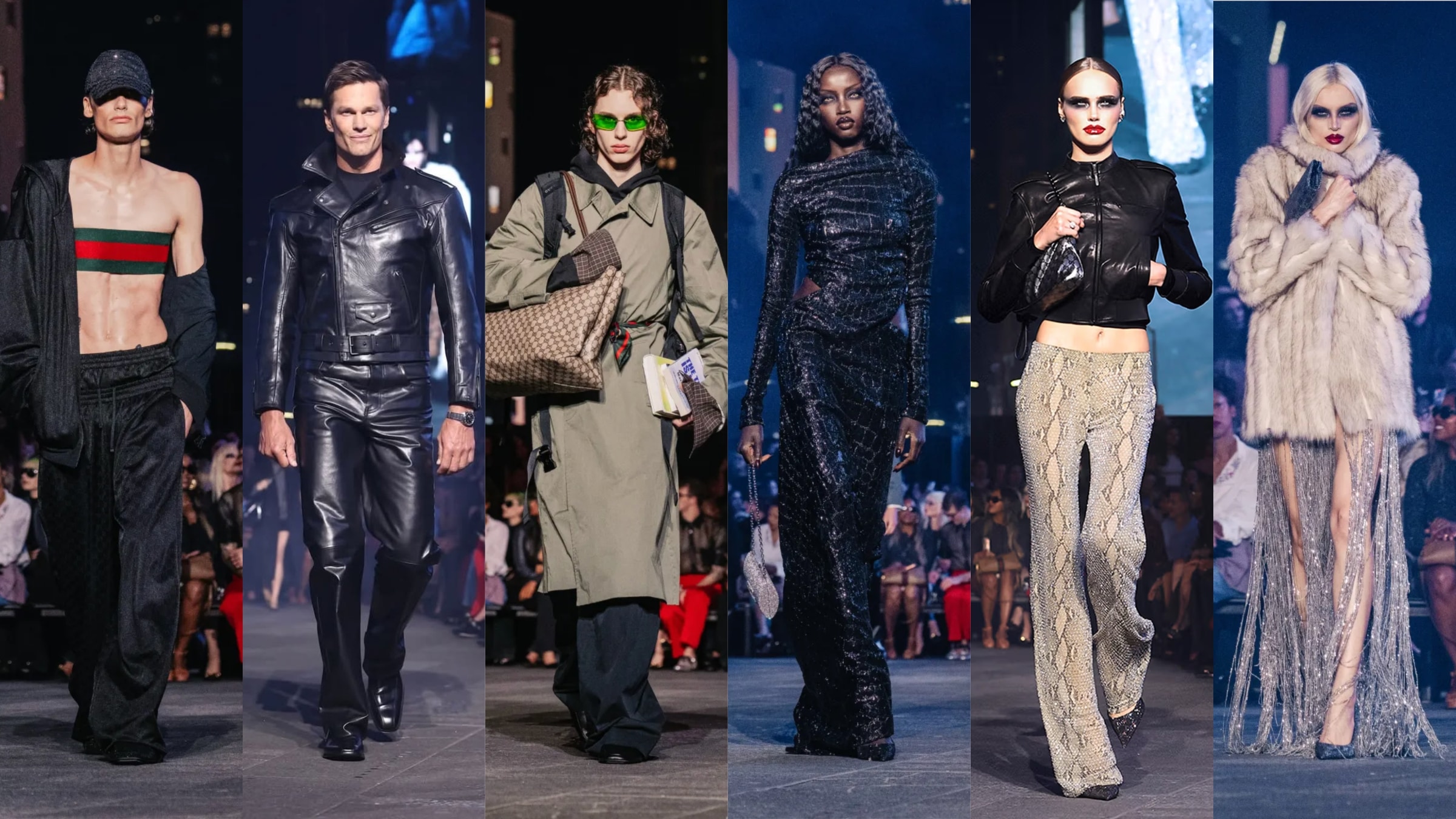
On the night of May 16, 2026, Gucci’s artistic director shut down Midtown Manhattan’s most saturated public space, erected black barriers around its concrete slabs, and sent 63 models through it wearing his Gucci Resort 2027 collection. The honking continued outside the barriers. The sirens did not stop. Times Square carried on being Times Square, and inside it, one of the most talked-about fashion shows of the year happened anyway.
This was not a show that used Times Square as a backdrop. Times Square was the argument.
Why Times Square Was Never a Neutral Choice
Gucci opened its first store outside Italy on New York’s Fifth Avenue in 1953. The relationship between the house and this city is not recent or incidental — it is foundational. When Demna chose Times Square over the Guggenheim, over a Chelsea gallery, over a rooftop with a skyline view, he was making the most aggressive possible interpretation of where Gucci’s cultural authority actually lives.
Not in a museum. Not in a curated white space. In the most commercial, most contested, most visually saturated address in the world.
The timing was not accidental either. This season, luxury fashion collectively decided that America is where the important statements get made. Louis Vuitton is presenting its own Cruise 2027 collection in New York at The Frick Collection on May 20. Jonathan Anderson staged his debut Dior cruise show in Los Angeles on May 13. The industry moved west and then north, and Gucci landed in the middle of it all — literally in the middle of Midtown — and made everyone else’s venue choices look conservative by comparison.
The North American luxury market context reinforces the decision, with projections pointing to continued growth in luxury spending driven by an increasing number of high-net-worth individuals. Demna understood that the most powerful statement Gucci could make in 2026 was not aesthetic — it was geographic.

What Is GucciCore — And Why It Matters
In internet culture, “core” is a suffix that defines the most fundamental, most concentrated version of something. Gorpcore. Cottagecore. Blokecore. Each one names a sensibility at its most distilled. Demna borrowed the logic and applied it to the house itself.
In practice, GucciCore is a permanent wardrobe of staples. Not seasonal. Not trend-dependent. The peacoat. The trench coat. The business suit. The essential shirt. The pencil skirt. Pieces that form the foundation of what people actually wear from the house, translated through Demna’s lens of New York archetypes and Italian glamour.
“What you see here is a garment vocabulary,” Demna told WWD before the show, “and then you can compose your own words with it.”
This is a significant shift in how a luxury house communicates its identity. GucciCore is not a collection in the traditional seasonal sense — it is a platform. A permanent offering that evolves rather than resets every six months. For a brand that has spent the last several years in identity flux, it is also a statement of intent: this is what Gucci is now, and it is not going anywhere. For a deeper look at how luxury houses are navigating identity right now, read our piece on whether luxury fashion brands still have an identity.

The Pre-Show — Consumerism as Content
Before a single model walked, Times Square’s billboards told a different story.
Gucci Acqua, Gucci Gym, Palazzo Gucci Hotel, Gucci Pets, Gucci Life longevity supplements — most fake, some real — blasted across the Times Square screens as distracting entertainment before the show. Real high jewellery. AI-generated pets wearing actual Gucci accessories. A faux luxury water brand believable enough to be mistaken for the real thing.
“I love that contrast,” Demna explained. “Whenever you watch something, it’s this annoying interruption of someone wanting to sell you something, which is kind of going back to what Times Square is about.”
The montage was many things simultaneously — a commentary on consumer culture, a brand exercise, a piece of entertainment, and a very expensive joke that landed. As a demonstration of power and a marketing exercise, it was hardcore. It was also the clearest possible articulation of what Demna is doing at Gucci: using the language of commercial culture as a creative tool rather than treating it as something luxury fashion needs to rise above.
The invitations for the show arrived as golden keys — a detail with multiple layers of meaning. In the 1970s and 1980s, Gucci inaugurated luxurious gallery spaces above its Beverly Hills boutique and its former Fifth Avenue store, accessible only with a gilded key. Demna sent those keys out as a quiet signal that he had done his homework on the house’s history, even while staging its most unconventional show to date.
The Collection — New York Characters in Gucci Clothes
The clothes themselves were built around New York archetypes rather than traditional fashion categories. Demna looked at the city and pulled out its recurring characters — and then dressed them in pieces that could only be Gucci.
The commuting banker arrived in tailored pinstripe suits topped with oversized logoed tote bags. The uptown woman came wrapped in shearling and reversible technical outerwear, iPhone in hand, floral bouquet under one arm. The downtown girl wore a cropped leather jacket with a matching miniskirt. The bodega regular carried flowers. The Upper East Side socialite moved through it all with the particular brittleness of someone who has always known exactly where she is going.
Standout pieces cut through the concept cleanly. The red peacoat in English wool — the same used for Britain’s Royal Guards — was the kind of piece that earns its place in a wardrobe without requiring context to understand. The hand-painted Flora airline coat with racing details referenced the house’s archival richness without feeling like a costume. The pencil skirt extended Demna’s ongoing study of the Tom Ford era with more confidence than in previous collections.
There were plenty of great pieces, but some got lost in the shuffle amid the show’s more seasonal, fashion-forward attire. The edgier pieces at times didn’t seem as assured as the Core ones, and often bore traces of what the designer did during his tenure at Balenciaga. That tension — between the GucciCore pieces that felt completely resolved and the seasonal 10% that felt borrowed from elsewhere — was the collection’s most honest quality.

The Gucci NY Collection — Where to Find It in New York
Alongside the Resort 2027 runway, Demna introduced Gucci NY — a limited-edition collection of accessories, shoes, jewelry, and handbags created specifically as a tribute to New York City.
The collection launched on Sunday, May 17, and is available for a limited time across five of Gucci’s New York locations and via its US e-commerce. Gucci’s Fifth Avenue and Wooster Street stores have also been redesigned with new decor that carries the GucciCore collection’s spirit into the physical retail space — making the stores themselves an extension of the show rather than just a place to buy what was on the runway.
For anyone in New York right now, both locations are worth seeing. The physical retail expression of a runway concept is often where the real design thinking becomes legible in a way that photographs cannot fully capture.
The Cast — Who Walked and What It Meant
This was not a traditional celebrity front row. The celebrities were on the runway.
Tom Brady walked in head-to-toe leather, playing into exactly the beefcake archetype Demna had written for him. Cindy Crawford closed the show in a black feathered evening gown — archly glamorous, entirely in command of the moment. Paris Hilton appeared brunette in a bright yellow print dress, carrying a crocodile Gucci-branded takeout container. Alex Consani wore a vampy sheer caftan stacked with necklaces. Lindsay Lohan moved through in all-black leather. Candice Swanepoel. Dree Hemingway. Anok Yai.
Demna’s vision was about being not only how the clothes are styled, but who wears them. The cast was an argument that Gucci belongs to a specific kind of person — or rather, to many specific kinds of people, all of them inhabiting the same city block at the same time. Whether that argument fully landed depends on how you feel about celebrity as cultural currency in 2026. For some, Tom Brady in leather is a powerful image. For others — and the TikTok commentary was pointed on this — it read as spectacle over substance. Both readings exist and both are honest responses to the same show.

The Conversation — What Fashion Is Actually Saying About This
The critical response to the Gucci Resort 2027 show has been genuinely divided, which is more interesting than a clean consensus would have been.
Business of Fashion described Demna’s revamp of the Italian house as coming “further into focus” through the Times Square presentation. AnOther called it “hardcore, euphoric, unmistakably Gucci.” These are the readings that engage with what Demna is building — a slower, more deliberate repositioning of the house around wearability and identity rather than spectacle for its own sake.
On the other side, the TikTok commentary was sharper. Forum critics called it “the most boring Gucci show ever” and “his Balenciaga Cruise New York show from a few years ago, but with Gucci-isms.” One video commentator noted that the most exciting moment of the evening was Paris Hilton appearing with brown hair. Another said the bags looked like ones you could buy from a blanket on the ground in Times Square itself — which was either a devastating critique or an accidental compliment depending on how you read the collection’s democratic ambitions.
The honest read sits somewhere between both positions. The show was a genuine cultural event. The collection was commercially strong and creatively uneven. The venue was a brilliant choice. Some of the clothes felt like a designer still working out what he is doing at a house that requires a very specific kind of confidence to wear correctly.

What GucciCore Tells Us About Where Fashion Is Going
The most significant thing about the Gucci Resort 2027 show is not what was on the runway. It is what the concept of GucciCore reveals about the direction luxury fashion is moving.
The traditional seasonal model — two main collections, cruise, pre-fall, each one a complete reset — is under pressure from every direction. Consumers are not buying seasonally. They are building wardrobes. They want pieces that work across years, not just across months. The most commercially successful luxury items are the ones that look as relevant in three years as they do the week they drop.
GucciCore is Demna’s response to that reality. A permanent foundation that evolves rather than disappears. A wardrobe platform rather than a seasonal statement. The naming — “Core” — is a direct acknowledgment of how the brand’s actual customers think about clothes. Not in terms of fashion weeks and runway moments, but in terms of what they reach for every day.
In popular subcultural parlance — Gorpcore, Cottagecore and the like — “core” defines the most central, the most fundamental attribute of a particular thing. Demna is applying that same cultural logic to Gucci itself. It is a smart move, and it is one that will either define a new era for the house or reveal itself as a very well-staged marketing concept within the next two or three collections.
The show also signals something broader about luxury and location. Fashion has always used venue as language. But the choice of Times Square — chaotic, commercial, contested — over the clean authority of a museum or gallery space suggests that the luxury industry’s relationship with aspiration is changing. The old model separated luxury from the world. The new model puts it in the middle of the world and dares you to look away.
Frequently Asked Questions
Where was the Gucci Resort 2027 show held? The Gucci Resort 2027 show — also referred to as Gucci Cruise 2027 — was held in Times Square, Midtown Manhattan, New York City on the night of May 16, 2026.
What is GucciCore? GucciCore is Demna’s concept for a permanent Gucci wardrobe collection — a foundation of staple pieces including peacoats, trench coats, tailored suits, and pencil skirts that remain in the collection long-term rather than rotating seasonally. The name draws on internet culture’s use of “core” as a suffix to define the most essential version of something.
Who walked in the Gucci Times Square show? The Gucci Resort 2027 show featured Tom Brady, Cindy Crawford, Paris Hilton, Lindsay Lohan, Alex Consani, Candice Swanepoel, Dree Hemingway, and Anok Yai among others walking the runway alongside professional models.
What celebrities attended the Gucci Resort 2027 show in New York? Guests at the Times Square show included Kim Kardashian, Mariah Carey, Iman, Stormzy, Willy Chavarria, and others from the fashion and entertainment worlds.
Where can I buy the Gucci NY collection in New York? The Gucci NY limited-edition collection is available at five Gucci locations across New York City, including the Fifth Avenue and Wooster Street stores, as well as via Gucci’s US e-commerce. The collection is available for a limited time only.
What is the difference between Gucci Resort 2027 and Gucci Cruise 2027? They refer to the same collection. Resort and Cruise are interchangeable terms used by the fashion industry for the mid-season collection shown between the main Spring/Summer and Autumn/Winter runway seasons.



Leave a Reply