
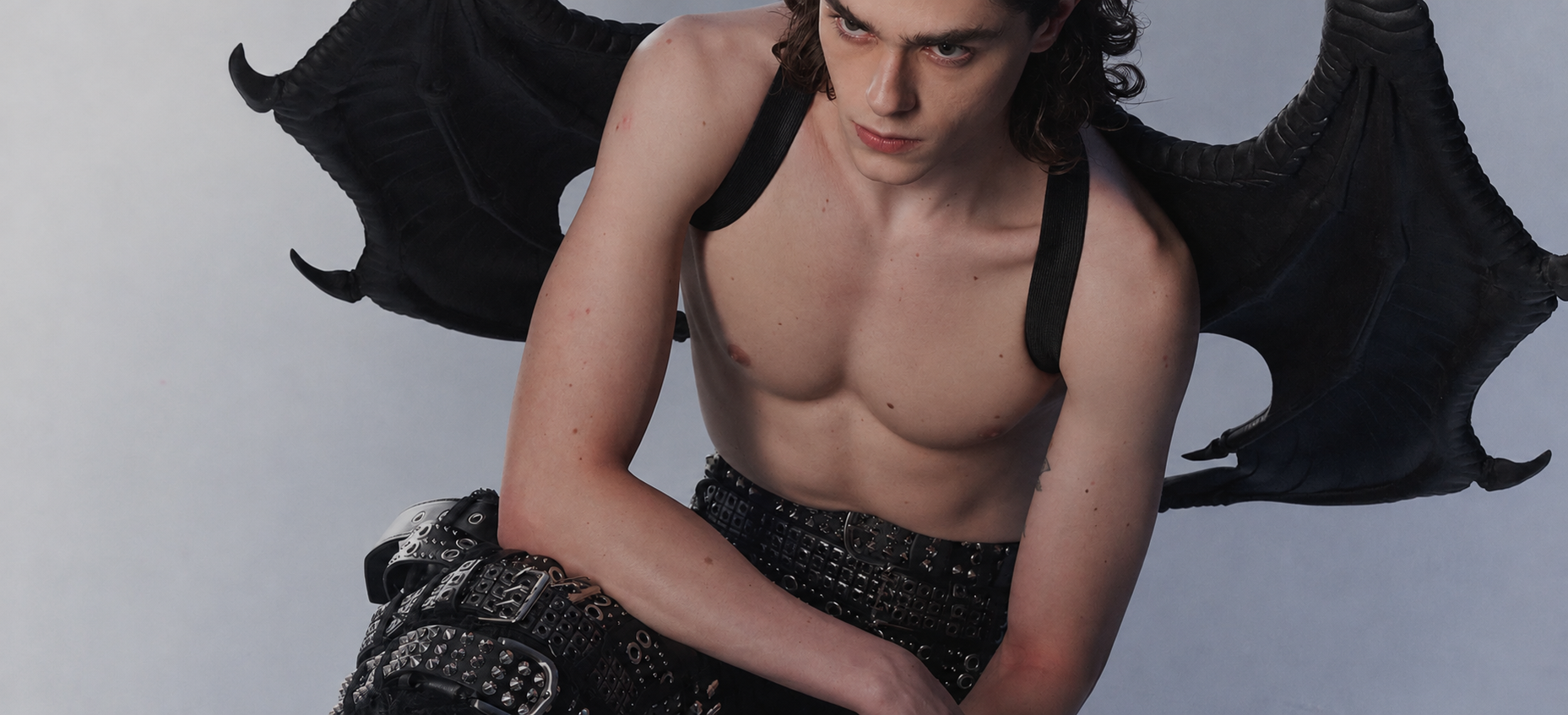
Through altered tailoring, personal drawings and deliberately unsettled proportions, Yen Te Lin turns the outsider’s perspective into a vocabulary for contemporary dressing.

A misplaced button can change the way a body appears to stand. An opening in a blazer can interrupt the authority associated with a suit. A drawing carried from a private notebook onto fabric can make a garment feel unexpectedly intimate. These are useful starting points for understanding NILDET, the London-based label founded by Taiwanese designer Yen Te Lin in 2021. Its interest lies in the small disturbances through which familiar clothing begins to express an unfamiliar experience.
NILDET appeared on the programme for London Fashion Day’s eighth season, scheduled at Porchester Hall on November 8, 2026. The occasion provides a timely reason to examine a design language that has developed across several collections: clothing shaped by the experience of feeling outside the frame. The question running through Lin’s work is how that feeling can acquire a physical form.
A name turned back on itself
The label’s name reverses the designer’s English name, Ted Lin. His profile on the London Fashion Week website describes this act of naming as a response to the difficulty of defining himself. Rearranging the letters creates room for another definition, one that the designer can determine. [2]
That gesture offers a precise introduction to his treatment of clothes. A recognisable structure remains available, but its order can change. A jacket still carries the memory of a jacket even when its construction interrupts what we expect from it.
Lin studied fashion at the Central Academy of Fine Arts in Beijing before completing an MA in Menswear at the University of Westminster. NILDET’s own account connects his experience of being an outsider in different cities with its unisex silhouettes, unusual prints and deconstructed designs. [3]
Moving between places does not automatically produce an interesting wardrobe. What matters here is how experience becomes a design decision. Lin’s work is most persuasive when it makes a feeling legible through proportion, placement or surface, allowing the clothes to carry the thought.
Before the brand came the drawing
An earlier collection, Daydreamer, helps explain that process. In the designer’s portfolio on NOT JUST A LABEL, Lin describes returning to his younger self: a teenage misfit who wanted to be a skater. Drawings made during moments of insecurity became part of an imagined world, while late-1990s street scenes informed deliberately awkward proportions. [4]
The drawing is significant because it gives imagination a practical role. It is something a person does with their hands, then develops into an image that can travel onto another surface. What begins as a private activity becomes visible on the body.
There is a particular tension in taking that material into fashion. Clothing enters public space. It is looked at, interpreted and sometimes judged before its wearer speaks. Carrying a personal drawing into that space introduces something vulnerable into an object expected to project confidence.
This is an enduring concern in Lin’s practice. In a 2017 interview with LVL3, conducted while he was studying for his master’s degree, he described “fashion as a medium that can carry messages to people.” He also spoke about Taichung, his home city, through the coexistence of traditional customs and contemporary style. The interest in clothing as communication predates NILDET itself. [5]

Awkwardness as a construction choice
A 2021 feature published by China International Fashion Week on Sohu provides a particularly revealing example. It describes displaced trouser buttons intended to suggest the twisting associated with an awkward seated posture. Other references came from temporary street structures, discarded furniture and everyday habits observed during the pandemic. [6]
Here, awkwardness has a technical task. Moving a fastening changes how a familiar garment is read. It can suggest imbalance or hesitation without requiring a printed statement to explain the emotion.
That approach deserves closer attention than the broad language of rebellion often attached to independent labels. Rebellion can become an image as predictable as any other. A specific alteration is more demanding: it must work within the garment, retain enough clarity to be understood and produce an effect beyond novelty.
The displaced button offers a useful measure of NILDET’s ambition. It allows an uncomfortable posture to become part of the design vocabulary. The body does not have to appear entirely composed for the clothing to make sense.
The suit becomes less certain
That negotiation continues through the label’s tailoring. Among the pieces documented on NILDET’s website is a single-breasted blazer made from wool suiting, with cut-out details and an open back. [7]
The material establishes a familiar relationship with formal dress. The openings complicate it. A suit jacket conventionally gives the body a continuous outline; removing part of that enclosure changes the relationship between structure and exposure.
Read through NILDET’s wider language, the gesture suggests a form of dressing in which confidence can remain incomplete. The garment can offer a strong outline while acknowledging the person within it. Authority becomes something constructed, and therefore something available for revision.
This gives the clothes a useful runway dimension. A front view supplies only part of their information. Turning, walking and passing another person can reveal a different arrangement. The garment asks to be understood over time, rather than reduced to a single frontal image.
Otherworld and the protective silhouette
The archive gives that tension another expression in Otherworld, NILDET’s Spring/Summer 2023 collection, documented on the London Fashion Week website. Contemporary coverage described dark tailoring, pronounced shoulders, metal-key details and purple-green prints. It also discussed a film concerned with a young man’s movement towards reconciliation with himself. [8]
Those elements bring protection and fantasy into the same wardrobe. A pronounced shoulder alters a person’s apparent scale. Metal introduces hardness. Print can make a surface feel less stable, shifting the eye away from the familiar outline of a shirt or jacket.
The combination is more interesting than a general invitation to escape. Fantasy becomes a way to rehearse another relationship with the body: how much space it occupies, how closely it permits itself to be seen, what it chooses to make visible.
Otherworld belongs to 2023, and should be read as part of the label’s development. Its relevance to NILDET’s present lies in the persistence of these questions, rather than in any claim that the same pieces appeared on the November 2026 runway.
A wardrobe with room for play
The brand’s online collections also show how this language can move beyond the more theatrical register of tailoring. Series 5 includes monster hats, a blue-dragon long-sleeved top and T-shirts carrying mythical-creature imagery. [9]
The change in scale matters. A hat or printed top allows someone to enter the designer’s world through an individual piece. The imaginative language can accompany ordinary movement through a city, without depending on a complete runway look.
Play also changes the emotional temperature of the clothes. An outsider’s wardrobe need not remain solemn. Strange creatures and exaggerated accessories can introduce humour, giving the wearer a way to make difference approachable on their own terms.
The recurring interest is authorship. Who gets to decide what a person should look like? NILDET’s answer emerges through objects that permit a degree of self-invention, from a disrupted jacket to a fantastical image worn close to the skin.

Reading NILDET through the runway
For its November programme, London Fashion Day presented NILDET through expressive tailoring, layering and textile manipulation. These descriptions align with the established vocabulary of the brand, although they do not provide a complete account of that particular collection. [1]
The broader editorial interest is already clear. NILDET gives the outsider a position from which to design. Feeling out of place becomes a source of information: about a proportion that seems wrong, a fastening that changes posture, or an image that makes sense to its maker before anyone else.
The strongest expression of that idea remains in the garments. Their alterations invite a closer look at how clothing teaches us to recognise confidence, ease and belonging. Lin leaves those signals open to adjustment. A person can inhabit the familiar shape of a wardrobe and still find room to redraw it.
Brand website: https://nildet.com/
Instagram: https://www.instagram.com/nildet_official/
Editor’s Note
NILDET caught our attention through the precision with which Yen Te Lin translates personal experience into clothing. Altered proportions, unexpected openings and expressive drawings give the outsider’s perspective a tangible form. This feature considers that language across the designer’s documented collections, exploring how feeling out of place can become a starting point for design.
QEditorial Magazine

References
[1] London Fashion Day official schedule and organiser’s NILDET announcement.
https://www.londonfashionday.co.uk/schedule/
https://uk.linkedin.com/company/londonfashionday[2] London Fashion Week official NILDET designer profile.
https://londonfashionweek.co.uk/designers/nildet[3] NILDET official biography.
https://nildet.com/pages/about-nildet[4] LIN YEN TE artist-supplied portfolio and Daydreamer collection account, NOT JUST A LABEL.
https://notjustalabel.com/lin-yen-te[5] LVL3, Ted Lin, interview dated 27 December 2017.
https://lvl3official.com/ted-lin/
Only the quoted 11-word phrase is reproduced in the article. Other material is paraphrased.[6] China International Fashion Week, feature published on Sohu, 13 September 2021. Chinese title: 专题 | 打破审美局限,多元化要怎么体现?
https://www.sohu.com/a/489497599_467704
The account of displaced buttons, posture and observed urban references is paraphrased from the Chinese text.[7] NILDET official cut-out blazer product page.
https://nildet.com/products/cut-out-blazer[8] Otherworld Spring Summer 2023: official archive and contemporary coverage.
https://londonfashionweek.co.uk/designers/nildet
https://www.archyde.com/nildet-releases-spring-summer-2023-collection-otherworld/
Archyde’s page is dated 26 September 2022. It is secondary reporting, not a new interview. Collection details are supported by the official 2023 collection archive.[9] NILDET Series 5 official collection.
https://nildet.com/collections/series-5
Additional useful first-person source
Ted Lin’s professional profile includes posts about Series 4 and a Paris showroom presentation of Series 5. Relative post dates were not treated as precise collection dates.
https://uk.linkedin.com/in/ted-lin-8399a615b


Leave a Reply