
In Corpus, the London-based sculptor brings vessels and figures into an intimate relationship, asking how the things we make preserve the shape of being human.
By Nicolò Di Stefano.
A vessel has a neck, a lip and a foot. We use these words so casually that their strangeness barely registers: an object made to hold something is described through the body that makes and handles it. In Corpus, Tancredi di Carcaci brings that connection into view. Figures rise from containers, surfaces interrupt anatomical outlines, and sculpture becomes a place where the distinction between a person and an object begins to loosen.
The exhibition, presented at Palo Gallery in New York through January 16, 2027, develops from the artist’s interest in ancient vessels and their relationship with human form. Its most compelling proposition is also its simplest: the objects we create can preserve an image of us, even when their original purpose has become remote. Palo Gallery
A past that remains unfinished
Born in London in 1997, di Carcaci works across stone, bronze and ceramic. His practice combines recognisable figures with abstraction, drawing on classical mythology and Renaissance art. These references establish a vocabulary, but they leave considerable room for invention. What matters is how an inherited form changes when another material, another fragment or another imagination enters it. Palo Gallery
An earlier exhibition, Spoglia, explored the reuse of historical elements. Reporting on that 2025 presentation, Rachel Summer Small described sculptures that combined cast bronze, ceramic and recovered stone. The logic of spolia, in which existing architectural elements acquire new contexts, offered a way to understand those encounters. Palo Gallery
Corpus carries that interest towards a more intimate scale of recognition. We know the swell of a container before we know its date. We recognise a torso even when the head and limbs are absent. Di Carcaci works within that interval, where the eye identifies something familiar and then discovers that its first explanation is insufficient.
The figure above the opening
In Adam, a dark torso appears above the mouth of a rounded vessel. The figure is incomplete, its broken outline held against the pot’s broad, continuous volume. Both are bronze, yet they offer different suggestions of weight. The container seems settled; the body appears caught in an uncertain relation to it.
The photograph makes the meeting especially clear. There is space around the torso, while the vessel gathers visual mass beneath it. The upper form might be emerging, balancing or withdrawing. Each possibility changes how the lower object is understood: as support, enclosure or something the body cannot entirely leave.
This ambiguity gives the work its emotional register. A recognisable fragment can invite a viewer to supply what is missing, but it also resists that completion. Adam remains a sculpture of partial presence. Its restraint lies in allowing a few bodily cues to carry the encounter, without providing a complete character or a fixed narrative. Artsy
The difference between these shapes also establishes a particular pace. The vessel can be understood almost at once, through its broad contour and central opening. The figure asks for a second reading. Its missing parts, uneven edges and position above the rim complicate the initial impression. The sculpture holds those two speeds together, allowing immediate familiarity to become the basis for a more searching encounter.

A body that changes its boundaries
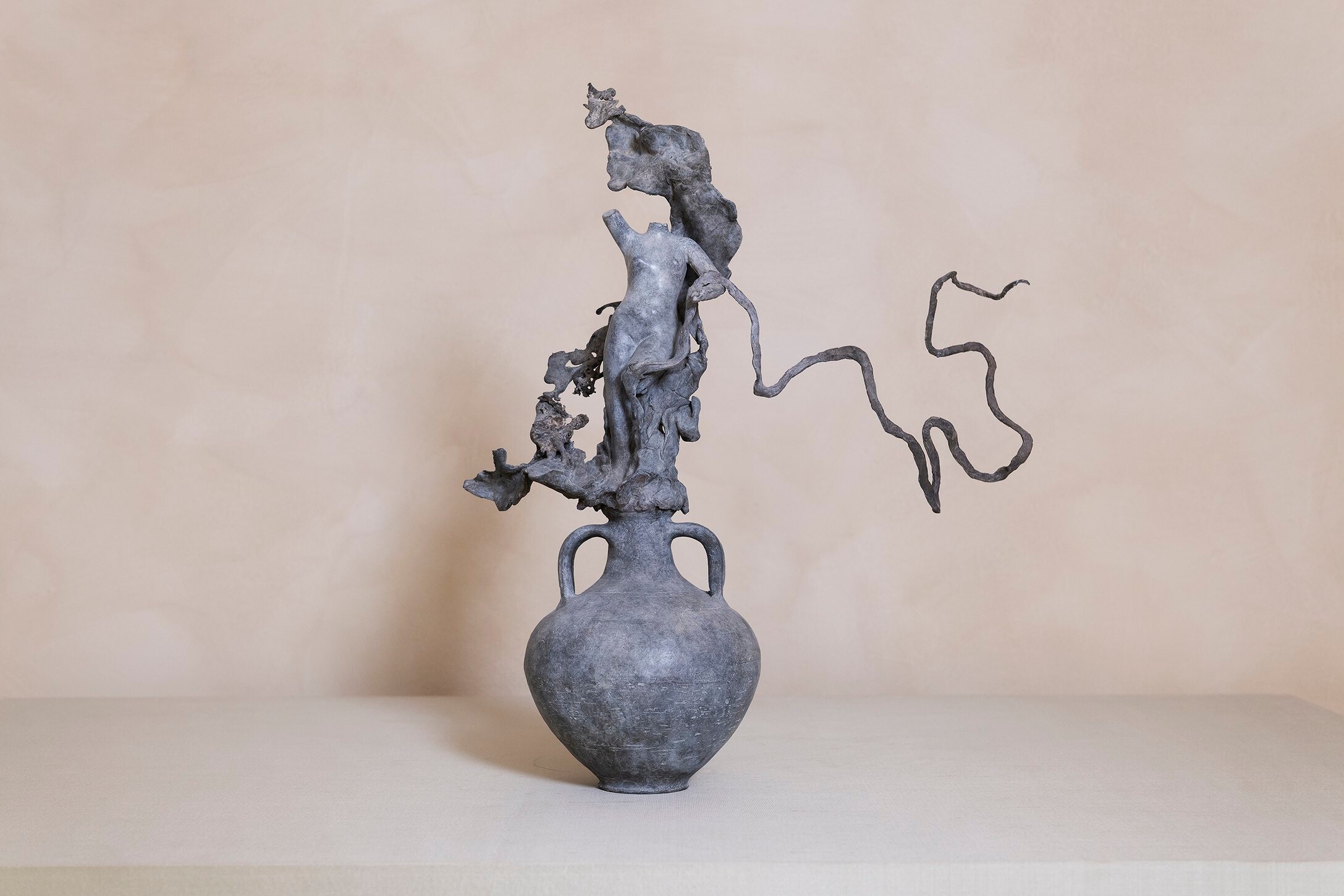
The relationship becomes more expansive in A body of water. A two-handled vessel supports a rising arrangement of bodily and irregular forms, with thin, wandering extensions reaching into the surrounding space. The bronze is grey, its uneven surface catching light across projections and recesses.
The rounded base offers an immediate point of orientation. Above it, that certainty disperses. A torso can be distinguished, but the boundaries around it become harder to settle. The eye moves between anatomy, branching lines and areas that seem to have accumulated through pressure or movement.
That change in visual rhythm is crucial. The sculpture connects the compact language of a container with a form that appears to exceed containment. Its title makes fluidity available as a reading, while the material supplies a persistent counterweight. Bronze holds these restless contours in place.
For a viewer, the result is a negotiation between recognition and attention. Seeing a body is only the beginning. Following the edges requires a slower look at where that body ends, what continues beyond it and how empty space participates in the composition. Artsy
What a surface can conceal
Herm offers another kind of transition. A small head and upper body emerge from an elongated, irregular lower form. Facial features remain subdued. The surface below is broken by ridges, depressions and overlapping textures, so that the figure’s apparent composure gives way to a much less settled structure.
Listed as a bronze work from 2026, Herm carries material continuity across these different registers. The face and the rougher lower body belong to the same object. Their encounter suggests that identity can remain legible even as its supporting outline becomes difficult to classify.
There is no need to decide immediately whether the lower section resembles a garment, a pedestal or an eroded body. Those associations can coexist. The sculpture rewards a form of looking that permits uncertainty to remain productive, giving the familiar face time to become strange. Artsy

The vessel wears its own history
Obsidian Figure brings a different surface into the conversation. The porcelain work places a dark, abbreviated torso above a vessel whose pale body is crossed by descending areas of colour. Gloss catches the light on the figure; around its lower section, irregular pale formations interrupt the silhouette.
The title might suggest stone, but the gallery’s listing identifies the medium as porcelain. That distinction matters to the experience of the object. Its darkness is something encountered through a ceramic surface, while the vessel below retains a contrasting brightness.
The body and container become connected by more than their placement. Colour travels across them, and changes in finish direct the eye from one section to another. Looking at the sculpture through its surface makes the meeting feel less like an assembled illustration of an idea. The material produces its own complications. Artsy
This is where the exhibition’s relationship with antiquity becomes particularly engaging. Historical distance is often imagined through damage, discolouration and incomplete survival. Here, a contemporary object can recall those conditions while openly belonging to a present act of making. Its apparent history is something the viewer must examine.

Photography introduces another layer to this reading. The images isolate each sculpture against a quiet background, making silhouette and surface legible. They cannot supply the changing viewpoints of an encounter in the gallery. What they offer is a clear invitation to imagine that movement: the space around a projection, the depth of a recess, the continuity behind a visible edge.
The objects that keep our proportions
Across these works, the vessel remains a remarkably persistent companion to the figure. It offers a stable shape against which the body’s interruptions can be read. Its opening also supplies a charged point of contact: an edge between an inside we cannot fully see and an outside available to inspection.
That relationship helps explain why Corpus feels relevant beyond its classical references. We continue to surround ourselves with objects adjusted to bodily dimensions, gestures and needs. A handle anticipates a hand. An opening determines an action. Even an object removed from use can retain those invitations.
Di Carcaci makes that familiarity available for reconsideration. His sculptures ask how much of the human figure survives in a form that initially seems separate from it. Their answer develops through looking: a curve becomes a shoulder, an opening becomes a threshold, a fragment acquires presence.
The encounter leaves the ordinary vocabulary of objects slightly changed. Neck, lip and foot begin to sound less incidental. In Corpus, the body persists through the shapes made around it, carrying a memory of touch into the space of sculpture.
Editor’s Note
Tancredi di Carcaci’s work drew our attention to a familiar detail: the language of vessels borrows from the human body. In Corpus, that connection becomes tangible through fragmented figures, rounded containers and surfaces that invite closer inspection. This feature explores the exhibition through published documentation and artwork photographs, considering how contemporary sculpture can renew our understanding of inherited forms.
QEditorial Magazine

Artwork images sourced from Palo Gallery and its Artsy listings, presented solely for editorial and informational purposes. All artwork and photographic rights remain with their respective copyright holders.

Leave a Reply