
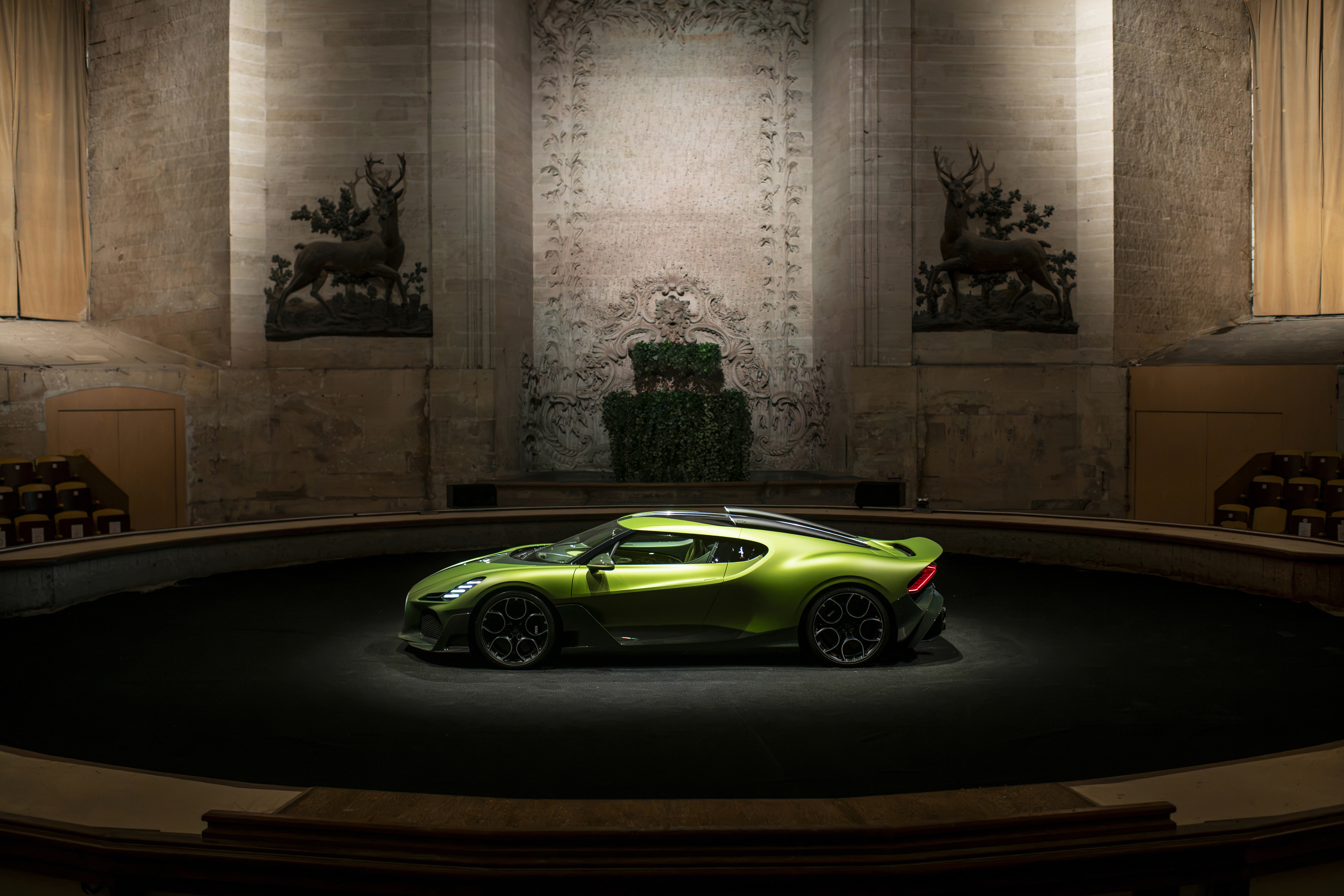
A single commission brings the Bugatti family’s artistic heritage into a contemporary hypercar, opening a conversation about taste, authorship and the meaning of owning something unrepeatable.
By Marco Bonatti

A commissioned object can reveal its owner without ever showing their face. The proportions of a room, the fabric chosen for a jacket or the sculpture placed beside a window can communicate a private sensibility. An automobile can perform the same function, although its engineering gives that expression an unusually demanding framework. With Brouillard, Bugatti has created a car whose most interesting quality is the relationship between a collector’s imagination and the people capable of giving it physical form.
Unveiled in 2025, Brouillard is a unique coupé and the first creation of Bugatti’s Programme Solitaire. Its public debut took place at The Quail during Monterey Car Week on August 15 that year. Its singularity provides the starting point for a larger question: when a car is commissioned for one person, how much of that person should the world be able to read in it?
A commission with a point of view
Solitaire gives that question a formal structure. Bugatti announced a maximum of two creations annually, each using an existing chassis and powertrain while receiving individual bodywork and interior treatment. This distinction matters. The engineering provides an established foundation; the commission introduces another layer of authorship through the shape and character of the finished object.
The comparison with couture becomes useful here. A commission requires decisions that must make sense together, beyond the appeal of individual materials. Personal preference becomes a coherent design only when someone can interpret it, edit it and understand where it should stop.
There is also an obligation on the client’s side. Choosing from a catalogue allows the manufacturer to supply most of the aesthetic reasoning. Commissioning something singular asks the owner to articulate a point of view. Money can make the process possible; it cannot, by itself, give the result conviction.

The family beyond the badge
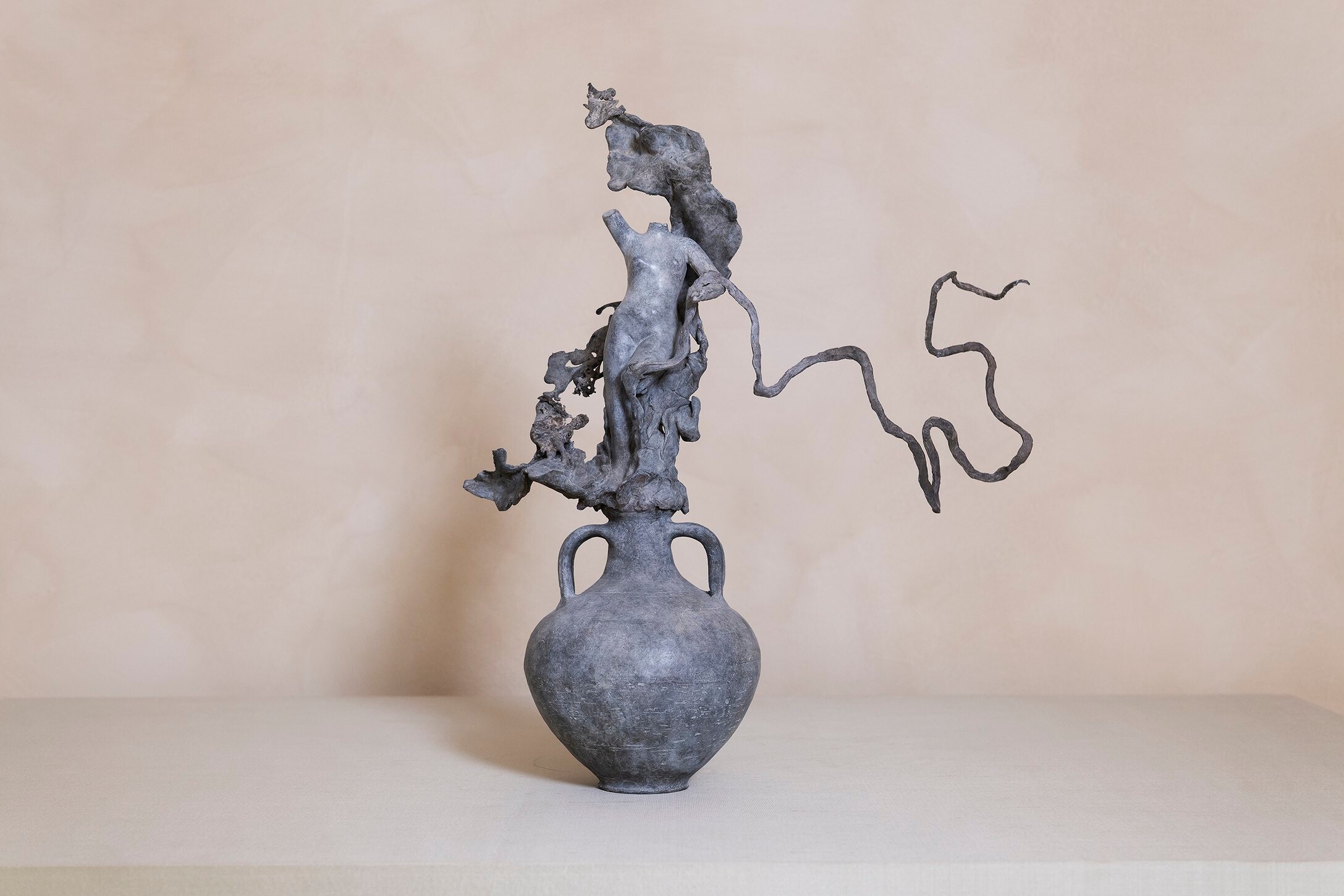
Brouillard’s owner collects historic and contemporary Bugatti automobiles, furniture by Carlo Bugatti and bronze sculptures by Rembrandt Bugatti. The commission therefore draws upon a family understood through several artistic disciplines. Its name recalls Ettore Bugatti’s favourite horse, bringing a personal detail from the founder’s life into the present.
This gives the project an unusually clear cultural foundation. A car can sit within the same intellectual world as a chair or a sculpture. Each object involves proportion, material and the interpretation of a body moving through space. Looking at them together changes the questions a collector might ask.
In this reading, ownership becomes an exercise in making connections. The significance of the new commission depends partly on what surrounds it, and on the knowledge its owner brings to it. An object gains depth when it belongs to a considered collection rather than simply enlarging one.
A body shaped by light
Bugatti design director Frank Heyl describes Brouillard through organic surfaces and equine musculature. Its darker lower body visually connects the car to its shadow, influencing the apparent lightness of the volumes above. These are deliberate acts of visual composition.
The published photographs invite attention to the movement of light across the bodywork. Curvature makes a surface change as the viewpoint shifts. That quality gives the car a sculptural presence: its appearance depends on a relationship between object, illumination and observer.
For an automobile, however, sculpture is only part of the assignment. The body must accommodate heat, airflow and mechanical demands. The challenge lies in making those requirements belong to the overall design. A successful surface carries its practical responsibilities without requiring the viewer to understand every technical decision behind it.

An interior with its own vocabulary
Inside, tartan fabrics sourced from Paris sit alongside green carbon fibre and aluminium detailing. Embroidered horses and a miniature horse sculpture within the gear selector continue the equestrian theme, while a glass roof changes the character of the enclosed space.
These choices make the cabin particularly relevant to a discussion of personal style. Pattern introduces a rhythm that differs from the surrounding technical surfaces. A small figurative detail asks for a closer look. Transparency alters the relationship between the occupant and the outside world.
The result can be approached as an interior in the architectural sense: a place where materials establish how someone wishes to live, even temporarily. The strongest commissions reward this slower attention. Their meaning survives the first photograph because details continue to offer something at closer range.
That is also where personalisation becomes most revealing. A choice encountered every time the owner enters the car may carry more emotional weight than a feature designed primarily for spectators.
Engineering beneath the personal expression
Brouillard uses Bugatti’s quad-turbocharged W16 in its 1,600 PS specification. Its technical foundation belongs to the established W16 programme, while the bespoke body gives that engineering a different visual identity.
For this article, those figures establish the scale of the design problem. Exceptional power brings physical requirements that no decorative concept can simply ignore. The commission must operate within those conditions, and its credibility depends on the relationship between appearance and capability.
There is a useful parallel with tailoring. Cloth has weight and resistance; a body has proportions and movement. The maker works with those realities. Automotive design adds far more complex forces, but the underlying creative discipline remains recognisable: expression becomes persuasive through an understanding of constraints.
The private object enters public life
In September 2026, Bugatti reported Brouillard’s handover to its owner at Chantilly Arts & Elegance Richard Mille. The car also received the event’s Best of Show recognition for concept cars, restomods and one-offs.
Chantilly provides an appropriate setting for the transition from private commission to public cultural object. A car created around one collector’s interests becomes something other people photograph, discuss and interpret. The owner retains possession, while its image begins a much wider journey.
That distinction complicates the idea of exclusivity. Physical access may belong to one person, yet visual familiarity can extend to millions. A unique object needs enough substance to remain interesting after its rarity has been announced.

What singularity can preserve
Brouillard offers a way to think about luxury through the quality of a commission. The important questions concern the decisions taken, the knowledge behind them and the relationships that made the work possible.
A single example can still be superficial. Equally, a familiar material can become compelling when someone uses it with understanding. Rarity establishes a condition; the finished object must supply the reason to care.
Read this way, Brouillard becomes a portrait assembled through choices. Its owner’s face remains outside the frame. What appears instead is an interest in a family’s creative history, translated into an automobile that other people can encounter on their own terms.
That leaves room for disagreement, which any expressive object should allow. Viewers may respond differently to the pattern, colour or equestrian references. A commission becomes culturally interesting when its decisions are specific enough to invite such responses. Brouillard gives personal taste a visible form, and lets that form speak in public.
Editor’s Note
Bugatti Brouillard invites us to consider how an automobile can express its owner’s identity. Through its connection to the Bugatti family’s artistic heritage, this singular commission offers a compelling perspective on personal taste, craftsmanship and the enduring appeal of objects created for one individual.
QEditorial Magazine

Photography courtesy of Bugatti Automobiles S.A.S., sourced from the official press kit and presented solely for editorial and informational purposes. All image rights remain with their respective copyright holders.

Leave a Reply