
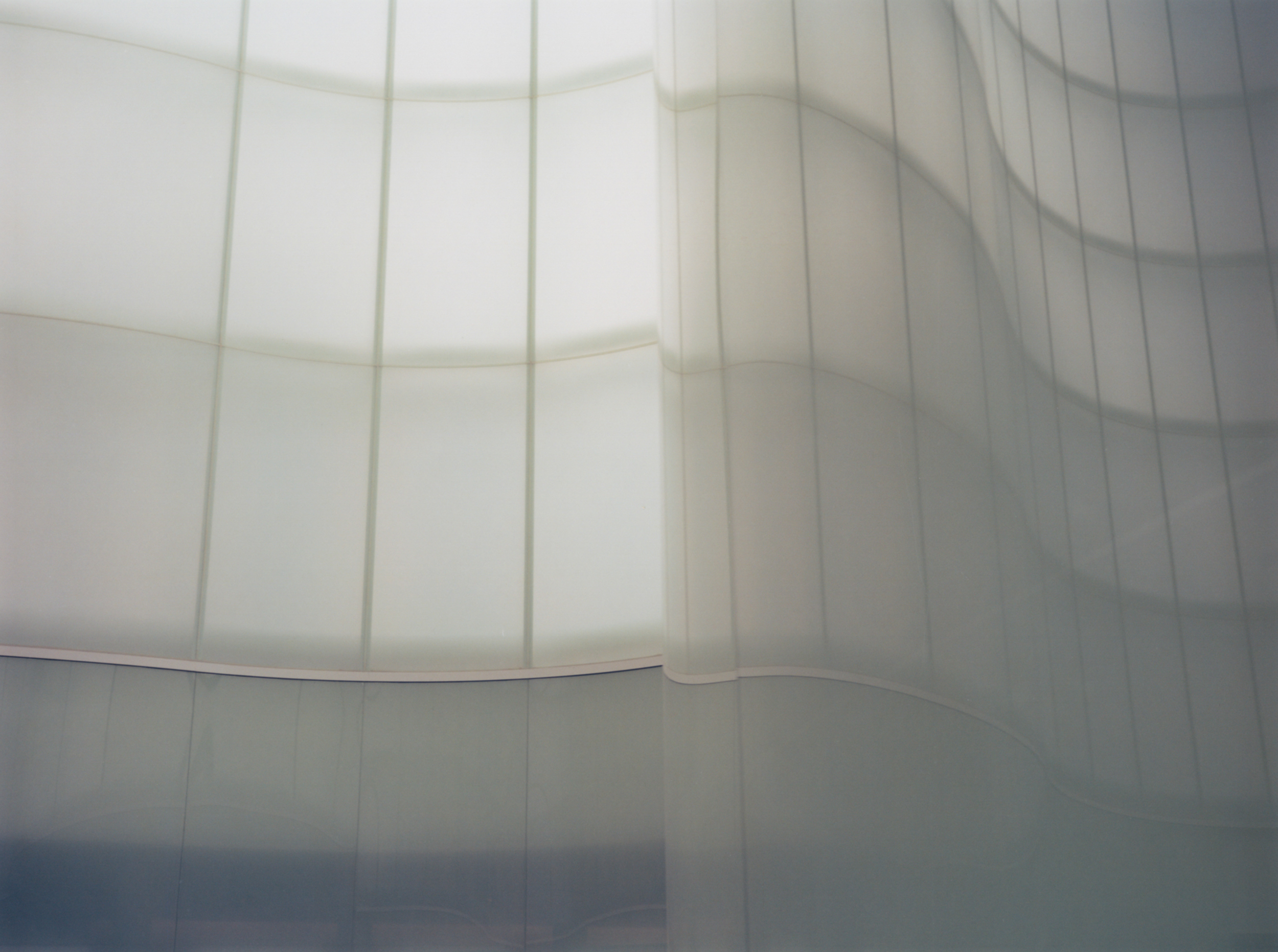
At COOR’s Seoul flagship, photographs of the architecture return to the space they depict. In conversation with QEditorial, Bossi reflects on the personal distance from which an image begins.

A photograph of a room usually travels away from it. It enters a book, a screen or an exhibition, offering a view of somewhere the viewer may never visit. In Presence, Simone Bossi brings the photograph back. Made inside COOR’s Seoul flagship, the images are installed within the architecture that first prompted them. The visitor can look from the photograph to the surrounding space, encountering both an interpretation and the place from which it emerged.
The arrangement makes a question tangible: what does a photograph allow us to notice when its subject is already within reach? For Bossi, the answer begins with the particular experience of being there. Speaking to QEditorial by email, he describes a practice in which the photographer’s emotional state and the character of a place continually act upon each other. Presence gives that exchange a physical setting.
The project began during a period of work in Seoul. Bossi came across the flagship and was drawn to its exposed concrete, light and unfinished qualities. He later met COOR’s creative directors and founders with a proposal for a photographic installation made specifically for the site. The measured presentation of the garments mattered to him: it allowed the architecture to remain perceptible, carrying what he describes as a quiet cultural message through its industrial heritage and reuse.
A fashion store is a revealing setting for this work. Clothing, architecture and photographs occupy the same field of attention. In Bossi’s account, his interest began with the room itself, before the proposal took shape. The installation carries that initial encounter into the place’s continuing life as a store, giving visitors another way to attend to an environment they might otherwise move through while looking at clothes.
Designed by Atelier KHJ, the flagship houses nine photographic prints on lightweight cotton paper, supported by custom oak bars with a reddish finish. Some images are positioned near the architectural fragments they depict. These decisions keep the photographs in dialogue with the room: printed surfaces have their own weight and texture, while the nearby architecture remains available for comparison. Looking involves a change of position as well as a shift of attention.

Finding a distance
Bossi studied architecture and worked as an architect for several years. Photography offered him a different duration of encounter with the spaces that had already become central to his professional life. Through the camera, he explains, he found “a slower and amplified experience of space,” something that could be imagined and real at the same time.
That distinction helps explain why his account of making an image rarely begins with equipment or composition. Asked what he looks for on first entering a place, he answers: “I look for a personal distance, a physical and mental point from which to observe, absorb, and let the atmosphere settle.” The position of the photographer is therefore also an emotional condition. He needs time to understand how he is meeting the place.
This makes subjectivity part of the work’s method. A room can call up memories or feelings that are difficult to name; those associations affect what draws his attention. Bossi describes the relationship as a continuous exchange, with photography providing a way to approach the resonance he senses. The resulting image carries the trace of an encounter that another person, arriving with different memories, could experience differently.
The exchange is not always easy. When asked about his most challenging photographic project, Bossi does not select a particular assignment. He describes the moments when his internal state falls out of harmony with the space. That friction makes the work harder, but can also lead him towards a different equilibrium. Difficulty enters his account as part of learning how to see, rather than an obstacle that technical proficiency alone will solve.
The viewer enters
Bossi names Robert Irwin, James Turrell and the Light and Space movement among his influences. Read alongside his responses, those references help locate his interest in the conditions surrounding an image: the light, the viewer’s position and the attention a setting makes possible. In Presence, the installation gives those conditions a role in how the photographs are encountered.
The viewer is essential to his understanding of a successful photograph. “If I am lucky enough, an image might be open enough to transcend time, allowing others to enter and see what they need to see,” he says. It is an ambitious hope expressed with hesitation. An image needs enough definition to hold attention, while leaving room for interpretations the photographer cannot determine in advance.
That openness gives Presence a purpose beyond displaying photographs in the place where they were made. The return does not complete the meaning of the images. Instead, it offers viewers a relationship to explore for themselves. They can attend to a fragment in the photograph, reconsider the room around it, or recognise a feeling that has little to do with the photographer’s original experience.
His teaching at RUFA, the Rome University of Fine Arts, extends this interest in other people’s perceptions. Bossi describes teaching as an exchange and a field of experimentation through different sensibilities. What he absorbs from students leaves traces in his own practice. The encounter with another way of looking continues to alter the person who makes the images.

Staying with uncertainty
Asked about artificial intelligence and photography, Bossi turns towards the experience of doubt. In a culture seeking immediate answers, he suggests, remaining with uncertainty may become increasingly significant. “Perhaps photography will reside less in the image itself and more in the physical, vulnerable act of being present within uncertainty.”
His answer offers a position from which to work, rather than a forecast about technology. Its emphasis falls on the photographer’s participation: spending time somewhere, responding to what is encountered and accepting that the result cannot be fully anticipated. Those concerns are already present in his description of arriving at COOR and waiting for a relationship with the space to emerge.
Other projects continue that inquiry. In his interview responses, Bossi mentions Captiva at Monologue London as a recent development, answering the question of what comes after Presence with “more and more presence.” The phrase suggests continuity in a practice that returns to the experience of space through different works.
For the visitor in Seoul, that inquiry takes a modest, physical form. A photograph hangs within the architecture it portrays; the surrounding room can be looked at again. What changes between those views belongs partly to the person standing there. Bossi has made the image and arranged its return. The next act of attention is the viewer’s.

Editor’s note
For QEditorial, Presence offers a way to consider how photography influences our relationship with the places we inhabit. A room can become familiar before we have paid much attention to its surfaces, its light or the way we move through it. Bossi’s decision to return photographs to the architecture they depict creates an opportunity to look again, moving between the image and the space around it.
We were interested in the personal experience behind that gesture. In his responses, Bossi describes the time spent finding a physical and mental distance from which to photograph, as well as the difficulty of working when his internal state feels disconnected from a place. These observations bring the discussion close to the circumstances of making an image: the photographer arrives with memories and expectations, encounters something beyond himself, and works through that exchange.
The setting at COOR’s Seoul flagship also connects the project to QEditorial’s interest in how fashion spaces communicate cultural identity. Architecture contributes to the experience of clothing, shaping how it is encountered and the atmosphere in which it is understood. Presence gives that surrounding architecture a further role, inviting attention to the place itself.
This article was developed from an email interview with Simone Bossi. The accompanying photographs were selected and provided by the photographer to extend the conversation into his wider practice; they should not be read as installation views of Presence. Together, the interview and image selection leave room for readers to consider how their own memories and attention shape what they see.
Discover more of Simone Bossi’s work at simonebossi.it and follow his photographic practice on Instagram @simonebossiphotographer.



Leave a Reply