
In Saudi Arabia’s Hejaz Mountains, Desert Rock brings private retreats, attentive service, and desert experiences into a landscape that shapes every part of the stay.
By Nicolò Di Stefano

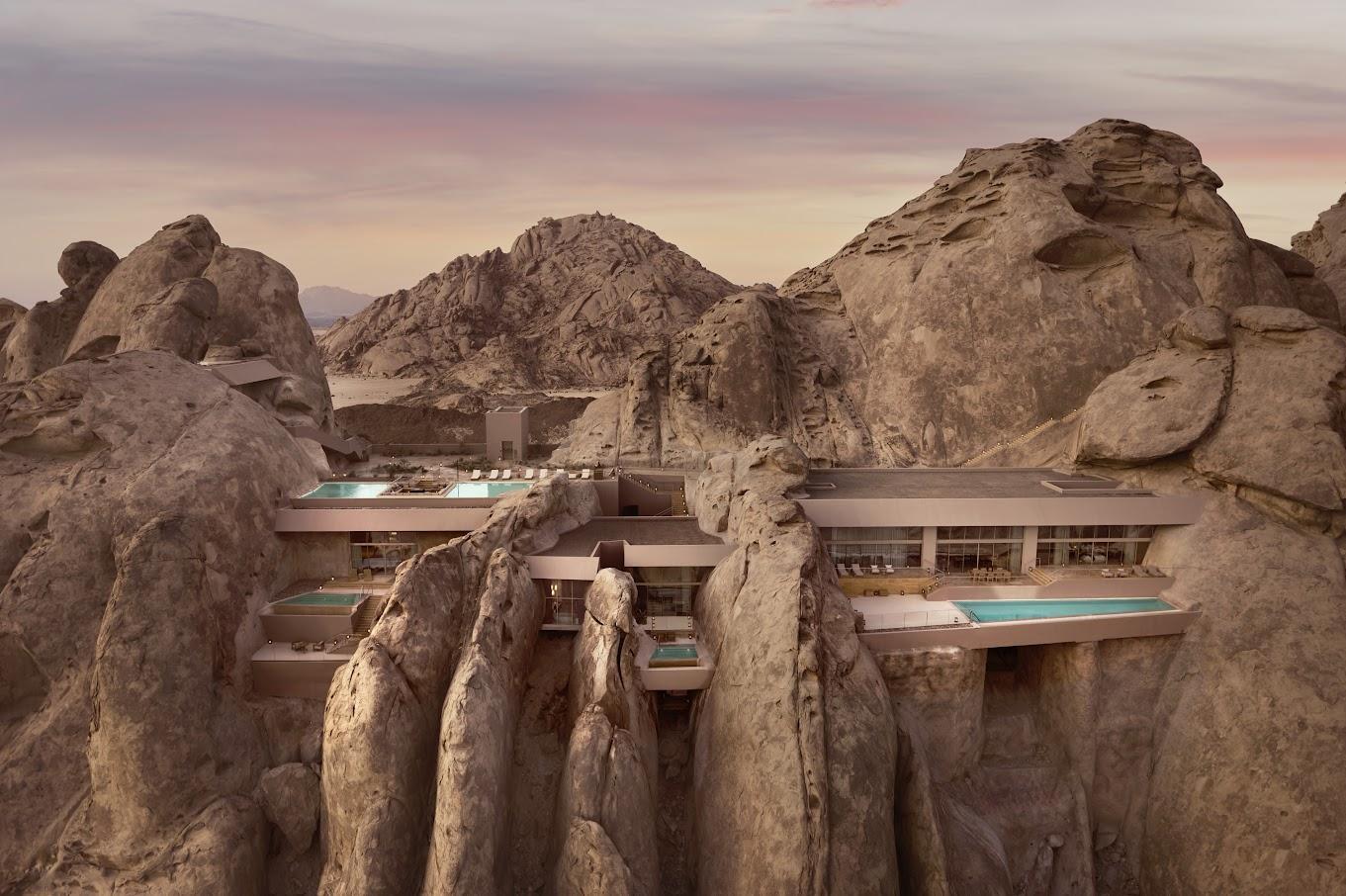
A swimming pool appears between two walls of rock. Beyond its edge, the mountain opens toward the desert. Elsewhere, glass marks the entrance to a suite within the massif, while terraces occupy narrow spaces between enormous boulders. At Desert Rock, these encounters between shelter and exposure give the resort its extraordinary visual character.
They also suggest a compelling idea of hospitality. The landscape determines where a room can sit, how a view is framed, and how closely an interior can engage with the world outside. Staying here means entering an environment whose scale exceeds the buildings themselves.
Designed by Oppenheim Architecture for Red Sea Global, Desert Rock occupies a mountainous inland setting within Saudi Arabia’s The Red Sea destination. Its architecture makes the terrain central to the experience: the mountain supplies the drama, while the resort creates places from which to encounter it. Oppenheim Arch
A place to feel sheltered
Oppenheim describes a design shaped around crevices, caves, and shaded slopes. These positions take advantage of cooler microclimates and reduce solar exposure, making the relationship with the mountain a practical architectural decision as well as a visual one. Oppenheim Arch
For hospitality, that approach has a particular significance. Shelter is among the oldest promises a place of accommodation can make. Here, the physical presence of rock gives that promise an unusually immediate expression. Walls, overhangs, and openings make enclosure something the guest can see.
The architects also describe buildings that recede into the terrain during daylight and become small points of illumination after dark. That change gives the resort two distinct readings: a landscape in which accommodation is partially concealed, and a mountain whose inhabited spaces gradually reveal themselves. Oppenheim Arch
Privacy becomes part of the composition. Distance, height, and the position of an opening help establish the character of each retreat. The architecture invites attention to the space directly around the guest, even as the views extend far beyond it.

Choosing a relationship with the mountain
Desert Rock’s accommodation categories offer different ways to occupy the terrain. Wadi Villas sit among the formations in the valley, with living spaces, outdoor areas, and private pools. Cliff Hanging Villas occupy elevated positions along the massif, bringing height and expansive outlooks into the experience.
The Mountain Cave Suites offer another relationship: accommodation integrated into rocky outcrops, with cliffside plunge pools and far-reaching views. Mountain Crevice Villas occupy spaces between rock pinnacles, where the positioning of the pool heightens the impression of suspension. Desert Rock
These differences make the choice of accommodation more interesting than a simple comparison of size. Valley, cliff, cave, and crevice describe distinct spatial experiences. One suggests a sheltered base among the rocks; another places the horizon at the centre of the stay.
The resort’s photography captures the tension between enclosure and openness. In some rooms, rock remains close to the interior. At the pool edge, the view extends into the desert. Together, those conditions suggest a retreat capable of feeling intimate within an immense setting.
The human side of a monumental landscape
A setting this dramatic needs thoughtful service to become a comfortable place to stay. Desert Rock places dedicated Villa Hosts within its hospitality model, with stays and experiences tailored to individual guests.
The resort connects that approach to hafawah, which it describes as the warmth and care of Saudi hospitality. It is a useful point of emphasis in a property whose architecture could otherwise dominate every conversation. Desert Rock
The most memorable element of a stay may be a view, but the ease of experiencing it depends on people. Understanding how much activity a guest wants, helping shape the day, and making an unfamiliar environment approachable are essential parts of the host’s role.
This is where Desert Rock’s editorial interest extends beyond its striking appearance. The mountain provides an extraordinary setting; hospitality brings it into the scale of an individual visit. The relationship between the two is the real subject.

A day with room for movement and stillness
The resort’s programme includes guided hikes, climbing, abseiling, via ferrata, and a zip wire. These activities introduce a physical relationship with the terrain: the mountain becomes something to move through and negotiate.
The Listening Room offers a quieter form of attention through curated vinyl and high-fidelity sound. Its inclusion is an appealing detail. A room devoted to listening gives a deliberate purpose to time spent indoors. desertrock.sa
The spa, located at the foot of the mountain, brings hammam, rhassoul, water therapies, and spaces for relaxation into the stay. Outdoor treatment areas and a yoga pavilion extend the wellness offering beyond an enclosed treatment room. Desert Rock
Taken together, these choices suggest a rhythm with room for different moods. A demanding walk and an unhurried afternoon can belong to the same visit. The landscape remains the common thread, whether approached through movement, rest, or observation.
Fire, flavour, and the evening table
Dining gives the resort another way to establish a sense of place. At NYRA, chef Osman Sezener’s Aegean approach brings together local ingredients, dry-aging techniques, and cooking over live fire.
The menu’s regional references reach beyond Saudi Arabia, giving the resort a culinary identity that combines its setting with influences from elsewhere. Basalt’s offering includes Saudi-inspired breakfasts and Peruvian cuisine, while Wadi Pool & Grill draws on Levantine flavours.
MICA introduces another dimension through non-alcoholic mixology by Matthias Giroud. Fermentation, preserving, and pickling feature in its approach, alongside smoked infusions and herbal drinks. The bar gives an evening ritual its own creative vocabulary, with seating indoors and around outdoor fire pits. Desert Rock Resort Saudi Arabia
These details matter because hospitality unfolds through familiar routines. Breakfast, a drink before dinner, or a shared meal gives structure to time away. At Desert Rock, those routines take place within the continuing presence of the mountains.

When the sky enters the stay
After sunset, the resort’s programme extends into astronomy observation, twilight walks, and night hikes. These experiences direct attention toward the changing conditions of the desert and the sky above it. desertrock.sa
There is something particularly fitting about this shift. During the day, the massif establishes the dominant scale. At night, the sky introduces another. The same place can support close attention to a rock surface and a much wider sense of distance.
Cultural activities add a human dimension to that encounter with the region. The resort lists palm-weaving workshops and Saudi coffee accompanied by storytelling among its offerings. Such experiences create opportunities to learn about practices associated with the place beyond its geology. desertrock.sa
Their value lies in the encounter itself: an activity, a conversation, or a technique that gives the visitor something more specific to remember.
The intimacy of an immense place
Desert Rock’s strongest proposition is the relationship between a monumental setting and the private scale of hospitality. Its pools, terraces, rooms, and shared spaces give guests different positions from which to experience the same mountain.
This makes the resort a compelling subject for design as much as travel. Architecture shapes the encounter, but the stay acquires meaning through smaller things: the choice of a quiet afternoon, a meal, a conversation with a host, or a view seen again as the light changes.
The photographs may first attract attention through their extraordinary forms. What holds interest is the possibility of spending time within them, allowing an initially overwhelming landscape to become familiar.
At Desert Rock, the mountain gives the stay its shape. Hospitality makes room for a personal experience inside it.
QEditorial Fashion Culture Identity



Leave a Reply