
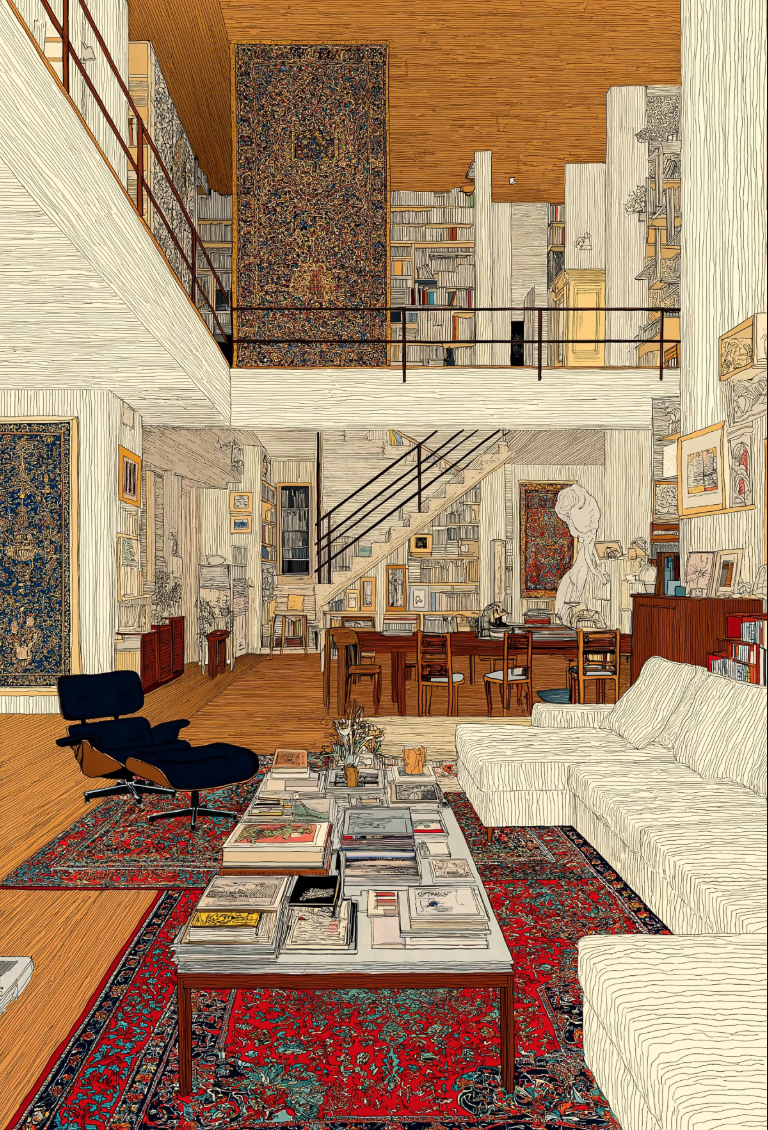
In HabiTextures, the Munich-based artist opens a conversation about emotional inheritance, artificial intelligence and the strange familiarity of places we have never known.
By Nicolò Di Stefano

You do not need to recognise a room to feel that someone is missing from it. A chair turned towards the light, books accumulated on a table, a space apparently waiting for conversation: these details can produce an intimacy that arrives before explanation. The room belongs to someone else. The feeling may already belong to you.
That encounter gives Richard Nadler’s HabiTextures a significance beyond its elaborate surfaces. The interiors are visually abundant and unoccupied, allowing the suggestion of human life to emerge through everything people might leave around them. Looking at them raises a question that extends beyond architecture or digital art: how does an experience rooted in one person’s life become available to another?
For Nadler, that question has a particular weight. His practice is shaped by family, remembered journeys and a relationship with art that began long before he developed the technological means to make these images. Artificial intelligence enters a story already populated by people, objects and attachments.
The challenge for the work is to carry something of that history into an encounter with a stranger.
An education before a profession
Born in Penzberg, Germany, in 1987 and based in Munich, Nadler works across artificial intelligence, generative systems, drawing and embroidery. Before dedicating himself to art, he studied business and finance and worked in London’s banking sector. His eventual professional transition followed a much earlier familiarity with artistic life.
His grandfather and mother painted. His father collected and sold African art. In an interview with Verse in 2022, Nadler described growing up surrounded by art and subsequently entering the digital art community as both a collector and a maker.
These family details offer more than an appealing origin story. They establish different relationships with an artwork: making it, choosing it, living alongside it, finding reasons to return to it. A painting can be something under construction in one room and an object of sustained attention in another. Artistic experience begins before anyone explains what to call it.
We should be precise about what this history establishes. His father’s involvement with African art does not, by itself, explain a particular pattern or composition in Nadler’s work. It places him within a childhood where objects received attention and where someone else’s interest could teach him to look.
That education also extended beyond recognised artworks. Nadler recalls his father encouraging him to feel fine cloth and notice details in a landscape. Surface and sensation were part of the same lesson: remain with something long enough for an initial impression to become a fuller encounter.
One way to understand his later practice is through the persistence of that invitation. The tools change; the wish to make another person look closer continues.

What remains available
Japan occupies an important place in Nadler’s memories of his father, who worked there and whom he visited during childhood. Their journeys included landscapes and cherry blossoms that recur in his accounts of the work. His father died when Nadler was eighteen.
It would be easy to organise everything that follows around loss. Yet that reading risks making the work emotionally narrower than the experiences from which it developed. Nadler has described these memories as carrying warmth and life, expressing a desire for others to encounter something of that feeling.
This is where biography becomes an artistic problem. Another person cannot inherit the experience exactly as it happened. They cannot occupy the same relationship, recover the same afternoon or attach the same significance to a landscape.
An artwork must find a form through which something can nevertheless pass between people.
Colour, rhythm and spatial arrangement become possible means of communication. A viewer may know nothing about the original journey and still experience anticipation, closeness or the pleasure of being absorbed in a place. Their response will be different from the artist’s memory. That difference is part of the exchange.
Seen this way, emotional fidelity does not require an image to reproduce a location accurately. An invented environment may allow a feeling to become perceptible without pretending to document its source.
This gives Nadler’s imagined worlds a productive ambiguity. Their visual unfamiliarity can coexist with emotional recognition. We have never been there, yet something encourages us to stay.
A machine enters the family story
Nadler describes a process that begins by establishing an idea, its structure and the atmosphere it should carry. He then develops and retrains customised diffusion models around a particular series, working through substantial quantities of generated material. In recent interviews, he has clarified that the initial “sketch” may be conceptual rather than a drawing on paper.
The sequence matters because it identifies a purpose against which the results can be judged. Generating more possibilities creates further decisions about what belongs in the work.
For an artist drawing on personal experience, those decisions involve an especially difficult translation. The computational system processes references and instructions. The person directing it brings attachments whose significance cannot be established by visual resemblance alone.
A convincing blossom is not evidence that an image carries the meaning of a particular journey. An intricately furnished room does not automatically communicate intimacy.
The artistic work lies partly in negotiating that distance: deciding which arrangement sustains the intended atmosphere, which detail becomes distracting, which impressive result remains emotionally unconvincing.
Nadler’s account of his process gives us a framework for understanding those choices. It cannot settle their success in advance. Personal history provides a reason for making an image; the image still has to create an encounter of its own.
That distinction is essential when discussing art made with AI. Time spent, technical complexity and autobiographical sincerity may inform our understanding, but a viewer meets the finished composition. What can it communicate before its explanation arrives?

Rooms with space for another life
HabiTextures makes that question accessible through the familiar setting of home. Nadler connects the collection to memories of his father hosting lively evenings with friends. He deliberately removes the inhabitants so that the surrounding light, fabrics and textures can suggest their presence.
The interiors invite us to imagine what might happen within them. A place to read implies time spent reading. Seating creates the possibility of company. Objects suggest preferences without revealing a complete identity.
Because the rooms are unoccupied, the viewer has room to contribute. Someone might recognise the atmosphere of a relative’s house; another might imagine a home they would like to create. The encounter does not depend on identifying Nadler’s childhood within the image.
Nor should these interiors be treated as verified reconstructions of his family home. Their relevance lies in the relationship they establish between a personal point of departure and the viewer’s capacity to imagine.
Their density complicates that invitation. Pattern offers pleasure and discovery, but it can also overwhelm. The eye moves between architectural order and surfaces that compete for attention.
That tension prevents comfort from becoming an entirely simple proposition. A room can shelter us while holding more objects, associations and traces of other people than we can immediately take in.
For some viewers, this abundance will sustain curiosity. Others may find it distancing. The work’s emotional ambitions remain open to that response. An artist can invite recognition without determining what every visitor will feel.
The most compelling possibility is that a stranger enters through their own associations and encounters something of Nadler’s concerns along the way. His memory establishes the conditions for an experience it cannot fully control.
Giving the image somewhere to stay
The translation of digital compositions into large-scale embroidery adds another dimension. Nadler has worked with Maison Vangart in Lyon to develop physical textile works. He describes the stitched quality as something that emerged within the digital images before becoming a material direction.
Verse’s presentation of HabiTextures includes the option for collectors to obtain embroidered counterparts to the digital works. The images accompanying this article show the digital compositions.
Embroidery changes how a viewer approaches the image. Thread gives the surface relief; scale and material invite shifts in distance. A composition encountered on a screen can become an object that occupies a room and participates in someone’s daily surroundings.
Within the reading proposed here, this has a particular resonance. A work shaped by inherited attention becomes something another person can live with. Its future associations will include rooms the artist has never entered and experiences he cannot anticipate.
Those later meanings do not erase its origin. They extend the life of the work beyond the circumstances that produced it.
This may be the most revealing way to approach Nadler’s relationship with technology. His practice raises questions about what people can transmit through the forms they make, and how new tools change the possibilities of that transmission.
We cannot possess another person’s memories. We can encounter a colour, a texture or an imagined room that makes us attentive to something in our own lives.
In HabiTextures, the absent inhabitants leave that possibility open. The rooms wait for someone whose history is different from the artist’s. When that person finds a reason to remain, a private attachment has begun a public life.

Editor’s Note
What stays with us in Richard Nadler’s work is the possibility that an image rooted in one person’s history can make room for someone else’s feelings. His family’s relationship with art, the experiences shared with his father and his sensitivity to materials give his practice an emotional continuity across changing tools. In HabiTextures, that continuity becomes an invitation: to consider what makes a place feel familiar, and how much of home exists in what we carry within us.
At QEditorial, we find this a compelling perspective on contemporary art and artificial intelligence. Nadler’s digital compositions and embroidered works encourage us to look beyond the method of production and ask what an image can communicate—and why we might return to it.
Explore Richard Nadler’s art and the HabiTextures collection at richardnadler.com.
QEditorial Magazine




Leave a Reply