
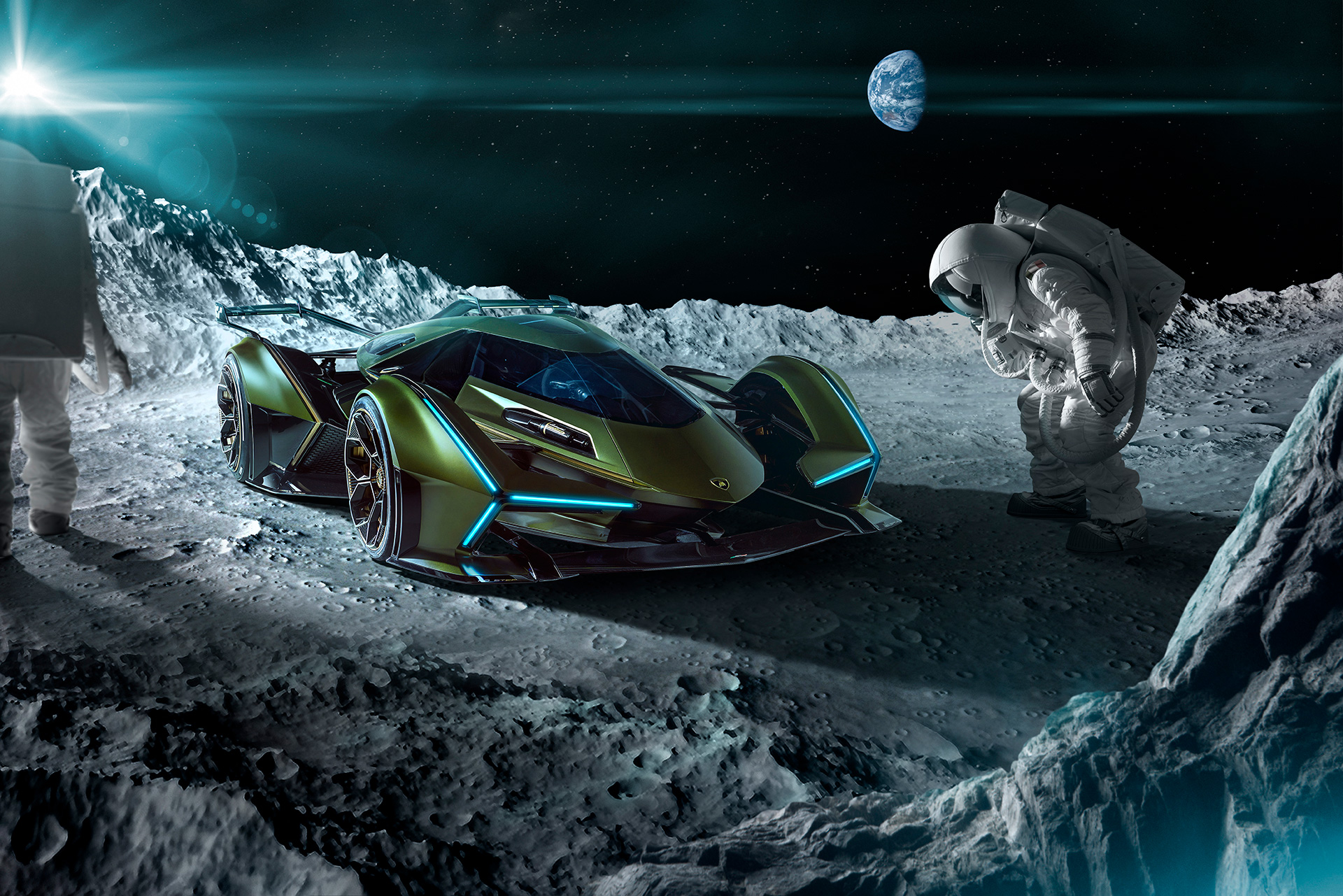
Created for virtual racing and presented as a full-scale model, Lamborghini’s single-seat concept explores how automotive identity survives when designers reconsider the familiar shape of a car.
by Marco Bonatti


A single seat, an exceptionally low silhouette, wheels that appear almost detached from the central body: the Lamborghini Lambo V12 Vision Gran Turismo makes its intentions visible before any specification enters the conversation. Its architecture concentrates attention on the person inside, while the surrounding surfaces turn the idea of speed into something sculptural.
Unveiled in Monaco on November 24, 2019, during the FIA Gran Turismo Championships World Finals, the concept brought a virtual racing project into physical space through a full-scale model. Developed by Lamborghini Centro Stile, it offered a striking proposition: a car conceived for a digital driving experience could also become an object with a powerful presence outside the screen. gran-turismo.com
For QEditorial, that relationship between image, object and experience is the most compelling way to approach the project. The Lambo V12 Vision Gran Turismo invites a question that extends beyond automotive design: how much can the shape of a familiar object change while its identity remains immediately recognisable?
A Body Built Around Absence
Seen from the front, the car appears organised around a narrow central core. The wheels sit within their own sculpted forms, while openings interrupt the relationship between the cockpit and the outer body. Its visual force comes as much from those gaps as from the surfaces surrounding them.
The eye travels through the composition. Instead of encountering one continuous enclosure, it follows separate elements that seem pulled outward by competing forces. The result feels tense and deliberate, with the driver occupying the point where everything converges.
This makes the car particularly interesting as a design object. Empty space gives each component greater definition. The outer sections frame the cockpit; the cockpit establishes the axis; the lighting gives the whole arrangement a recognisable face.
Even at rest, the composition suggests movement. Its surfaces appear to gather around the centre before expanding toward the wheels, creating an impression of energy held under pressure.

The Driver at the Centre
The concept’s single-seat layout places the driver centrally. Its proposed entry sequence approaches the cabin from the front, while the principal controls sit on the steering wheel and driving information is projected into the driver’s line of sight. These features belong to the concept’s intended experience, rather than a specification for a production vehicle. gran-turismo.com
The arrangement gives the project an unusually personal character. There is no passenger alongside the driver to share the scene. Every visible decision appears to reinforce an individual relationship with the machine.
That creates an interesting tension with its public image. From the outside, the car is theatrical and expansive. Inside, the experience is conceived around concentration.
For a project designed for a player, this is a meaningful choice. The central seat translates the act of controlling a virtual vehicle into a physical position. It gives an otherwise screen-based experience an imagined bodily dimension: where the shoulders sit, where the eyes look, where the hands meet the controls.
The cockpit becomes the point at which fantasy acquires human scale.
The Future Carries a Memory
The project was developed by the Centro Stile team under Mitja Borkert. Gran Turismo’s official description identifies references to Marcello Gandini’s design language, the Lamborghini Countach and the 1970 Bertone Stratos Zero. Its recurring hexagons and Y-shaped lighting carry familiar visual signatures into the new composition. gran-turismo.com
These references help explain why such an unconventional shape still reads as a Lamborghini.
The connection is stronger than a badge. It lies in the relationship between a low profile, sharp geometry and an almost confrontational stance. Familiar elements remain legible even as the overall architecture changes.
There is a useful parallel with fashion. A designer can alter the construction of a garment dramatically while preserving a recognisable approach to proportion, volume or the body. Identity survives through a consistent way of making decisions.
Here, heritage operates in that same manner. It supplies a visual vocabulary that can be rearranged, exaggerated and tested. The concept looks forward while retaining a memory of the design culture from which it emerged.
Its futuristic quality comes partly from this tension: the form is unfamiliar, but its attitude feels established.

A Mechanical Anchor for the Fantasy
The proposed powertrain derives from the Lamborghini Sián FKP 37, combining a mid-mounted V12 with a supercapacitor hybrid system. Gran Turismo’s British specification describes an output of up to 818.5 bhp. These figures concern the concept and its virtual representation; they should not be read as independently tested performance results for the full-scale display model. gran-turismo.com
The mechanical connection gives the project a reference point within Lamborghini’s engineering world. An extreme visual proposition becomes easier to understand when it retains a relationship with an identifiable powertrain.
Yet the numbers are only one part of its appeal. A specification can describe output, but it cannot fully account for the impression created by the car’s proportions.
The most memorable aspect is the relationship between the enclosed driver and the dramatically articulated body surrounding them. Performance becomes visible through composition before it becomes measurable through acceleration or speed.
When the Screen Becomes a Design Space
A virtual car occupies an unusual position in design culture. It can be experienced through interaction, while remaining beyond the ordinary conditions of ownership.
That changes how an audience encounters it. A photograph offers a fixed perspective. A driving game gives the player an active role within an imagined machine.
The physical model adds another layer. It allows the proportions to occupy real space, turning a digital proposition into something viewers can walk around and assess with their own bodies as a reference.
Neither format makes the other redundant. Each reveals a different aspect of the idea.
This is where the Lambo V12 Vision Gran Turismo becomes more than a dramatic shape. It demonstrates how a design can move between different forms of experience while maintaining its coherence. On a screen, it promises participation. As an object, it invites observation.
For a luxury brand, that distinction matters. Desire can begin through an encounter with form, long before any possibility of purchase enters the picture.


A Different Kind of Automotive Object
The Lambo V12 Vision Gran Turismo rewards attention beyond the familiar questions of price, availability and road performance.
Its significance lies in the freedom of its proposition: one driver, a fragmented body, a recognisable design language pushed toward an unfamiliar arrangement. It gives Lamborghini’s visual identity room to stretch.
The result also offers a productive way to think about concept design itself. A concept can make an argument through shape. It can test how an audience responds to a new proportion, a different relationship with the body, or an altered understanding of what an object should look like.
Here, that argument centres on the driver and the space surrounding them.
The car’s lasting image is one of concentrated presence: a human figure enclosed within a machine whose surfaces seem to reach outward. Between that intimate centre and its expansive silhouette, Lamborghini gives automotive desire a form that can inhabit both the physical world and the imagination.
Editor’s Note
This feature revisits a concept unveiled in 2019 through QEditorial’s perspective on design and digital culture. It draws on official Gran Turismo materials. The Lambo V12 Vision Gran Turismo is discussed as a virtual racing concept presented through a full-scale model, rather than as a production road car.


Leave a Reply